


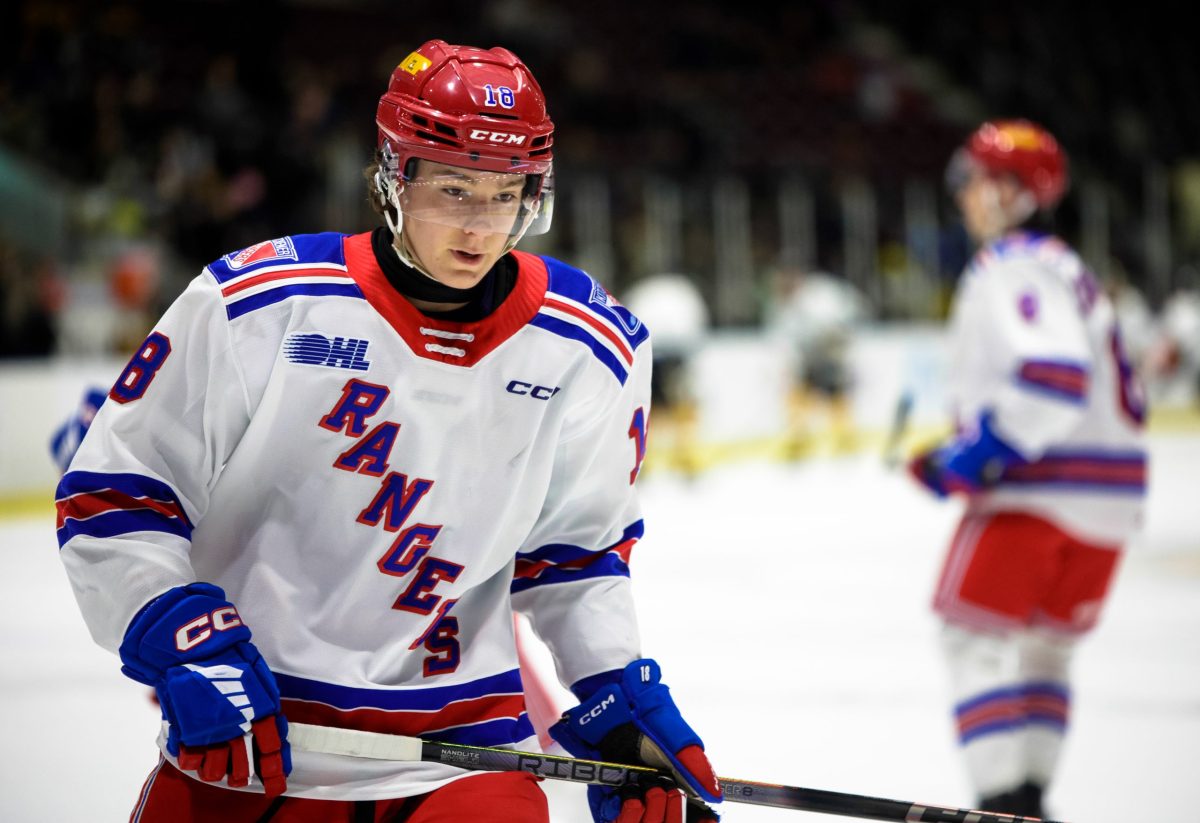
D - Kitchener Rangers (OHL)
6-foot-0, 190 pounds, Shoots: L
DOB: 08.04.2007 - Aylmer, Ontario
Despite not having a single skater break the 70-point mark, the Kitchener Rangers were among the top teams in the CHL for the bulk of this season. Their second place OHL finish came as somewhat of a surprise after losing their three best players in the 2024 offseason (Hunter Brzustewicz and Matthew Sop graduated to the AHL, Carson Rehkopf was traded to Brampton for ten draft picks) but among the young players that stepped up in 2024/25 was draft-eligible defenceman Cameron Reid.
Reid’s usage skyrocketed this season as he was elevated to a top pairing role with Kitchener, also becoming a fixture on the top power play unit and second penalty kill unit. He finished third on team scoring with 54 points and led the team with a +39 rating while wearing an “A” as a 17-year-old. Reid was also named an Assistant Captain at the OHL Top Prospects Game and played in the CHL USA Prospects Challenge.
As a blueliner with high-end mobility and hockey IQ, Reid was a perfect fit for pretty much every situation the Rangers needed him in this year. He moves the puck well, making decisive passes and finding teammates before defenders have time to adjust. He is aggressive in jumping up to create offensive chances with his elite skating, often even leading the rush. His edge work and reads make him dangerous on the rush offensively, and help him shut down the rush effectively when the puck is going the other way. He is also competitive and wants to lay the body, but still needs to get stronger in order to effectively defend in some one-on-one cases. Reid will likely be selected in the 15-25 range of the first round of the draft. He appears to have 2nd pairing upside at the NHL level, showcasing flashes of being an excellent rush defender, while contributing a bit offensively as well.
Skating
Cameron Reid’s skating is the backbone of his game and the main reason he’s able to impact shifts so consistently. His mobility lets him escape pressure, jump into the play, and kill rushes with just a few strides. His ability to change direction and use crossovers to gain space makes him particularly dangerous in transition. He’s especially effective when he’s reading the play and attacking space with confidence. There is room for improvement, though. He could still benefit from adding a bit more explosiveness to his stride, particularly when skating with the puck. If he can add another gear straight-line, his skating will be a true standout tool at the NHL level.
Highlights like this are common for Reid, who constantly displays his ability to slip away from opponents and create space for himself.
If Reid gets a little bit of space in open ice, he can be a pretty swift mover, thanks to some quick feet and smooth edgework.
Reid shakes the forechecker early in this clip, and then after moving the puck, he finds an open lane and gets to the net for the deflection.
Here’s Reid’s straight line speed with the puck, which is probably his weakest attribute when it comes to skating. He’s still able to generate enough speed with a couple of crossovers to stay ahead of the backchecker and beat the far defender to the net.
Grade: 55
Shot
Cameron Reid can beat goalies from range on occasion and converts when he gets a clean look, but he’s not a particularly dangerous shooter. Instead, he uses his point shots to create offense by generating chances for those around the net. He gets wristers off quickly and typically places them well, aiming for tips or rebounds rather than trying to pick corners. That quick-release mindset is reflective of how he moves the puck as a passer as well. His slapshot doesn’t show up often, but that’s not a problem since he’s usually just trying to get pucks through traffic for his teammates.
Here, Reid evades an opponent and opens up his hips a bit, putting most of his weight on his back foot. He whips the puck off-balance but is still able to pick the top corner from long range, beating the goalie clean.
No huge wind-up needed for Reid’s slapshot, as he just puts his head down casually and steps into it. This one goes straight in, but you can tell he is shooting the puck, hoping for a deflection on this one.
This is what a lot of shots from Reid look like: low and ready to be deflected or finished off on the rebound.
Grade: 52.5
Skill
Reid’s puck skills aren’t flashy, but they’re more than good enough to complement his high-end skating at the junior level. He’s confident carrying the puck through the neutral zone and has no hesitation jumping up to lead the rush. One skill that really stands out is how quickly he can take control of and move the puck, which makes him dangerous in transition and on breakouts. He sees the ice well and usually trusts his first read, which helps him move the puck efficiently. He may not be the most creative distributor, but his decisions are quick, and he pushes play in the right direction. Reid will likely need to improve his puck skills a bit to be an offensive contributor as a pro.
Here’s an example of Reid attacking an opponent straight on as a puck carrier as he dekes through the defender and uses his edges nicely to evade the hit and get a shot off. Reid doesn’t give up on the play, though, as he forks the puck out of the goalie’s glove and taps it to his teammate below the goalline. He loops back around and gets open in the slot for the one-timer.
Reid is confident in his reads; he sees a lane and moves the puck right away.
This clip is an excellent summary of Reid for a multitude of reasons: a good read defensively on the rush where he closes the gap to negate the play, the instant switch to offense up the ice, and taking what’s available to him offensively. In this case, the defender was unsure of how to contain him, and Reid instantly slipped to the outside, blowing by him.
Again, here, Reid makes a defensive play and instantly turns it into offense. Excellent hands picking up the loose puck and deking his opponent before picking a top corner from a distance.
Grade: 55
Smarts
One of the most impressive parts of Cameron Reid’s game is how well he reads and reacts to the play. He’s constantly scanning, whether he has the puck or not, and that awareness allows him to make quick decisions when he gets the puck on his stick. Sometimes he can make gaffes when under pressure with the puck, or can get dragged out of position in the defensive zone, but he often recovers quite quickly thanks to his skating. Offensively, he’s good at recognizing when to jump into space or hold back to support possession, and defensively, he sorts through coverage effectively and times his pressure very well.
After moving the puck up ice, he times his pinch perfectly here, taking away all of the London winger’s time and space. Having forced a turnover, Reid then finds an open lane to the net and ends up being dangerous in the slot, hunting for a rebound.
Reid seems to always be in the right spot when defending the rush, and is very decisive with his passes once he gets the puck.
Excellent job by Reid here to recognize the gap in defensive coverage and find a huge hole of open ice.
Reid identifies an opportunity to jump up and create some offence and does just that here. He skates into the gap and displays some good puck handling under pressure.
This clip starts off with a turnover under pressure by the Kitchener defender, but he instantly makes a physical play at the blueline to negate a rush. He then makes a good breakout play when he gets chased out from behind the net.
Grade: 55
Physical/Compete
He’s not quite “small”, but Cameron Reid will definitely need to add strength before making the jump to the pro level. He’s a willing and engaged defender who doesn’t shy away from physicality; he’ll happily step up at the blue line or finish checks along the boards. He does a good job holding his own when defending the rush, largely thanks to his excellent skating and using his weight to step into opponents. But there are still times when he gets bumped off the puck a bit too easily or loses body position in front of the net, especially against bigger, heavier opponents. He’s a competitor, but adding muscle will help him win more one-on-one battles and help round out his physical game to include some of the toughest areas on the ice, too.
Reid shows no hesitation to play the body here, then gets the puck out of the defensive zone quickly.
Again, Reid is happy to play the body when defending his blueline.
Right at the beginning of the shift, Reid is on the receiving end of a hit. He doesn’t back down, though or shy away. He engages with the London forward all the way down the ice.
One area where Reid will need to improve is his net-front play in his own zone. He often gets outmuscled when battling for position in front of his own net and is regularly too passive when he should be clearing a line of vision for his goaltender.
Here’s another example of Reid not getting the job done in front of his net, and he and his partner failing to sort out coverage assignments led to a goal against.
Grade: 52.5
OFP: 54.25
A note on the 20-80 scale used above. We look at five attributes (skating, shooting, puck skills, hockey IQ and physicality) for skaters and six for goalies (athleticism/quickness, compete/temperament, vision/play reading, technique/style, rebound control and puck handling). Each individual attribute is graded along the 20-80 scales, which includes half-grades. The idea is that a projection of 50 in a given attribute meant that our observer believed that the player could get to roughly NHL average at that attribute at maturity.