


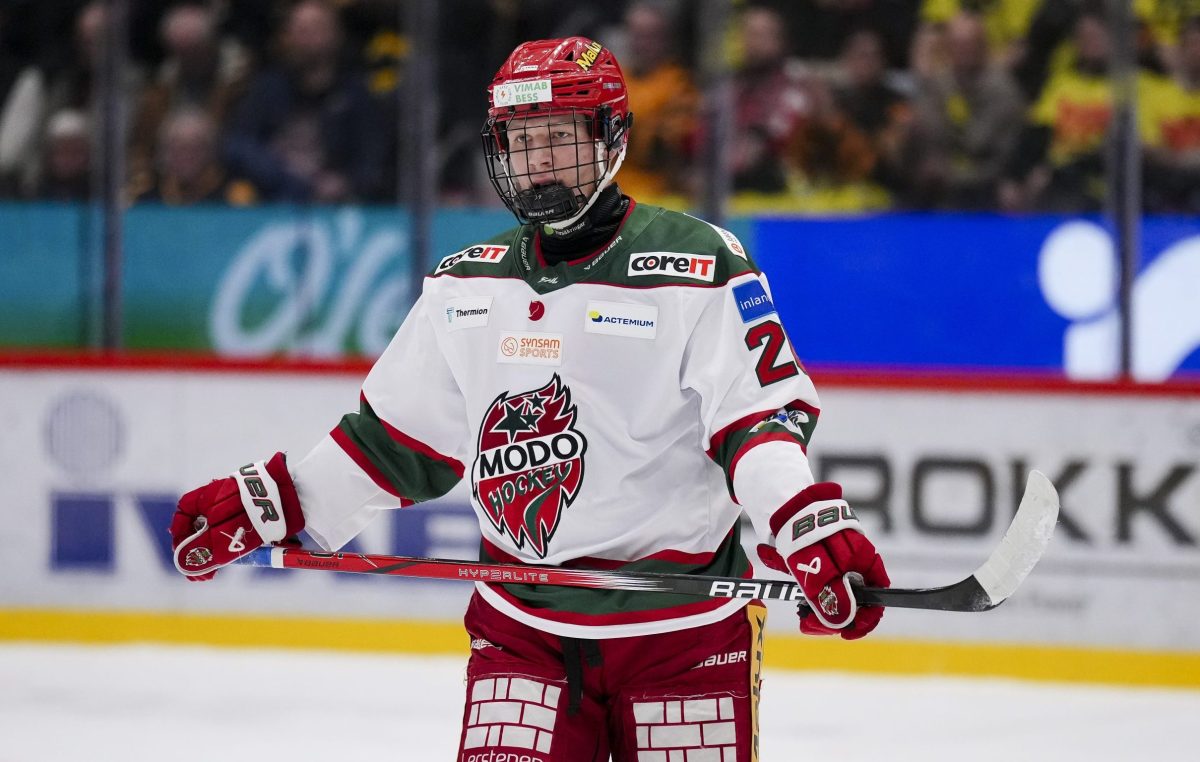
Foto: Ola Westerberg / BILDBYRÅN / COP 117 / OW0200
C - MoDo Hockey (J20 Nationell)
6-foot-1, 195 pounds, Shoots: L
DOB: 02.06.2007 - Örnsköldsvik, Sweden
Gästrin's play last season might not have been very noticeable at first glance. However, this season Gästrin has really taken a step forward, played a consistent two-way game and improved his offensive game considerably. There really is no flaw in his game, but there’s also no elite parts either. Even though he had taken steps forward in his offensive game, there are still questions about how translatable it is to the NHL. His potential might never become better than being a quality bottom-six player, and it will probably be the reason if he slips in the draft. However, having that complete package makes Gästrinone of the more sure-fire, translatable players in this draft that can make it to the NHL.
Only producing 16 points in 41 games in his D-1 season with MoDo J20 was anything but spectacular. However, Gästrin is a young June birthday and would be slightly further behind in development compared to his peers that season. He still accumulated a ton of experience by playing 41 games in the Swedish junior leagues and also getting quite a few reps at the international tournaments.
This season, the workload was pretty much the same, if not more, and Gästrin has progressed quite well. Bumping up his production to 42 points, 18 goals in 40 games, is a big improvement from last year, while also bringing a great two-way game. He was a workhorse for his Modo J20, and his coaches trusted him in any situation, playing first-line minutes and sometimes topping 25-plus minutes a game. Outside of his local play, Gästrin also represented Team Sweden in 19 U18 games and produced insane numbers with his 32 points. There are also some leadership qualities with Milton, as he was an assistant for his J20 team and captained the U18 Swedish team. While not being as much of a difference maker, he still got to play eight games in the SHL without producing a point,t but having dipped his toes professionally already could pay dividends in this upcoming season when he’s playing with the degraded MoDo in the Hockeyallsvenskan.
With his good playmaking and vision, the smart work defensively and great transition ability as a centerman, Gästrin could project as a 2nd line centre at the NHL level. While that might be far-fetched, as his offense is not dynamic enough, but thanks to his great two-way play and consistent effort, there’s no doubt that he will make the NHL one day; he’s too versatile not to find a spot at least on the bottom six.
His game fits more as a centerman, but he has proven that he can play wing as well. That versatility is only going to help him. The key to success does not necessarily involve him improving parts of his game, more than he has finding confidence and playing comfortably at every level of professional hockey. What role he’ll play in the NHL will all depend on how translatable his offense can be. Projecting whether he’ll have the same confidence in junior as in professional leagues is impossible to do, as this is all in the hands of Milton, and he’ll be the deciding factor of how far he can go in his career.
Skating
This is the area where you saw the most noticeable development in his game: the skating. Early parts of the season, he would look quite sluggish at times and had difficulties gathering up velocity, but would eventually reach his solid top-end speed. He’s always been a north-south skater, where he likes to utilize his speed in transition and on the rush. But, towards the end of the season, the acceleration part of his skating had gotten better and was more efficient in establishing speed through the neutral zone.
The way he utilizes his skating in the offensive zone is pretty straightforward; he likes to go hard to the net and take laps around the zone with the puck; rarely do you see him on the perimeter. This is possible thanks to the slow pace of J20, but the NHL plays at a much faster pace, and it will be interesting how Milton adapts to that. While his acceleration has improved throughout the year, Gästrin still needs to work on his power to be able to pivot along the boards and evade defenders faster. Focusing on lower core strength, edgework, and explosiveness is going to be huge for his development.
#22 in the clip
Mentioned before that the edgework needs improvement, but in this clip, Gästrin actually shows how he can keep up defensively by making sharp turns.
#22 in the clip
Showing some good acceleration here and gaining separation speed to become a passing option on the rush.
#49 in the clip
This is later in the season, around January, and you can see here how, just in his first few steps, he gathers enough power to gain good speed through the neutral zone.
#49 in the clip
Here, his strides aren’t as efficient, and he probably expends more energy than needed, but still gathers up speed quite quickly.
#49 in the clip
Great acceleration again, but notice the solid crossovers as well to be able to get past the opposition’s pressure.
Grade: 50
Shot
A lot of Gästrin’s offense comes around the net. He likes to be behind the net, looking for passes in front or driving the net hard with a power move. On the powerplay, MoDo would, for the most part, put him in front of the net to tip in pucks, but also be able to get the puck behind the net looking for passing options. He can shoot in different ways with a lot of power behind it, usually with a wrist shot or slapper and in good abundance. The issue is that his shot lacks accuracy. His offensive game is not necessarily creative, but the encouraging thing is that he creates a lot of chances for himself by getting the puck towards the crease or making himself open to score goals on the doorstep. He’s great at finding these open spots in high-danger scoring areas, can recognize when an odd-man rush is developing, and will make himself available on the rush.
Goalscoring from long range is not Gästrin’s strength. The shot itself is pretty underwhelming; it’s not going to beat goalies cleanly at the NHL level due to his bad accuracy and lack of deceptiveness. How translatable his current offensive game is a question mark, and this area of his game will be the biggest reason, too, if he doesn’t develop into a top 6 center. But if he can continue to be a netfront presence, tip in pucks or score goals in the bumper position, he could find success. A good player type to have in front of the net, simply enough.
#49 in the clip
Pretty impressive stick handling work here to be able to get the puck towards the net, not an overly threatening shot, but creates a scoring chance for himself by driving to the crease.
#49 in the clip
A great individual play here from Milton and gets himself into the middle of the ice, but it does raise the question of how translatable this would be towards NHL defence.
#49 in the clip
Without losing any speed through the neutral zone, he one-touches the puck perfectly and drives the net hard for a finish.
#49 in the clip
Nice tip in front.
#49 in the clip
Didn’t score many of these backhand shots this season, but pulled off this shot perfectly.
#49 in the clip
His puck handling ability is going to be explained later in this article,e but one area he does well is the one-touch ability and can work in tight with his hands. Solid wrist shot for the finish
#49 in the clip
Some good hockey IQ is put on display, recognizing that the opponent is going to turn the puck over, and Milton quickly speeds up to join the attack.
Grade: 50
Skill
The playmaking is what really makes you believe in Gästrin’s offensive potential. It’s simple, yet effective. There are two main things that he does when creating scoring chances. He’ll skate into the offensive zone with high speed or be behind the net looking for teammates in front. On an odd-man rush, he will either drive towards the middle to get the defence moving and open up passing lanes or put himself on the perimeter to then skate along the boards behind the net and look for a teammate in front that way. His mindset is that entering the offensive zone with good enough speed is only going to make it harder for the opponent to defend. The second thing he does is work the boards effectively, winning puck battles behind the net. As soon as he gains separation from a defender, he will look to pass towards the crease. The puck is usually on Gästrin’s stick for these two reasons, especially when he was playing for his MoDo. He can slow the pace down, skating around the offensive zone while shielding the puck with his body. The success in his playmaking is more about quantity than quality. He does, however, suffer at times from forcing passes or not being able to make a good enough pass, as he simply does not possess the skill to do so.
While his puck protection ability has been really good all season long, his puck skills need some improvement. Gästrin doesn’t have soft hands, and it becomes most apparent when he’s skating at high speeds through the neutral zone. The puck can get away from him at times, and even though he has good one-touches, it’s also something that will be harder for him to complete when the game is at a high pace. But even if he never really improves in this area, it shouldn’t be a major issue. He has still shown that he has good enough puck-handling ability along the boards and is difficult to knock off the puck, which is a huge advantage when playing in the NHL.
In transition, Gästrin might be the best center in doing so. He constantly supports his defensemen down low, digging out pucks or being a passing option. During breakouts, he can also be calm and corral the puck while being under pressure, doesn’t panic or throw errant passes around. If he’s not making the breakout pass himself, he’ll skate the puck up the neutral zone. Gästrin’s not the greatest skater, but he’s very good at timing himself to gather up enough speed to skate with the puck for an entry. Besides his great defensive gam,e which will be explained below, the transition ability is another reason why he should stay at center as his game will excel the most there.
#49 in the clip
Gästrin is everywhere on the ice in this clip. This is a good example of how his play has been the whole season, trying to be involved in every play in the offensive zone.
#49 in the clip
Does a great job here by driving play through the neutral zone and finishes with a clean wrist shot.
#49 in the clip
Shows impressive poise with the puck and makes a good pass that unfortunately does not end up as a goal this time around.
#22 in the clip
Here’s a clip of when Gästrin lacks creativity and forces plays. As mentioned before, he loves to make passes from behind the net, but this time he forces a pass when he could’ve made a better play.
#22 in the clip
Nice tic-tac-toe play where Gästrin is the one starting it.
#22 in the clip
Drives play as usual and finds a teammate wide open.
#49 in the clip
Strong puck protection ability is put on display and finds a teammate in front, good vision as well. Also, notice how fired up he gets when the goal is scored. That’s actually a recurring theme in his overall game: being highly competitive.
#49 in the clip
Starts a rush, drives into the offensive zone with good speed and finds a teammate with a well-timed pass. One of the main regular plays he has done this season.
#49 in the clip
Displaying some quick decision-making and good offensive instincts by finding a teammate despite the broken play.
#49 in the clip
Good vision is put on display again.
#49 in the clip
Strong play by Milton, fights off multiple defenders and finishes off by throwing a pass in front that ends up as an assist.
#22 in the clip
Here he’s having trouble corralling the puck at higher speeds, something that recurred throughout the season.
#22 in the clip
Usually, Gästrin possesses good one-touch ability, but sometimes the puck can get away from him, another reason why he needs to improve his stickhandling ability.
#49 in the clip
Great breakout from Gästrin, poised with the puck and does not panic despite the pressure.
#22 in the clip
Supports his defensemen down low by reading the pass and grabbing the loose puck, then gets the puck out by giving it back to his defenseman.
difficult.
Grade: 52.5
Smarts
Gästrin is a great defensive player. This is what’s going to make his floor NHL-level and why he’ll find a spot in a lineup. He reads the game very well, but it’s the defensive effort that is most impressive. In his own end, he’ll follow the puck carrier closely, not giving him an inch, making reads to intercept passes, having a disruptive stick in lanes or hounding the puck carrier from behind, sticklifting to regain puck possession. Overall, he’s always in the correct defensive position, and he puts great effort into his backchecks. He’s got good size, and while he doesn’t utilize it in body checks, he does use it defensively by establishing body position to block off opponents. Gästrin simply does all the right things defensively. Playing for his MoDo in the juniors, the coaches could rely on him in any situation, and he was their horse for them, reaching 27 minutes in one game even (!). Being a center at that makes him extremely valuable as a player. Obviously, there's a very high chance that he won’t be that type of player at the NHL level, but you know that he could at least project into a 4th line center that will kill penalties for you and be trusted defensively. His hockey smarts are quite sound, too. The offensive instincts are there, by how well he finds plays and can see through traffic. But it’s the defensive awareness that is most impressive. He does have a tendency to make poor decisions with the puck by turning the puck over. His puck-handling ability isn’t the greatest at times, and if he doesn’t make the correct decision early, he can become overwhelmed by the opposition’s pressure.
In general, though, Gästrin is mistake-free and getting this type of play night in, night out is such an important trait that NHL teams would value very highly.
#22 in the clip
Simple play, yet he quickly eliminates the offensive try from Czechia, and his defenseman can gather the loose puck.
#22 in the clip
Here, Gästrin hounds the puck carrier ferociously and makes a great sticklift from behind to turn the puck the other way.
#49 in the clip
Another brilliant sticklift.
#49 in the clip
Gästrin follows the play closely, disrupts the shot attempt and later wins the puck battle.
#22 in the clip
Yet another sticklift. It’s incredible also how quickly he transitions the puck to offense. In this clip, he regains possession and quickly finds a teammate who gets a great look on net.
#22 in the clip
Bad play from the Czechian player, but Gästrin reads where the play is headed and gets a takeaway.
#49 in the clip
Again, he reads where the pass is coming, grabs it and then transitions the other way.
#49 in the clip
Here, he shows some bad passing ability and decision-making. Instead of holding onto the puck, he forces a pass back to his defenseman that ends up as a turnover instead.
#49 in the clip
Poor shot selection as the shot is easily anticipated.
Grade: 60
Physical/Compete
Standing at 6-foot-1, 185 pounds, Gästrin already has solid size for his age. And that size is very noticeable in games. He’s not a guy who will leverage his body in hits or be tough along the boards. His size comes into play when he has the puck on his stick, putting his body between the puck and the defender. In board battles, he works hard and stands his ground well, not to be pushed around. With how good he forechecks and with his size, you would probably like him to play a more power forward style, but that might just not be his mindset as a player. If he needs to make the switch to wing, he will be more inclined to forecheck along the boards and might change his playstyle because of this.
There’s definitely no laziness to his game, but he’s also not a high-motor guy. He puts 100% effort in every shift, and while he’s not always tenacious in his compete, it doesn’t really fit his playstyle since he’s at center and is more of an observer defensively than a head-on defensive guy. But the consistency and character traits that Gästrin possesses are top-class in this draft. He’s incredibly consistent each game he plays and rarely has a night off. He’s a player you can safely put in any situation and be comfortable that he will bring steady play; it is extremely rare to be that mature as a junior player. Another thing that has popped out in my viewings is how competitive he is. All hockey players who play at the highest junior levels and professionally obviously have to be competitive, but Gästrin stands out. Not necessarily a tangible trait that you may favour highly but nonetheless is worthwhile mentioning.
#22 in the clip
Amazing never-give-up type of play from Gästrin here, harassing the puck carrier constantly.
#49 in the clip
Same thing here, not the greatest skater, but can keep up with the opposition and forces them to a turnover.
#49 in the clip
Here’s a play where you would’ve liked him to play the body. If he had forechecked harder, he could’ve created a turnover.
#49 in the clip
In this clip, he’s both strong in his lower core and with his stick.
#22 in the clip
Does such a fantastic job here by being strong along the boards and putting his body between the puck and multiple defenders.
Grade: 55
OFP: 53.875
A note on the 20-80 scale used above. We look at five attributes (skating, shooting, puck skills, hockey IQ and physicality) for skaters and six for goalies (athleticism/quickness, compete/temperament, vision/play reading, technique/style, rebound control and puck handling). Each individual attribute is graded along the 20-80 scales, which includes half-grades. The idea is that a projection of 50 in a given attribute meant that our observer believed that the player could get to roughly NHL average at that attribute at maturity.