


Buy the Breakout or Buy the Dip?
Goaltender development has always been one of the more unpredictable aspects of dynasty fantasy hockey. We spend years evaluating junior and professional performances, comparing prospect rankings and projecting which young netminders will eventually emerge as elite NHL starters, only to discover that the transition to the highest level rarely follows a predictable path. Jesper Wallstedt and Yaroslav Askarov have been intertwined near the top of dynasty goaltending rankings for years, but their first extended NHL opportunities have produced dramatically different results, creating an interesting dilemma for managers evaluating their long-term value.
Wallstedt, selected 20th overall by Minnesota in 2021, has emerged as one of the league's most promising young goaltenders following an impressive rookie season that included 18 victories, a .916 save percentage, a 2.61 goals-against average and four shutouts in 35 appearances. He subsequently started 10 of Minnesota's 11 playoff games, providing further evidence that the organization views him as a significant part of its future. Askarov, selected 11th overall by Nashville in 2020 before eventually joining San Jose, entered the NHL with an equally impressive prospect reputation but has experienced a much more difficult transition. His first full season with the Sharks produced 21 victories in 47 appearances, although his .883 save percentage and 3.63 goals-against average left considerable room for improvement.
The contrast extends beyond their statistical performances, as the two goaltenders find themselves in different organizational situations and at different points in their development. Minnesota is already a competitive team with an established defensive structure, while San Jose is still building around an exceptionally talented young offensive core. Wallstedt has demonstrated that he can provide high-level NHL goaltending immediately, whereas Askarov's long-term upside remains attractive despite the inconsistency of his early results. For dynasty managers, the question is whether Wallstedt's demonstrated success justifies his substantially higher acquisition cost, or whether Askarov's declining value creates an opportunity to acquire a potential long-term starter at a considerable discount.
The Case for Wallstedt
Wallstedt's argument begins with the fact that he has already delivered the NHL performance dynasty managers were hoping to see when Minnesota selected him in the first round. His 2025-26 season represented a significant breakthrough, particularly considering that he entered the year with just five NHL appearances across the previous two seasons. His 18 victories and four shutouts were impressive, but the .916 save percentage was arguably more important because it demonstrated an ability to consistently outperform expectations against NHL competition. His subsequent playoff deployment further strengthened his position within the organization, suggesting that Minnesota views him as considerably more than a promising prospect waiting for an opportunity.
Jesper Wallstedt. That's it. That's the post. https://t.co/tUXjVpJIwS
— Sportsnet (@Sportsnet) May 10, 2026
Hockey Prospecting's Byron Bader provides additional support for Wallstedt's development, with his goalie score reaching 4.33 in 2025-26, a substantial improvement over his previous professional seasons and the highest figure of his career. His modeled probability of becoming an NHL regular has fluctuated throughout his development, currently sitting at 49%, although that figure is less informative now that he has established himself as a legitimate NHL contributor. The more interesting takeaway is the dramatic improvement in his goalie score following his first extended NHL opportunity, particularly when compared with Askarov's less encouraging recent trajectory. While goaltender projection models have considerable limitations, Wallstedt's ability to deliver his strongest performance against NHL competition is an encouraging development.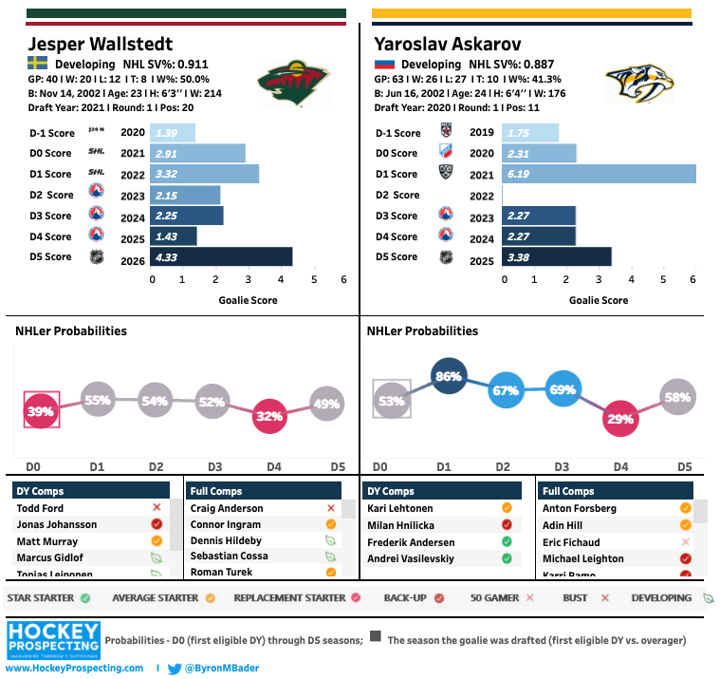
Evolving-Hockey's 2025-26 goaltending metrics provide further evidence that Wallstedt's success wasn't simply a product of favorable circumstances. At even strength, he performed above average in save percentage and expected goals against per 60, with particularly strong results in goals prevented relative to expectation. His shorthanded performance was even more impressive, with his save percentage, goals saved relative to expectation and expected-goals-adjusted results all ranking substantially above average. These numbers suggest that Wallstedt was providing meaningful value beyond what Minnesota's defensive environment alone would predict, an important distinction when evaluating whether his impressive rookie statistics are sustainable.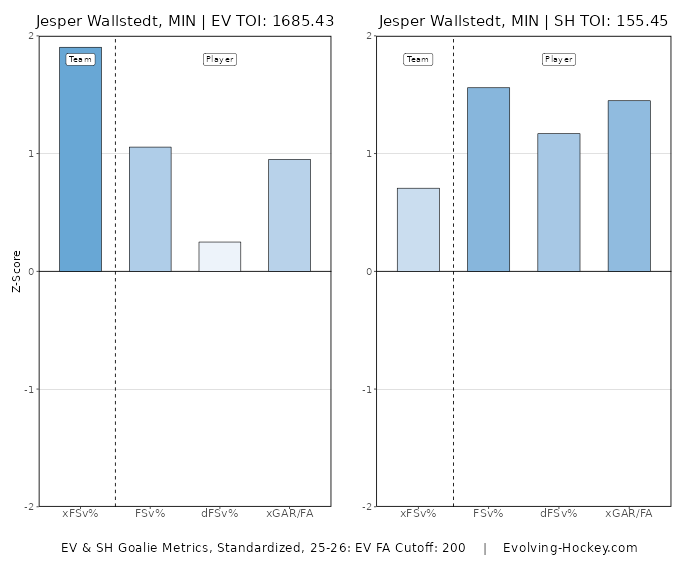
HockeyViz offers a complementary perspective on Wallstedt's performance, particularly when examining his shot-saving tendencies. Across the 2025-26 season, he allowed 95 goals against approximately 98.7 expected goals, suggesting that his overall results were modestly better than expected based on the quality and location of the shots he faced. His strongest performance came against wrist and snap shots, where he allowed 62 goals against 69.1 expected, while his results against slapshots and deflections were somewhat less favorable. The accompanying shot maps illustrate that Wallstedt was particularly effective in several dangerous areas around the net, although the distribution also highlights the normal variation that can occur across different shot types.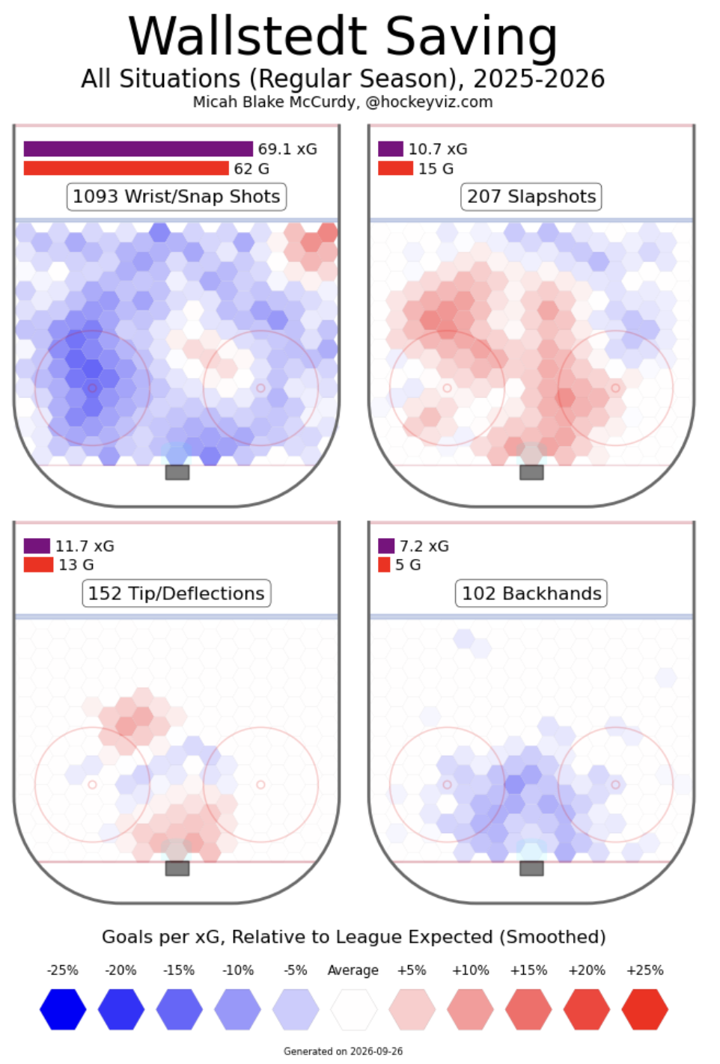
HockeyViz's shot-saving maps provide additional insight into Wallstedt's strengths and areas for improvement. His performance against wrist and snap shots was particularly encouraging, allowing just 62 goals against 69.1 expected goals across 1,093 shots. He also performed well against backhand attempts, surrendering five goals against 7.2 expected. The maps reveal considerable success across several high-danger areas, particularly around the faceoff circles and portions of the slot. However, his results were less impressive against slap shots, allowing 15 goals against 10.7 expected, while also surrendering slightly more goals than expected on tips and deflections. These differences highlight both his ability to handle conventional shooting opportunities and the challenges posed by certain shot types, although the smaller samples warrant caution. Overall, Wallstedt's shot-saving profile offers encouraging evidence of his technical foundation, while identifying areas where further refinement could improve his consistency.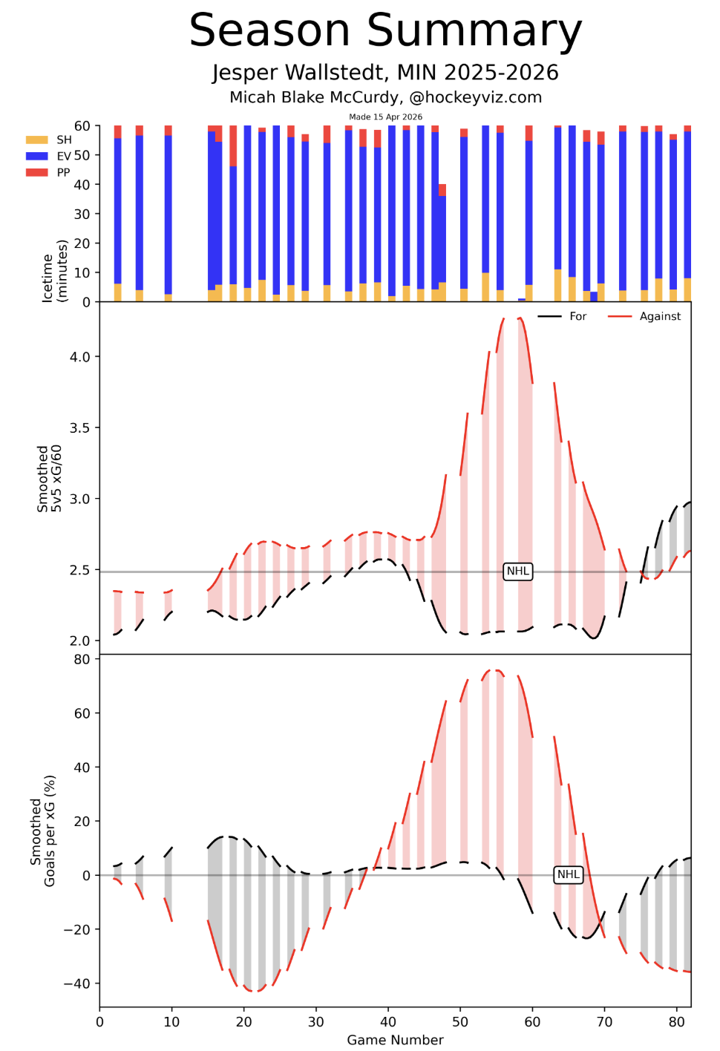
Perhaps the most interesting aspect of Wallstedt's season was the considerable fluctuation in his performance environment. HockeyViz's season summary illustrates how Minnesota's defensive results changed throughout the campaign, particularly during the middle portion of the season when expected goals against increased dramatically. During that stretch, the Wild were surrendering opportunities at a rate exceeding four expected goals per 60 minutes, substantially above the league average. Interestingly, the team's actual goals against remained considerably lower than expected during much of this period, suggesting that goaltending performance helped compensate for defensive breakdowns. The underlying numbers subsequently improved, although the relationship between expected and actual goals continued to fluctuate. For Wallstedt, these patterns reinforce the importance of evaluating goaltenders within their defensive environment rather than relying exclusively on traditional statistics. They also demonstrate how quickly circumstances can change over the course of an NHL season, even within an established organization like Minnesota.
Jesper Wallstedt. https://t.co/pVMOezYQa0
— Spoked Z (@SpokedZ) October 21, 2026
The beginning of the 2026-27 season has provided further encouragement, with Wallstedt establishing himself as Minnesota's primary option in goal. His latest victory against Seattle on October 24 improved his record to 7-2-2 through 11 starts, continuing an impressive opening stretch following his breakout rookie campaign. Entering that contest, he had posted a .915 save percentage and 2.19 goals-against average, with approximately 6.3 goals saved above expected. Although his performance has fluctuated somewhat, including four-goal outings against St. Louis and Edmonton, Wallstedt has demonstrated an ability to deliver strong performances consistently. More importantly, his early workload and results suggest that Minnesota has considerable confidence in his ability to handle significant NHL responsibility. While the season remains young, Wallstedt's combination of technical consistency, favorable underlying metrics, and an increasingly established role makes him one of the most attractive young goaltenders in dynasty formats.
Jesper Wallstedt. https://t.co/pVMOezYQa0
— Spoked Z (@SpokedZ) October 21, 2026
The primary concern surrounding Wallstedt is no longer whether he possesses the talent to succeed in the NHL, but whether his rapidly increasing acquisition cost adequately reflects the uncertainty inherent in goaltender development. His impressive results against conventional shooting opportunities and ability to outperform expected goals provide legitimate reasons for optimism, but his struggles against certain shot types and the volatility illustrated by HockeyViz suggest that continued development should not be taken for granted. Wallstedt has provided considerably more evidence of NHL readiness than Askarov, making him the safer dynasty investment at this stage. However, fantasy managers must weigh that relative security against a premium acquisition cost following his breakout campaign. The long-term upside remains substantial, but acquiring him at peak market enthusiasm could limit the potential return on investment.
The Case for Askarov
Askarov's argument requires a different approach because his first full NHL season didn't produce the results dynasty managers anticipated when he was considered one of hockey's premier goaltending prospects. After several productive AHL seasons and a reputation built around exceptional athleticism, quickness, and technical ability, Askarov finally received an extended NHL opportunity with San Jose in 2025-26. His 21 victories demonstrated that he could handle a substantial workload, and he was named the Sharks' Rookie of the Year, but his .884 save percentage and 3.63 goals-against average were disappointing, particularly given the expectations surrounding his arrival. Those struggles have continued into the early stages of 2026-27, with Askarov posting a 3-4-0 record, .883 save percentage, and 3.43 goals-against average through seven starts. However, his two most recent appearances offer some encouragement, including a 29-save performance against Toronto and a 41-save victory over Ottawa. While these outings suggest he may be finding his rhythm, the broader results remain inconsistent, reinforcing the considerable gap between his impressive physical tools and his ability to deliver reliable NHL production. For dynasty managers, Askarov remains a high-upside investment, but one that requires substantially more patience than Wallstedt.
YAROSLAV. ASKAROV. https://t.co/Q48Pv0AaK0
— JD Young (@MyFryHole) March 4, 2026
Hockey Prospecting's historical model illustrates why Askarov generated so much enthusiasm earlier in his development. His goalie score reached an exceptional 6.19 during his first post-draft season, substantially exceeding Wallstedt's corresponding peak and reinforcing the offensive-era prospect reputation that followed him into professional hockey. However, his subsequent scores declined, settling at 2.27 during consecutive AHL seasons before improving to 3.38 in his first full NHL campaign. His modeled NHLer probability has also fluctuated considerably, currently sitting at 58% after falling as low as 29% during the previous season. These projections suggest that Askarov's development has been less consistent than anticipated, although the historical peak remains evidence of the considerable potential that initially made him such an attractive dynasty prospect.
YAROSLAV. ASKAROV. https://t.co/DeCEtndxIo
— JD Young (@MyFryHole) January 21, 2026
Evolving-Hockey's 2025-26 metrics provide a less encouraging assessment of his NHL performance, particularly at even strength. Across more than 2,100 even-strength minutes, Askarov's save percentage, goals saved relative to expectation and expected-goals-adjusted results were all below average, suggesting that his struggles weren't simply the result of playing behind a rebuilding Sharks team. His shorthanded performance was more encouraging, with several metrics finishing slightly above average, but the overall profile indicates that he has yet to demonstrate the consistency necessary to establish himself as a dependable NHL starter. That distinction is important because while San Jose's defensive limitations undoubtedly create additional challenges, the underlying numbers suggest that Askarov also bears responsibility for his disappointing results.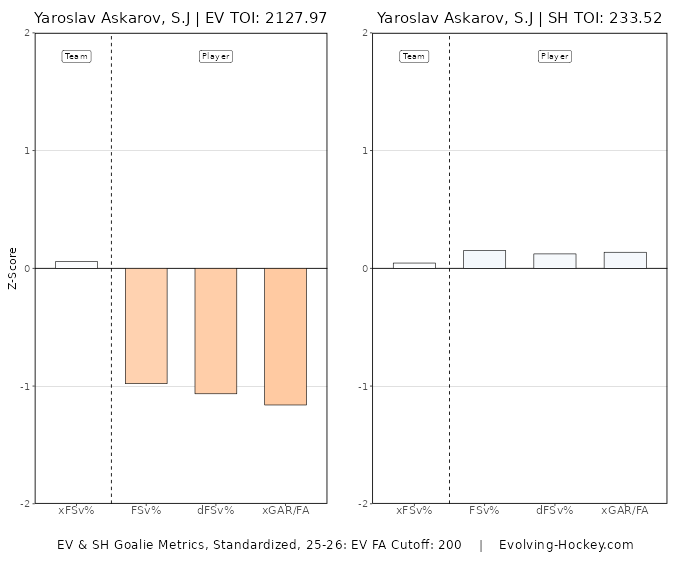
HockeyViz's shot-saving analysis provides a more detailed picture of Askarov's struggles during the 2025-26 season, particularly when examining the types of shots that caused him problems. Across all situations, he surrendered 159 goals against just 138 expected goals, allowing approximately 15.2% more goals than anticipated based on shot quality. The most significant discrepancy came against wrist and snap shots, where he allowed 119 goals against 92.7 expected, a concerning difference of more than 26 goals. His performance against slapshots was similarly disappointing, surrendering 19 goals against 14.7 expected. However, his results were considerably better against tips and deflections, where he allowed just ten goals against 18.6 expected, while his performance against backhand attempts was approximately in line with expectations. These differences suggest that Askarov's difficulties were not universal across every shot type, but were particularly pronounced against conventional shooting attempts, which represent the majority of shots NHL goaltenders face.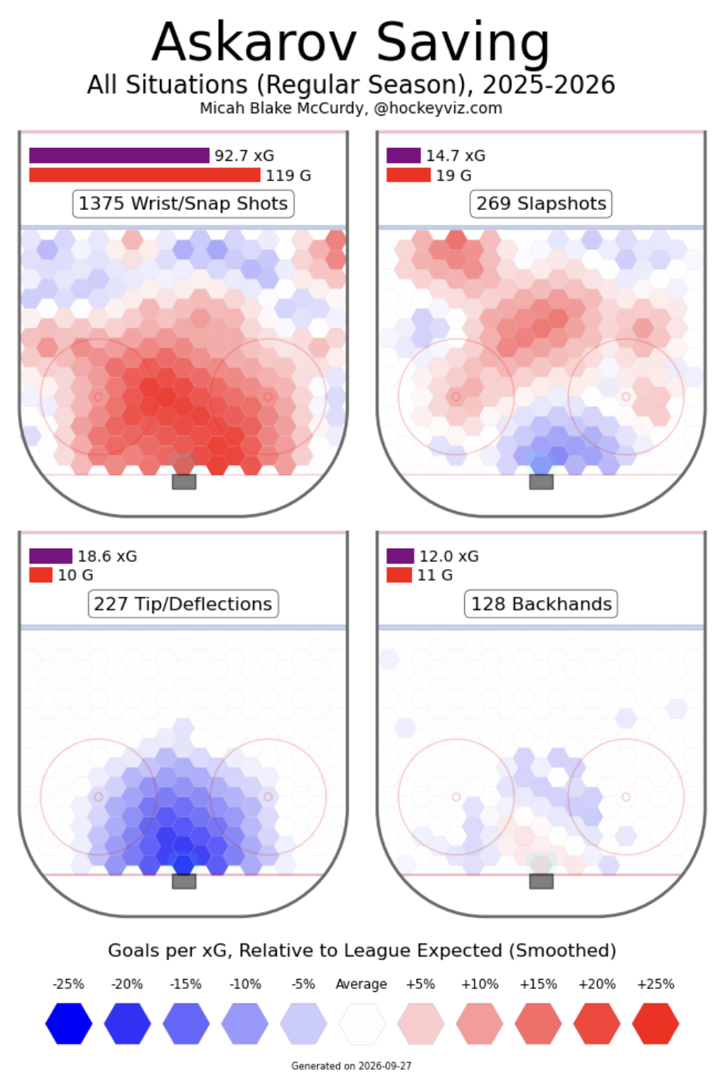
The broader HockeyViz shot-saving history further illustrates the volatility of Askarov's performance. His results have fluctuated considerably throughout his NHL development, with periods of strong play followed by substantial stretches in which his goals allowed exceeded expectation. The model's overall historical shot-saving measure currently sits at +8.4%, indicating that his observed goals-against rate has exceeded the expected rate over the period displayed. That contrasts sharply with Wallstedt's corresponding figure of -4.2%, reinforcing the difference in their recent NHL results. However, Askarov's history also demonstrates that his performance hasn't followed a consistently negative trajectory, suggesting that there may still be room for meaningful improvement as he gains experience and San Jose's defensive structure develops.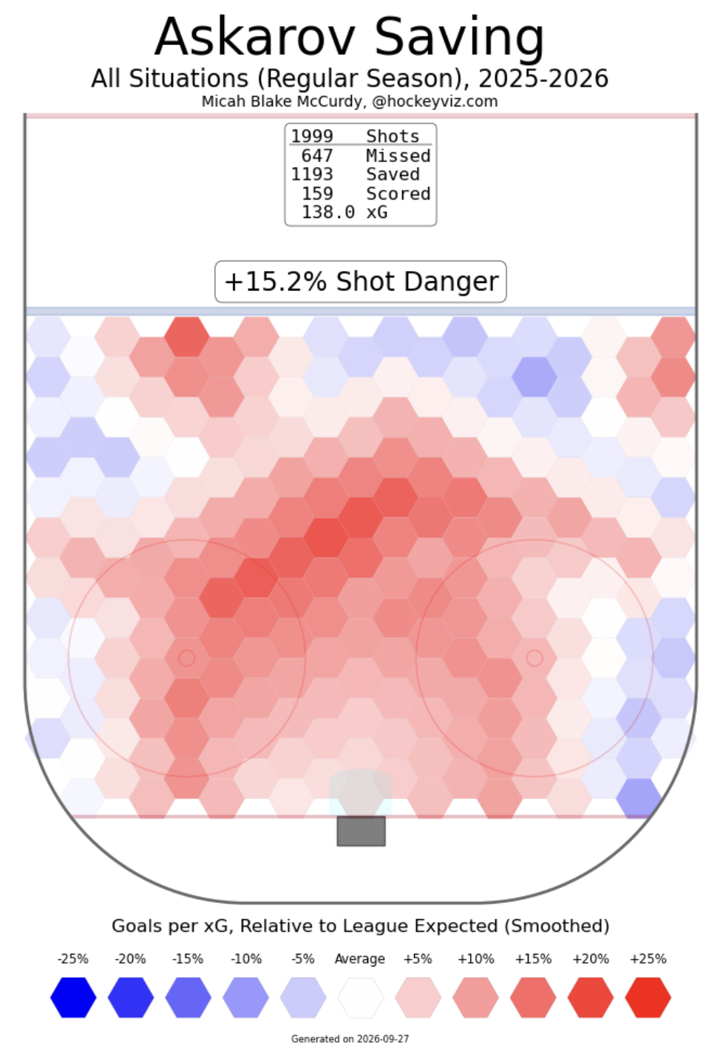
The overall shot-location map reinforces these concerns, revealing elevated goals-against rates across much of the central scoring area, including the slot and regions surrounding both faceoff circles. The concentration of red throughout these dangerous areas indicates that Askarov struggled to prevent goals relative to expectation, even after accounting for the quality and location of the shots he faced. The season-long performance chart adds another important dimension, illustrating just how dramatically his results fluctuated. After a particularly difficult stretch early in the season, his underlying numbers improved temporarily before deteriorating again around the middle of the schedule, when his smoothed five-on-five expected goals against climbed above 4.0 per 60 minutes. That increase suggests that San Jose's defensive environment was also contributing to his difficulties, exposing him to an unusually high volume of dangerous opportunities. Encouragingly, the final portion of the season showed some stabilization, with his expected goals against returning closer to league-average levels and his actual goals-against results becoming more competitive. Nevertheless, the substantial gap between expected and actual goals allowed over much of the campaign demonstrates that Askarov's struggles cannot be attributed solely to the defensive shortcomings of the team in front of him.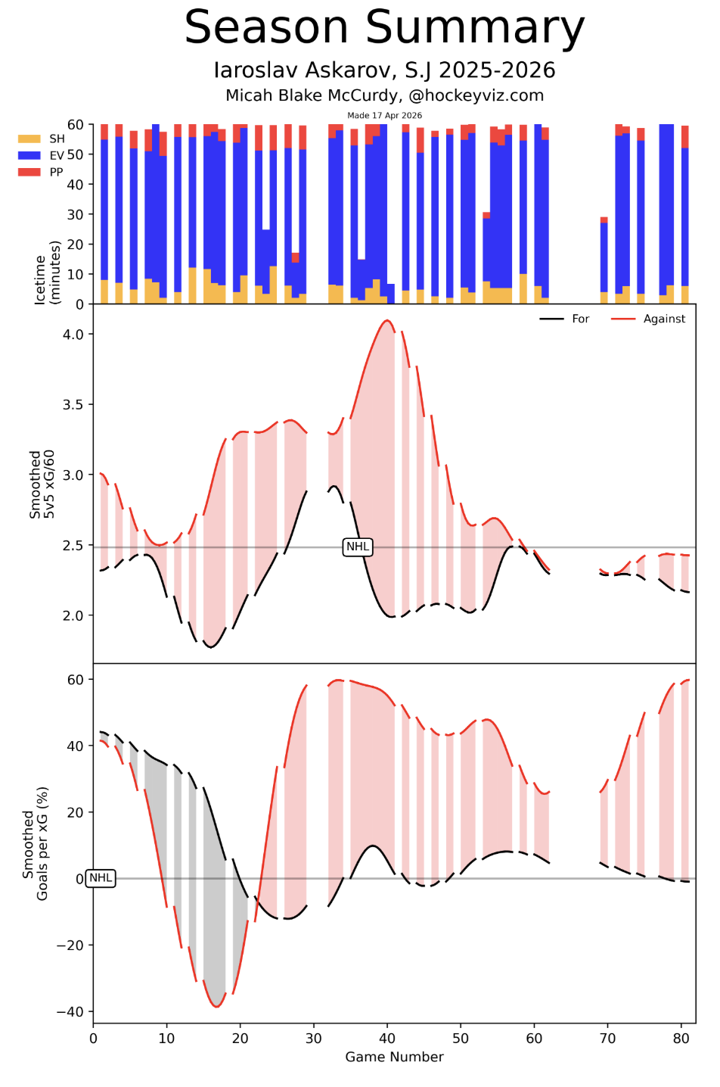
The most important consideration for Askarov may ultimately be his organizational situation and long-term developmental trajectory. San Jose is assembling one of the NHL's most exciting young offensive cores, and although the Sharks remain a developing team, their long-term outlook is encouraging. Askarov has already demonstrated that he can handle a substantial NHL workload, and the organization has made a significant investment in his future following his acquisition from Nashville. His performance against tips and deflections also provides some encouragement that his underlying abilities remain capable of producing above-average results in certain situations. However, translating his exceptional athleticism into consistent positioning, rebound control, and more efficient save selection will be essential if he hopes to close the considerable gap between his actual results and expected performance. If San Jose continues improving defensively while Askarov develops greater consistency, he could eventually emerge as the primary starter for an increasingly competitive team. That combination of potential workload, organizational commitment, and improving team quality preserves an attractive fantasy ceiling, even if his current performance and statistical profile remain considerably less reassuring than Wallstedt's.
YAROSLAV ASKAROV ROBS DRAKE BATHERSON WITH AN INSANE SAVE https://t.co/2HDQaLF9Ef
— Sportsnet (@Sportsnet) October 23, 2026
The challenge is determining how much patience dynasty managers should exercise. Askarov is now 24 years old, and while that's hardly old for a goaltender, he's no longer a prospect whose future can be evaluated entirely through junior and AHL performances. His NHL results matter, and the underlying metrics suggest that his difficulties have been substantial rather than merely unfortunate. Nevertheless, the combination of his historical prospect profile, athletic ability and potential long-term opportunity makes him an intriguing acquisition target if his disappointing performance has caused his dynasty value to fall considerably.
The Battle
The comparison between Jesper Wallstedt and Yaroslav Askarov has become increasingly one-sided, at least when evaluating their current NHL performance. Wallstedt followed an impressive rookie campaign with a strong start to 2026-27, posting a 7-2-2 record, .917 save percentage, and 2.10 goals-against average through 11 starts. Askarov, meanwhile, continues searching for consistency, opening the season with a 3-4-0 record, .883 save percentage, and 3.43 goals-against average through seven appearances. Wallstedt has established himself as a reliable NHL option, while Askarov remains a projection built largely around his athleticism, prospect pedigree, and long-term opportunity.
The underlying numbers reinforce that distinction. HockeyViz's 2025-26 analysis showed Wallstedt allowing 95 goals against 98.7 expected, while Askarov surrendered 159 against just 138 expected. Askarov's struggles were particularly pronounced against wrist and snap shots, suggesting that his difficulties cannot simply be attributed to San Jose's rebuilding defensive structure. Evolving-Hockey's metrics paint a similar picture, with Wallstedt consistently outperforming expectations while Askarov has struggled to provide comparable value. Although Hockey Prospecting's historical models once favored Askarov's upside, Wallstedt's recent development has provided considerably stronger evidence of his ability to succeed at the NHL level.
The more interesting question for dynasty managers is whether the gap in acquisition cost has become larger than the gap in long-term potential. Wallstedt is unquestionably the safer investment and the preferred option for teams looking to compete immediately. However, Askarov remains just 24 years old, and San Jose's emerging young core could eventually provide him with an attractive combination of workload and team success. His recent struggles have created an opportunity to acquire a talented young goaltender at a substantial discount, albeit with considerable risk.
The Verdict
I'm rostering Jesper Wallstedt in a straight-up comparison, but I'm actively exploring opportunities to acquire Yaroslav Askarov at a discount.
Wallstedt has established himself as one of the NHL's most promising young goaltenders, building on an impressive rookie campaign with another strong start to 2026-27. His traditional statistics, favorable underlying metrics, and growing responsibility in Minnesota provide compelling evidence that his success is sustainable. While his dynasty value has risen considerably, he offers the stronger combination of demonstrated NHL ability, organizational stability, and long-term fantasy upside.
Askarov remains a considerably riskier investment. His struggles have continued into 2026-27, and HockeyViz's shot-saving analysis suggests that his difficulties extend beyond San Jose's defensive shortcomings. Nevertheless, his exceptional athleticism, historical prospect pedigree, and potential to become the primary starter for an improving Sharks team preserve an intriguing fantasy ceiling. At just 24 years old, there is still time for his performance to catch up with his potential.
Ultimately, Wallstedt is the better dynasty asset, but Askarov may be the more interesting buy-low opportunity. I'm comfortably choosing Wallstedt if acquisition cost is equal, but if acquiring him requires paying a premium while Askarov can be obtained at a substantial discount, the latter becomes an appealing gamble. The key is recognizing that Askarov's upside remains enticing, even if the probability of reaching it has become considerably less certain.