


Team Outlook
Since winning the Stanley Cup in 2019, the Blues have largely remained in a competitive window, but one that has gradually narrowed rather than meaningfully evolved. St. Louis has qualified for the playoffs in six of the past eight seasons, yet three of those appearances ended in first-round exits, and this year they appear unlikely to return at all. Instead of committing to a full rebuild, the organization is signaling a retool, attempting to recalibrate on the fly while preserving long-term credibility.
"Obviously we're embarrassed for where we're at in the standings."
Caught up with #STLBlues GM Doug Armstrong ahead of the Olympic break.
Here's part of his blunt assessment of the season in St. Louis so far: pic.twitter.com/FsJMncfgpA
— Corey Miller (@corey_miller5) January 28, 2026
General Manager Doug Armstrong’s recent comments expressing embarrassment with the team’s position in the standings underscores that urgency. For dynasty managers, this transitional phase creates opportunity. As the Blues reassess their internal hierarchy, some prospects are beginning to separate as better fits for the next iteration of the roster, while others may be carrying more market value than their realistic fantasy projections justify. This edition highlights three players whose stock remains on the rise and three whose current perception may be ahead of where their long-term fantasy utility ultimately lands.
Buy Candidates
Jimmy Snuggerud, RW
Why Buy?
Snuggerud’s early NHL usage has reinforced why his profile translates so cleanly, even if the surface-level results have been uneven. Rather than relying on creativity or puck dominance, he has shown an ability to contribute within structure, using his frame effectively, getting pucks to the net, and consistently attacking high-danger areas. His shot remains his defining trait at the NHL level, and he looks comfortable playing a direct, north-south game that does not require extended offensive-zone freedom to be effective. Those habits have allowed him to earn trust quickly, even in minutes that are not heavily sheltered.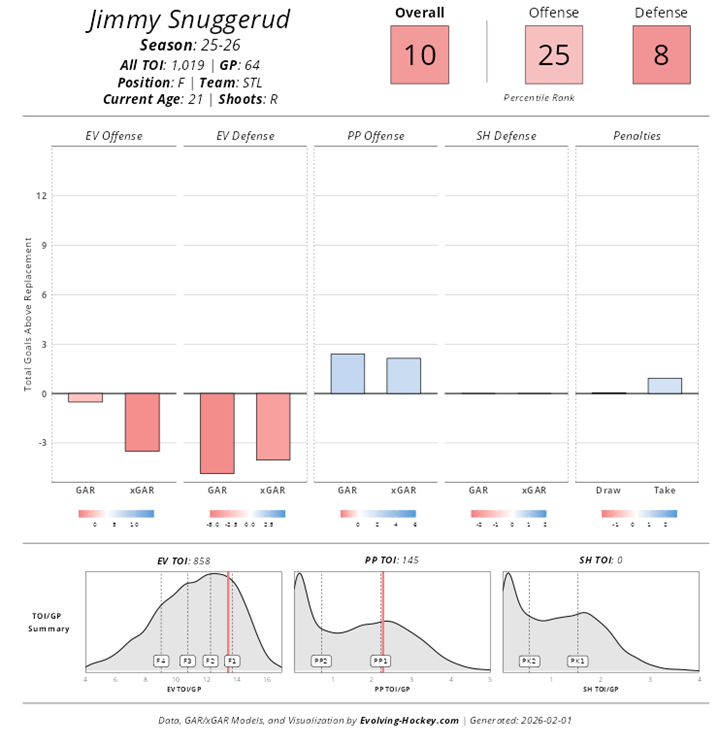
From an evaluation standpoint, this is where opportunity emerges. His Evolving Hockey player card shows poor initial five-on-five results at the NHL level, which may cause some fantasy managers to sour prematurely. However, those early struggles are not unexpected for a rookie adjusting to pace and structure, and they mask some encouraging signs. Most notably, his power-play impact has already been strong, reinforcing the idea that his shot and net-front instincts translate immediately in offensive situations. That split between even-strength results and special-teams effectiveness often creates short-term value inefficiencies in dynasty formats.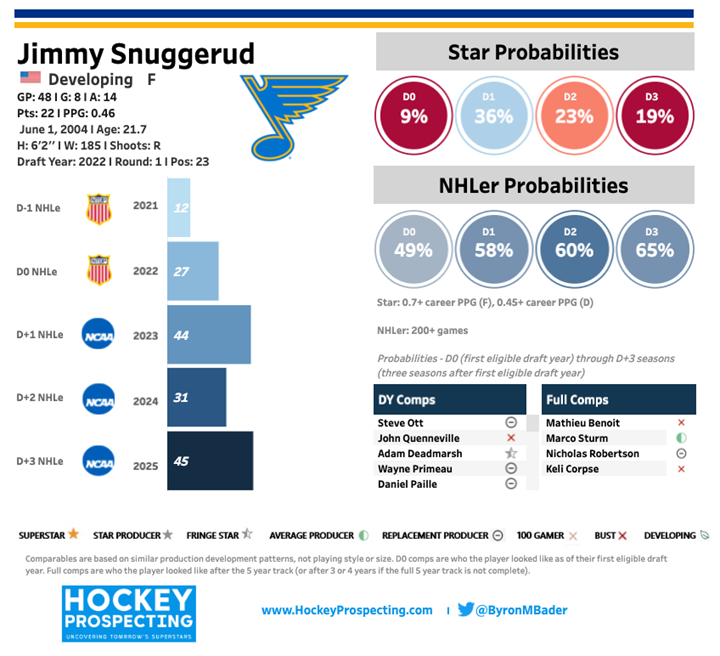
Zooming out, Snuggerud’s long-term outlook remains solid. According to Hockey Prospecting, he graduated the model with a 19% chance of becoming a star, a meaningful signal for a player whose game is built on translatable habits rather than flash. With the remainder of this season and all of next still remaining on his entry-level contract, the Blues have a clear runway to evaluate how he fits into their future plans during a retooling phase. Players who shoot, compete, and contribute on the power play tend to stick sooner than expected. If his role continues to grow incrementally while perceptions lag behind early results, this remains a strong buy window before his value stabilizes.
Justin Carbonneau, RW
Why Buy?
Carbonneau plays with pace and confidence, attacking defenders with purpose and showing a growing ability to generate offense off the rush. His scoring is not purely opportunistic. He creates chances through controlled entries and assertive puck movement, pointing to a skill set that has the potential to scale beyond junior competition if the underlying habits continue to mature.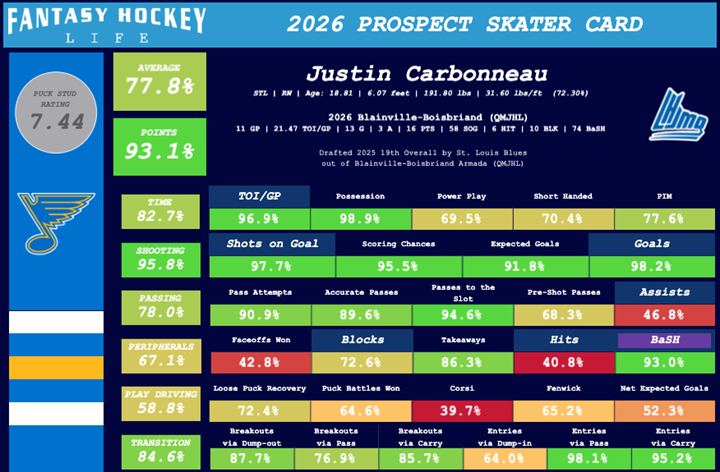
One of the longstanding knocks on Carbonneau has been his two-way consistency, but that area of his game has taken a meaningful step forward this season. His Fantasy Hockey Life skater card reflects improvement across several key areas, most notably in loose puck recoveries, puck battles won, play driving, and transition impact. Those gains suggest a player who is learning how to influence play away from the puck, not just finish it. In addition, Carbonneau offers strong contributions in peripheral categories such as shots, hits, and blocks, giving him a higher floor than many offense-first wingers.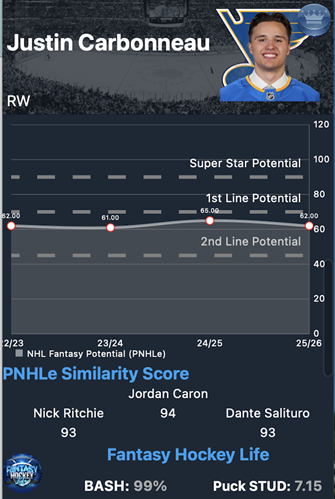
The appeal here is timing. Carbonneau’s pNHLe via the Rank King application has been somewhat muted this season, which may be partially explained by his increased focus on rounding out his all-around game rather than purely chasing offense. That dip in projection could create a buying opportunity if managers anchor too heavily to the headline number. The underlying trajectory still supports top-line upside if his offensive confidence and play-driving continue to translate. For dynasty managers, this is the type of asset worth acquiring before production, deployment, and perception realign and close the value gap.
Adam Jiricek, D
Why Buy?
Jiricek brings a toolkit that is always worth betting on from the blue line: size, mobility, and offensive instincts. He is at his best when activating into space, moving pucks decisively, and supporting the rush. His confidence with the puck has continued to grow alongside increased responsibility, which has clearly been the case this season. While his defensive game drew questions earlier in his development, that area took meaningful steps forward this year, helping round out his overall profile.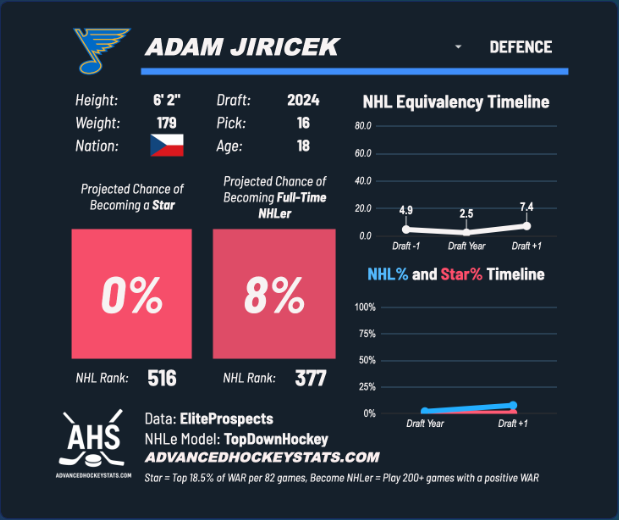
The uncertainty surrounding his profile is exactly what makes this a buying opportunity. His Advanced Hockey Stats card assigns him a zero percent chance of becoming a star, largely driven by limited scoring during his draft-minus-one and draft-year seasons when injuries significantly disrupted his development. That context matters. Those early seasons are heavily weighted by the model, but they do not reflect the player Jiricek is now. Showing that card to the current manager may even help soften acquisition cost, especially if they are risk-averse or model-driven.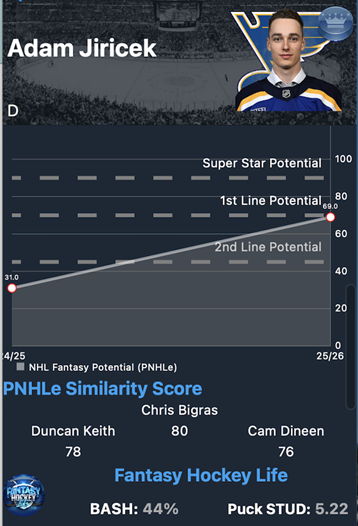
What should provide reassurance is how he has played more recently. Jiricek has been outstanding for the Brantford Bulldogs, the class of the OHL this season, playing heavy minutes in all situations and driving play from the back end. He carried that same responsibility at the Under-20 World Junior Championship for Czechia, leading them to a silver medal while earning Best Defenseman of the Tournament honors. His pNHLe via the Rank King application comes in at 69, a projection that weighs his current production more heavily, and while the Duncan Keith comparable may be ambitious, it underscores the level of upside still in play. If he earns sustained power-play opportunities at the professional level, his value could rise quickly from its current discount.
Sell Candidates
Theo Lindstein, D
Why Sell?
Lindstein has long profiled as a better real-life player than fantasy asset. He is a dependable, intelligent defender whose game is built on positioning, reads, and limiting mistakes. Those traits make him appealing to NHL coaches and give him a clear path to regular minutes, but they do not translate cleanly to fantasy value. While he can move the puck efficiently and support play, his offensive assertiveness is limited, and he is unlikely to be a primary driver of scoring from the blue line. Even his peripheral contributions lag behind what fantasy managers typically need from a defense slot.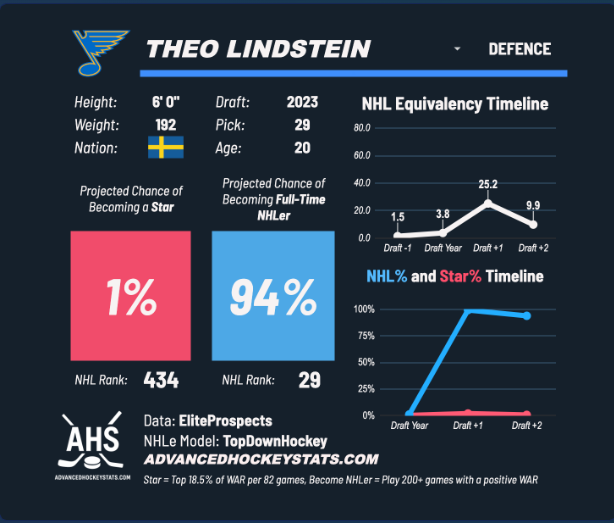
The data reinforces that divide. Lindstein’s Advanced Hockey Stats card assigns him just a one percent chance of becoming a star, while giving him a 94% probability of becoming a full-time NHL player. That is exactly the profile he fits. He is very likely to play meaningful NHL games and be trusted in defensive situations, but that usefulness is far more valuable to his team than to your fantasy roster. If another manager is valuing him as a future top four fantasy contributor based on role security alone, this is a strong window to sell. His NHL future looks stable, but his fantasy ceiling likely remains modest unless his offensive involvement changes dramatically.
Logan Mailloux, D
Why Sell?
Mailloux remains one of the more polarizing defense prospects because of his raw offensive tools. He can shoot, skate, and generate offense in flashes, which continues to buoy his perceived upside, but the volatility in his game has not gone away. Decision-making under pressure, defensive consistency, and overall processing remain real concerns, and those issues directly impact trust, deployment, and long-term role security at the NHL level.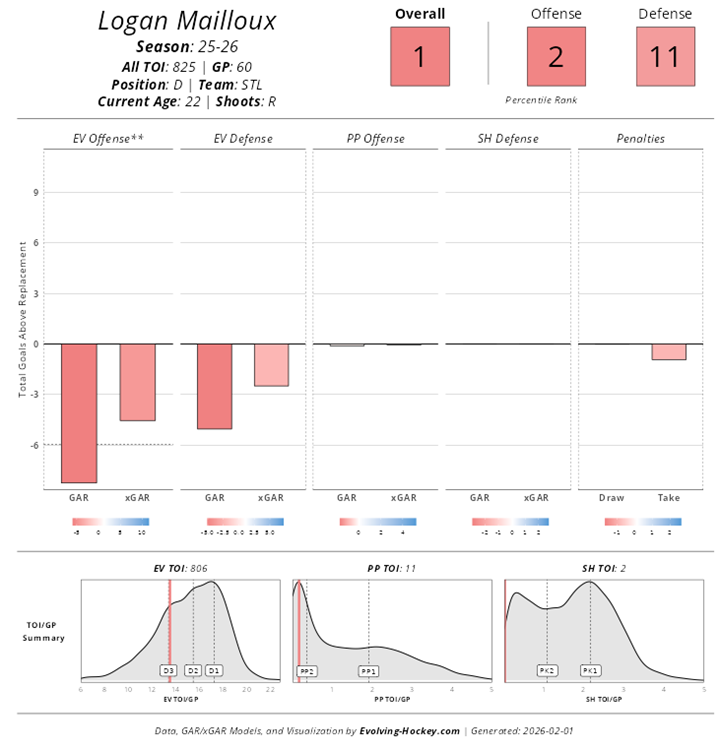
The underlying results this season strengthen the sell case. According to Evolving Hockey, Mailloux’s impacts have been extremely poor on both the offensive and defensive sides of the puck, leaving him heavily reliant on securing a power-play role to maintain fantasy relevance. While St. Louis was willing to trade Zachary Bolduc to acquire him, and Bolduc has looked solid in Montreal, that transaction may still be inflating Mailloux’s perceived value. If another manager is buying into upside alone, this is a strong window to sell and reallocate that value into a more stable asset.
Dalibor Dvorský, C
Why Sell?
Dvorský is a legitimately strong offensive player, and the recommendation to sell has nothing to do with doubts about his scoring ability. He graduated the Hockey Prospecting model with a 41% chance of becoming a star, and his early NHL usage has already translated into tangible results, nearly 10 power-play points in just over half a season. His processing with the puck, ability to find space, and comfort in offensive situations all point to a player who should produce at the NHL level, particularly on the man advantage.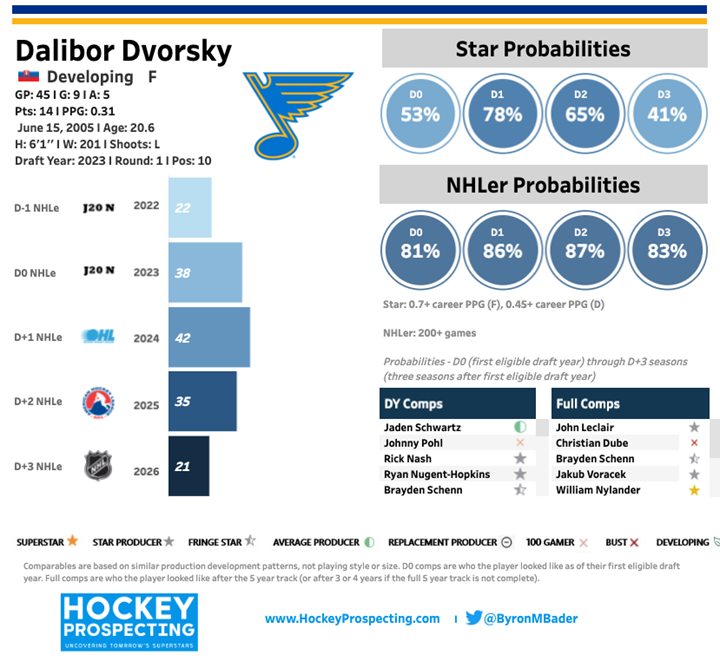
The limitation lies on the other side of the puck. Dvorský has long been a defensive liability, and that concern has carried over to the NHL. Evolving Hockey grades his defensive impact in just the 33rd percentile, and within the Blues lineup he ranks near the bottom in both Corsi against per 60 minutes and expected goals against per 60 minutes. Those deficiencies make it difficult for him to consistently earn the kind of five-on-five usage needed to reach his absolute ceiling. He can still be a productive scorer, but a true top-end outcome becomes less likely if coaches have to manage his minutes carefully. The recommendation here is not to sell cheap, but to capitalize if another manager is valuing him as a pure offensive centerpiece. Targeting returns consistent with a 70 to 80 point forward makes sense while that perception still exists.
Summary
| Player | Role | Key Insight |
| Jimmy Snuggerud | Buy | Pro-ready winger with reliable scoring habits and a clear NHL pathway |
| Justin Carbonneau | Buy | Offensive winger whose trajectory is undervalued |
| Adam Jiricek | Buy | High-upside defenseman with power-play potential if development clicks |
| Theo Lindstein | Sell | Reliable defender whose fantasy ceiling likely trails market perception |
| Logan Mailloux | Sell | Volatile offensive defenseman reliant on power-play deployment |
| Dalibor Dvorský | Sell | Solid center whose fantasy value may be inflated by positional scarcity |