


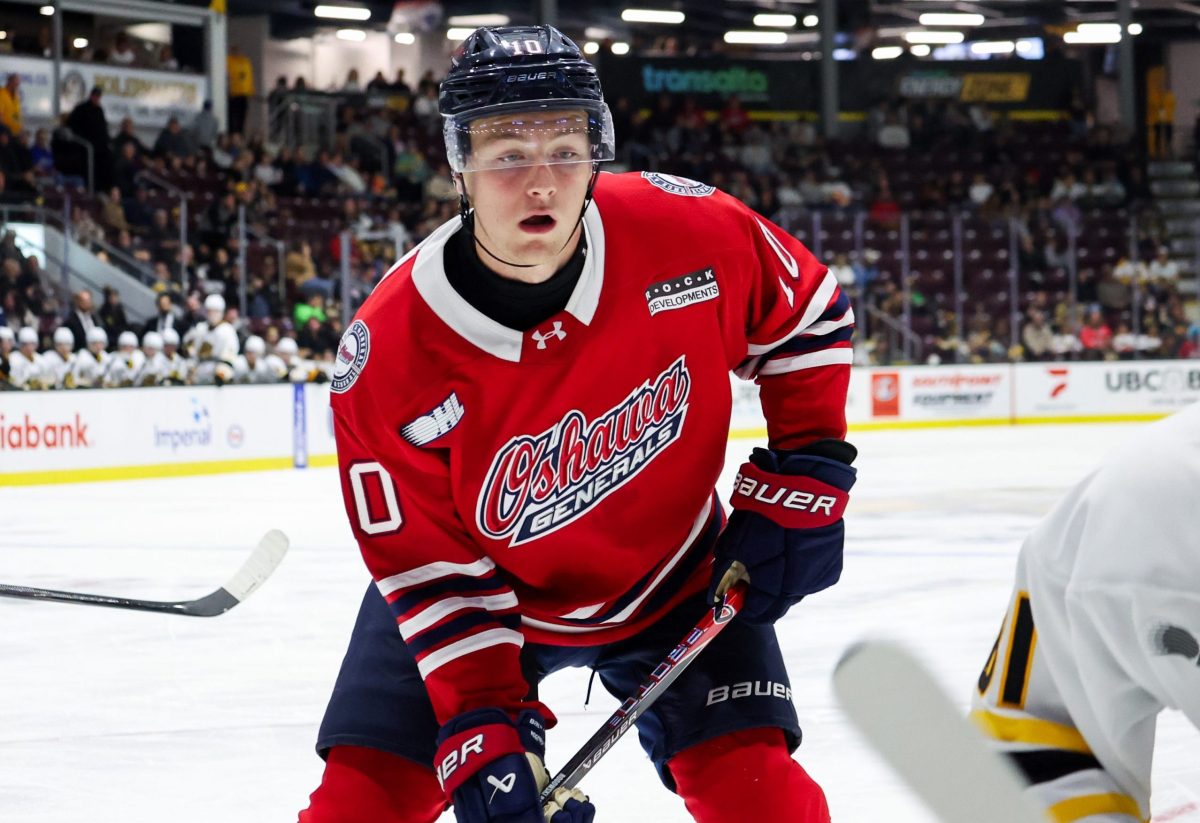
Brooks Rogowski
2026 NHL Draft Eligible
Position: C/W, Shoots: R
H/W: 6-foot-6, 231 pounds
Date of Birth: 2008-06-28
In 2024, the Oshawa Generals shocked the OHL scouting community when they selected behemoth power center Brooks Rogowski in the second round of the OHL Draft…out of a Michigan high school. That’s not exactly a common occurrence. Rogowski did play in a higher end AAA program growing up, Little Caesars, but because of high end baseball commitments, he switched to playing primarily high school hockey in his U15 year. Obviously, the Generals’ scouting staff deserve a ton of credit for unearthing this gem. In fact, Rogowski was always operating under the assumption that he would end up playing NCAA baseball as it runs in the family, never truly focusing on hockey development until he joined the OHL. Breanna McNeill, a content creator for the OHL, wrote a terrific piece on this that you can check out here.
Rogowski turned heads in his rookie year with the Generals, helping them reach the OHL Championship. He proved to be way ahead of the expected development curve. Rogowski then earned a spot on the U.S.’ Hlinka/Gretzky Cup team this summer, helping them capture gold in a more defensively oriented, checking role. This season in Oshawa, he’s been tasked with way more offensive responsibility on a rebuilding Generals’ team. There have been ebbs and flows…and injuries (like a broken finger suffered in a fight), but Rogowski is closing the year out well from a production standpoint and that should have him on the radar of the U.S. as they look to make additions to their U18 team from outside of the NTDP.
Obviously, the allure here is that Rogowski is a power center prospect who could be a versatile pro through the middle of an NHL lineup. While he is physically developed, he’s underdeveloped from a skill and experience perspective; can that gap close and if it does, what is Rogowski’s ultimate upside? Additionally, is he a center long term? If you view him as a winger (where he has spent the majority of the second half of this year with Oshawa), he has less value because he’s not ever going to be a high-end NHL skater. However, he is a highly intelligent two-way player who supports play well, has shown significant progress as a goal scorer, and who shows good vision with the puck. As he fills out his frame, the physical upside is limitless. He would be an absolute load to handle for even NHL defenders. Teams could utilize him as a net front presence on the powerplay, but he has also shown very well killing penalties through his junior career.
One of the main concerns that I’ve seen and heard come up consistently in the scouting community is that Rogowski lacks consistent physical intensity and engagement. Not exactly what you like to see from a 6-foot-6 forward who could dominate physically. It brings back memories of a guy like Logan Brown. That said, I’m not quite as concerned about this as others and I do feel that he’s become better in this regard as the season has progressed. I’ll break that down later in this report. The other concern would be that Rogowski lacks the skill to be a top six contributor; this is a more legitimate concern through my scouting lens. Rogowski is raw; he’s still putting everything together and we don’t really know how that’s going to work out. The range of outcomes here runs the full gamut. Career minor league player due to pace, physicality, and skill limitations. Bottom six role player. Or, if things hit right, an all situations, versatile Swiss Army knife who can slide up and down your lineup. Think Nick Bjugstad. But, as alluded to, an NHL team is going to have to be patient with Rogowski. He’s going to likely play another year in the OHL with Oshawa. Then he’ll head to Michigan State, perhaps for another two years. He’s a long-term project, but one who could pay off nicely.
Skating
Rogowski’s skating is best described as “good enough” for the game he plays. He can build linear speed with his long strides. He will utilize linear crossovers to help him protect the puck while he builds speed through the neutral zone. His quickness and top speed would both be considered average, but it takes a lot of lower body strength to move 230+lbs. As he improves his conditioning, given that his stride length and mechanics aren’t terrible, we should see marked improvement in his speed and power as he matures physically and continues to work to improve his skating profile.
The biggest issue would be in Rogowski’s balance and ability to play off his edges. He’s very much a straight-line attacker. He can lose his edges too easily and be knocked off balance. When he tries to cut back or make a lateral push, he often loses speed or even falls. He pivots well enough and can build speed out of turns, but when tasked with changing direction quickly, he struggles. He also can struggle to regain his stride when knocked off balance by contact. He can power through defenders at times, when attacking in straight lines, but when pivoting or playing off his edges, he gets knocked off stride too easily, such as in the cycle or when looking to work East/West with the puck. Another issue is that Rogowski’s skating really hasn’t improved much over the course of the season. Watching him at the Hlinka/Gretzky, I felt like there was a chance that it could really become a solid trait for him with the right in-season work; he was showing progress from the previous year and beating defenders with his power. However, then…and now, his stride and effectiveness are limited by balance and agility issues. There’s no question that will be a focus of his this offseason.
Rogowski builds speed quickly through linear crossovers, catching the Swedish defense flatfooted at the Hlinka/Gretzky.
Rogowski carves up the neutral zone again utilizing linear crossovers.
Rogowski shows off his linear speed by getting to the puck and then he makes a great pass to a teammate for the goal.
Rogowski loses an edge when contacted trying to cut around the defender.
Rogowski loses an edge trying to make a quick cut back to the outside.
Rogowski breaks through the defense but loses balance just as he’s about to get his shot off.
We see the lack of power here as a two on one is negated due to Rogowski’s inability to maintain speed/build to a solid top speed.
GRADE: 50
Shot
This is an area of Rogowski’s game that has improved significantly over the course of the year. I found that he was having trouble finishing off plays early on in the year. He was heeling or toeing shots and wasn’t connecting on enough of the chances he was earning in tight. However, he’s really gained confidence in his shooting ability, and he’s been converting on more of his chances in the home plate area.
Rogowski doesn’t have an elite shot. He doesn’t possess a heavy one-timer. He’s not a huge threat to score from a distance or from the flank. However, he does possess scoring upside based on some translatable goal scoring skills. Rogowski’s favourite weapon is a quick snap shot which he elevates quickly and generates good velocity with. He often catches goalies flat footed with it because of its quick release. It’s rare to see Rogowski use anything with a longer load time, like the slapper or even a dragged wrister. In tight, he has good hands for redirections and putbacks, showing an ability to finish on both his backhand and forehand. This is likely how he will score the majority of his goals as a pro.
Rogowski breaks through the defense, fights through stick checks, and roofs one with his quick snapshot.
Great interception by Rogowski and an even better finish upstairs. You get the better angle at the very end of the clip.
Rogowski picking corners again.
GRADE: 52.5
Skills
If you’re looking for a highly creative pivot who can consistently beat defenders one on one with skill, Rogowski is probably not your guy. That’s just not his game. He can struggle to maintain possession through the middle of the ice when he tries to be creative. If he’s beating defenders one on one, it’s in a straight line by powering through them. Rogowski, perhaps more alarmingly, can also struggle to maintain possession in the cycle, losing possession as he tries to pivot. He can fumble pucks in his feet or be too easily separated from the puck along the wall for someone his size. This is the area that will truly need work as this is where he will need to live at the NHL level. But he flashes instances where he dominates down low and does prolong possession, so the development of consistency is possible as he works on his small area stick skill and strength.
Where Rogowski does show great puck protection skill is in open ice. He is great with stick lifts to help him create space. He has a really strong stick and shields the puck well, fighting off contact to help open up passing or shooting lanes. Likely due to his time as a high-end baseball player, his hand eye coordination is excellent. He is such an effective net front presence, not just because of his timing and size, but also because he redirects pucks well and has quick hands to deposit second chance opportunities. Rogowski also shows great talent as a passer. He can thread pucks through small seams, and he has been particularly effective in the New Year as a playmaker.
A sample of Rogowski’s work as a net front presence. He shows skill corralling the rebound, keeping the play alive with defenders all over him, which ultimately leads to an Oshawa goal.
More good work near the blue paint as he finishes off a second chance opportunity.
And more good work near the crease as he shows off his hand/eye skill by deflecting a shot through his legs.
Did I mention that Rogowski was a baseball player?
Rogowski chips and chases and secures the puck first, but he loses control as he tries to fight through stick checks and pivots.
Rogowski loses control in the cycle.
Rogowski protects the puck well on a broken play, fighting off the stick checks of two Saginaw defenders before finding a teammate in the slot for the goal.
An ugly play as David Bedkowski catches Rogowski with his head down entering the neutral zone. I thought about not including this clip, but I do believe it shows that Rogowski’s puck skill and control is not a confident part of his game as he has to keep his head down to maintain possession as he tries to escape back pressure.
Rogowski loses control as he tries to make a move in the neutral zone.
Really nice sequence by Rogowski here. First, he helps to secure the puck in the defensive end and starts the breakout. Then he gets a pass back and shows off some nice skill, beating the defender one on one, narrowly missing the goal.
GRADE: 52.5
Smarts
This is the bread and butter of Rogowski’s game. While much of Rogowski’s game can be considered raw, his decision making at both ends is quite advanced for a player who really hasn’t focused entirely on hockey for that long.
He shows incredible promise as a defensive forward at higher levels, both because of his size and because of his play reading/anticipation. He has played both center and wing this year and he’s excelled defensively in both instances, supporting defenders in the slot, down low, and along the wall when the situation calls for it. His reach is just so disruptive. If he can add a little more physicality, he could be an elite shutdown forward at higher levels. He can also lose focus from time to time and get caught puck watching, losing sight of his check. That needs to be tightened up.
Rogowski also shines as a playmaker because of his excellent vision. He rarely forces plays. Yes, offensive zone turnovers have been an issue at times, but they result from skill limitations, not poor decision making. What makes Rogowski unique is that while he finds success as a brute who can play the net front, he also makes his linemates better by finding them in the slot out of the cycle or off the forecheck.
Rogowski also has great off-puck habits in the offensive zone. He supports the cycle well. He gets to the net. He just seems to have a pretty clear understanding of his strengths and where he can best help his team offensively. He also seems to understand that he needs to leverage his size. He routinely chips and chases and is willing to put in the effort to earn his touches. Lastly, and perhaps an underrated component of his game, Rogowski is terrific at kick starting the breakout. Like a defender, he makes a great exit pass and is able to create scoring chances for his team in transition with his quick thinking, heads up passing ability.
A subtle, but excellent play by Rogowski working with Owen Griffin in transition. He delays long enough to draw in pressure, then slides the puck back to Griffin, who now has that open lane.
Excellent shift from Rogowski that sees him keep the play alive with some strong protection work, then he finds a soft spot in zone coverage and deposits the goal.
Excellent defensive play by Rogowski here leads to an Oshawa goal.
Another good defensive play as he supports the net front and disrupts a passing lane, then he out skates and out muscles a Sting player to create an odd man rush.
More good defensive work from Rogowski. Look at the assertiveness and communication as he tells a teammate to challenge the puck carrier while he defends the slot and breaks up the play.
One of those instances where Rogowski lost focus and his check snuck behind him to score. Is this an IQ issue or an intensity issue or both?
GRADE: 57.5
Physicality/Compete
This is the most highly debated component of Rogowski’s game. You would absolutely love to see him be more consistently involved physically given his size advantage. He’s not a heavy hitter, per say. He could stand to be even more dominant along the wall. However, over the course of the season, he’s become harder on pucks and in puck pursuit. This increased compete level has made him a more consistently noticeable player and has helped him improve the consistency of his offensive production…even on a retooling Oshawa team.
If you were to grade his physicality and compete level based solely on what we see now, he’d be barely average at the pro level. However, you just have to project that he’s going to gain confidence in his ability to dominate physically as he matures. He doesn’t need to be Tom Wilson. It doesn’t seem like he has the mindset to be that kind of physically intense player. However, he will power through defenders. He will finish checks to help secure the puck or force turnovers. Consistency is often the last thing to find bigger forwards because it takes outstanding conditioning to be a power forward type, who can impact the game in so many different ways. As such, I do believe that he can be an above average physical player in three or four years, when he is likely ready for a full time NHL role.
When people criticize Rogowski’s lack of physical engagement, this is an example of what they are talking about. Just too soft defending the slot, poking at the puck instead of physically overwhelming him like he is capable of. As a result, Crombie gets his pass off and the result is a goal against.
Another poor defensive play, this time on the powerplay. He tracks back well but does not physically engage enough to tie up Kuhta’s stick; the weak stick check/lift just doesn’t get it done.
Here’s Rogowski at his best, applying pressure on the forecheck and helping to force a turnover with his physicality.
Again, more of this is needed. Eliminates his man physically in the defensive end and Oshawa secures the puck.
A solid defensive play on the recovery. Rogowski gets beat and caught puck watching, but he stays with it, breaks up the play, then protects the puck through contact to help start the breakout.
At this level, Rogowski can simply power through defenders with his size.
GRADE: 55
OFP: 53.625
A note on the 20-80 scale used above. We look at five attributes (skating, shooting, puck skills, hockey IQ and physicality) for skaters and six for goalies (athleticism/quickness, compete/temperament, vision/play reading, technique/style, rebound control and puck handling). Each individual attribute is graded along the 20-80 scales, which includes half-grades. The idea is that a projection of 50 in a given attribute meant that our observer believed that the player could get to roughly NHL average at that attribute at maturity.