


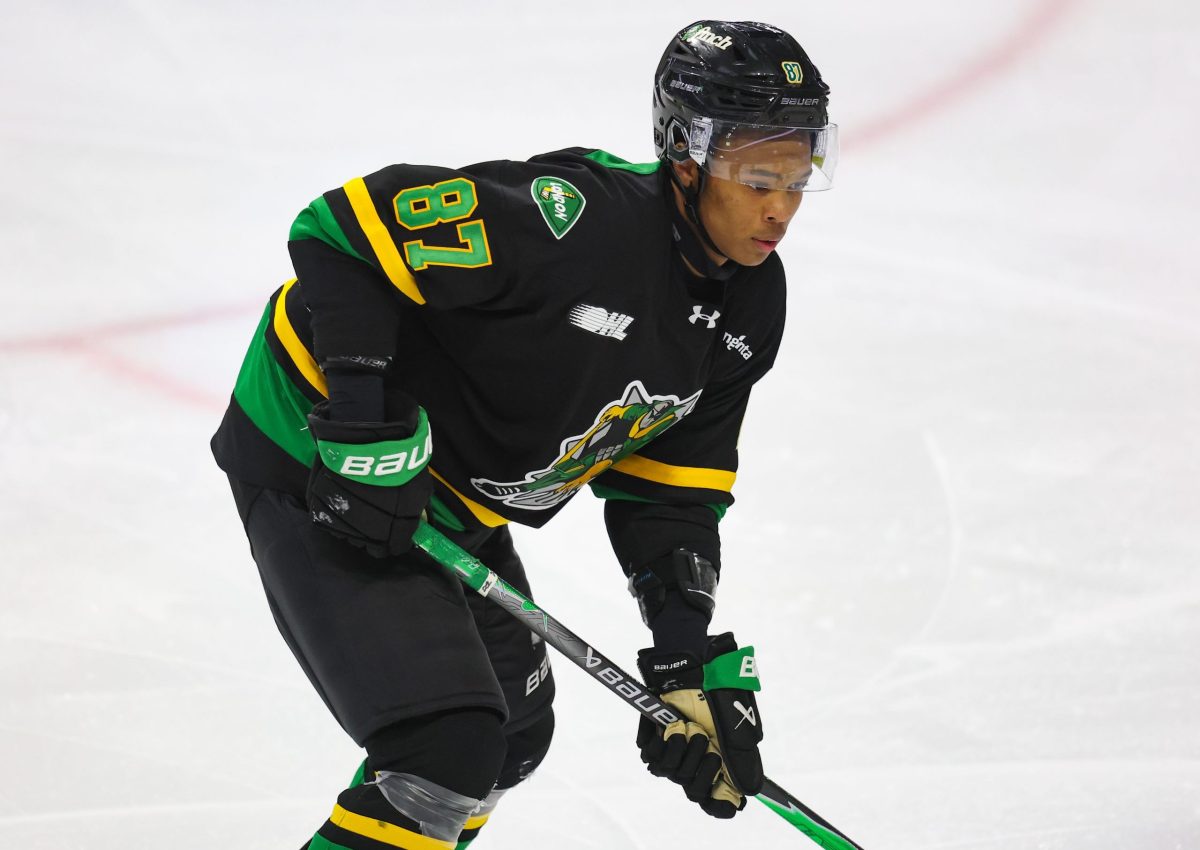
Jaxon Cover
2026 NHL Draft Eligible
Position: LW, Shoots: L
H/W: 6-foot-1, 185lbs
Date of Birth: 2008-02-13
The hockey journey of Jaxon Cover and how he arrived at this point is nothing short of remarkable. Born in Miami and raised in the Cayman Islands, located in the Western Caribbean about 277 kilometers south of Cuba, Cover’s path to the game is both unique and inspiring. Growing up in a region not traditionally known for producing hockey players - with just a single rink in the entire country, built for roller hockey, not ice hockey. Jaxon grew up playing soccer and inline roller hockey, he did not start playing organized ice hockey until the age of 14, when his family moved to Canada.
Cover split his time playing minor hockey with the York-Simcoe Express while also attending St. Andrew’s College (SAC), a prep school located in Aurora, Ontario, north of Toronto. His skating and processing ability attracted the likes of the London Knights to select Cover in the fourth round of the 2024 OHL Draft. Cover spent last season playing at the U18 level with St. Andrew’s College, where the environment proved highly beneficial to his development. The structure of the program allowed him additional time to focus on his game, accumulate valuable repetitions, and continue building strength off the ice. This foundation has played an important role in accelerating his overall progression. After his season with St. Andrew’s concluded, he made three appearances with the Knights, recording two assists. This season, Cover has established himself as a key contributor to the Knights and has seen his stock rise significantly on NHL Draft boards. He possesses a lot of raw skill, most notably his skating ability and competitiveness are traits that immediately stand out when watching him play. While there are still areas of his game that require refinement, he projects as a longer-term development player. However, when placed in the right environment with proper patience and development support, his combination of skating, work ethic, and hockey IQ — especially given his unique path — makes his ceiling well worth the investment.
Skating
What makes Jaxon’s development particularly unique is that, despite only beginning organized ice hockey roughly four years ago, skating has already become one of his standout attributes — a strength that can largely be credited to his background in roller hockey. You can see elements of his roller hockey background in his glide, as his stride resembles that of a roller skater. Cover tends to generate power more through his knees than his hips — a technique likely developed from his time playing roller hockey. Cover has excellent physique and plays with a high end motor, averaging about 16 minutes of time on ice per game. As he continues to add strength particularly in his lower body, it should further enhance key areas of his skating.
Cover possesses a smooth skating stride and displays strong shiftiness with the puck, attributes that can be largely credited to his background in inline roller hockey.
On this play, Cover, acting as the primary forechecker, angles the play wide to force the failed dump-in. Recognizing that London has regained possession, he swings wide, using efficient footwork, needing minimal crossovers to pivot and reach top speed. His combination of skill with the puck and footspeed allows him to attack defenders one-on-one to generate high danger scoring opportunities.
To expand further, Cover is at his best when he is able to build speed through the neutral zone. In this sequence, he collects the puck with pace and displays strong acceleration, using quick crossovers to generate momentum through the middle of the ice. As the defender gaps up, Cover transfers his weight to efficiently explode wide, creating separation and an odd-man situation inside the offensive zone.
On the ice, Cover is in constant motion, defenders need to be wary of his speed if they decide to pinch or retrieve a loose puck.
GRADE: 55
Shot
At the conclusion of his first full OHL season, Cover experienced a learning curve but maintained a solid level of consistency throughout. He started the year strong, averaging 2.6 shots per game while recording 12 points in his first 15 games, before hitting a mid-season lull. He regained form down the stretch, averaging close to 2.5 shots per game and posting 16 points over his final 15 games. Overall, Cover led all Knights forwards with 160 shots on goal, 23 more than the next closest teammate. Analyzing his shot mechanics, Cover does not possess an overpowering shot but gets the release off quick. While primarily a playmaker, Cover demonstrated flashes of his goal-scoring ability, finishing with 20 goals in his first full OHL season.
Cover scoring by elevating his shot.
Cover has been effective in the bumper for London as he needs little time to get his shot off when positioned net front. He can slide out to become the one-time option or find a way to get his stick on rebounds to cash in on second chance opportunities.
A couple of examples of Cover finishing plays off with his good backhand.
GRADE: 52.5
Skills
One of the more intriguing aspects drawing scouts to Cover’s game is his raw skill set. What makes him a possible ‘under-the-radar’ type prospect is the collection of tools he possesses that have yet to be fully refined. The value in a player like this lies in the potential — if an organization can effectively develop and harness those raw abilities, there is a greater opportunity for him to evolve into an impactful contributor at the next level. The London coaching staff were able to untap some of Cover’s raw skillset by utilizing him in favourable situations and closely monitoring his development. Cover has shown very quick progress in learning how to use his body to create leverage, while also demonstrating the ability to beat defenders one-on-one with both his hands and footwork.
Cover can snap the puck quickly, as the season progressed he showed improvement in manipulating his hands to change shooting angles, allowing him to get shots off in tight spaces.
Cover is starting to put it together, understanding how to effectively combine his skating and skill to beat defenders.
His size and raw power is another asset Cover is starting to piece together. He is learning how to leverage his size more efficiently.
Cover developed his shiftiness on the ice through his background in roller hockey. Whether it’s his lateral movement, ability to play pucks in his feet, or his hands in one-on-one situations, he consistently shows creativity and control in tight areas.”
GRADE: 57.5
Smarts
Considering Cover did not begin playing organized ice hockey a few years ago — and had to learn a few fundamental rules such as offsides and icing, which are not present in roller hockey — his progression speaks highly of his hockey IQ. His ability to quickly process and adapt to the game highlights how rapidly he is learning and developing. He credits much of his shiftiness and decision-making to his inline roller hockey background, where the smaller playing surface, slower pace, and reduced number of players demand quick reads and creativity in tight spaces. Cover processes the game well, consistently scanning the ice to find teammates or anticipate his next move. Cover’s progression throughout the season has earned him increased opportunities at even strength, along with a key role on the Knights top power-play unit. As a skilled, playmaking power forward, he is often relied upon for zone entry, extending possessions and creating offence off the cycle. Coach Dale Hunter has been more selective with Cover’s defensive deployment, limiting his exposure in defensive-zone matchups and not utilizing him on the penalty kill. Moving forward, continued refinement of his defensive details and consistency away from the puck will be key in earning greater trust and transitioning into a more complete player at higher levels. Cover is showing improved timing in his routes into space, more consistently finding open ice to create quick offensive opportunities and stretch defensive coverage.
You’ll have to bear with the clip, as Cover and his defender move in and out of frame on this sequence. While he does not score, this play stands out due to his constant foot movement, which he uses to manipulate the penalty-kill structure and eventually find open space in the slot.
A nice quick play here by Cover leads to the London goal.
After a quick scan of the ice, Cover leaves a subtle drop pass for his teammate leading to the goal.
A nice play on the zone entry here by Cover drawing in three defenders and dishing the puck out to Sam O’Reilly alone in the slot.
Cover makes a number of strong plays in the defensive zone here to disrupt passing lanes to end the Windsor cycle. He competes to win puck battles down low and use his feet to exit the zone relieving any sort of pressure.
Given how quickly he has progressed as a hockey player to this point, parts of his decision making with the puck still need time to catch up - particularly his reads in the offensive zone. Recognizing when to take defenders on versus when to move puck on entries. He will need to learn to play more assertively in certain situations, understanding when he can exploit quick looks or have to maintain possession down low until more support arrives.
GRADE: 55
Physicality/Compete
Cover’s physique and strength are certainly still very raw at this stage of his development. Listed at 185 lbs, Cover has a lean, athletic build. The goal for this summer should be to add on mass and strength. A productive offseason focused on strength training will benefit multiple areas of his game, particularly his skating. Added strength should help improve his balance and mobility, translating to winning more puck battles. Cover’s physical presence on the ice remains inconsistent. His agility allows him to slip out of checks and avoid contact.
A strong, competitive shift by Cover. Starts with the zone entry dump-in, followed by winning back possession of the puck, attacking the middle of the ice before distributing out for a point shot to then regain possession below the dots in the offensive zone creating a second chance opportunity.
Cover on the receiving end of a heavy hit by Brady Martin but does a good job to move the puck to retain possession in the offensive zone.
A strong committed backcheck — applies pressure without taking a penalty and eliminates any shot opportunity.
Cover has the athletic frame to add muscle, and continued physical development will be important. A key area of his development will be becoming harder to play against — limiting instances where he is outmuscled on pucks.
GRADE: 50
OFP: 54.25
A note on the 20-80 scale used above. We look at five attributes (skating, shooting, puck skills, hockey IQ and physicality) for skaters and six for goalies (athleticism/quickness, compete/temperament, vision/play reading, technique/style, rebound control and puck handling). Each individual attribute is graded along the 20-80 scales, which includes half-grades. The idea is that a projection of 50 in a given attribute meant that our observer believed that the player could get to roughly NHL average at that attribute at maturity.