


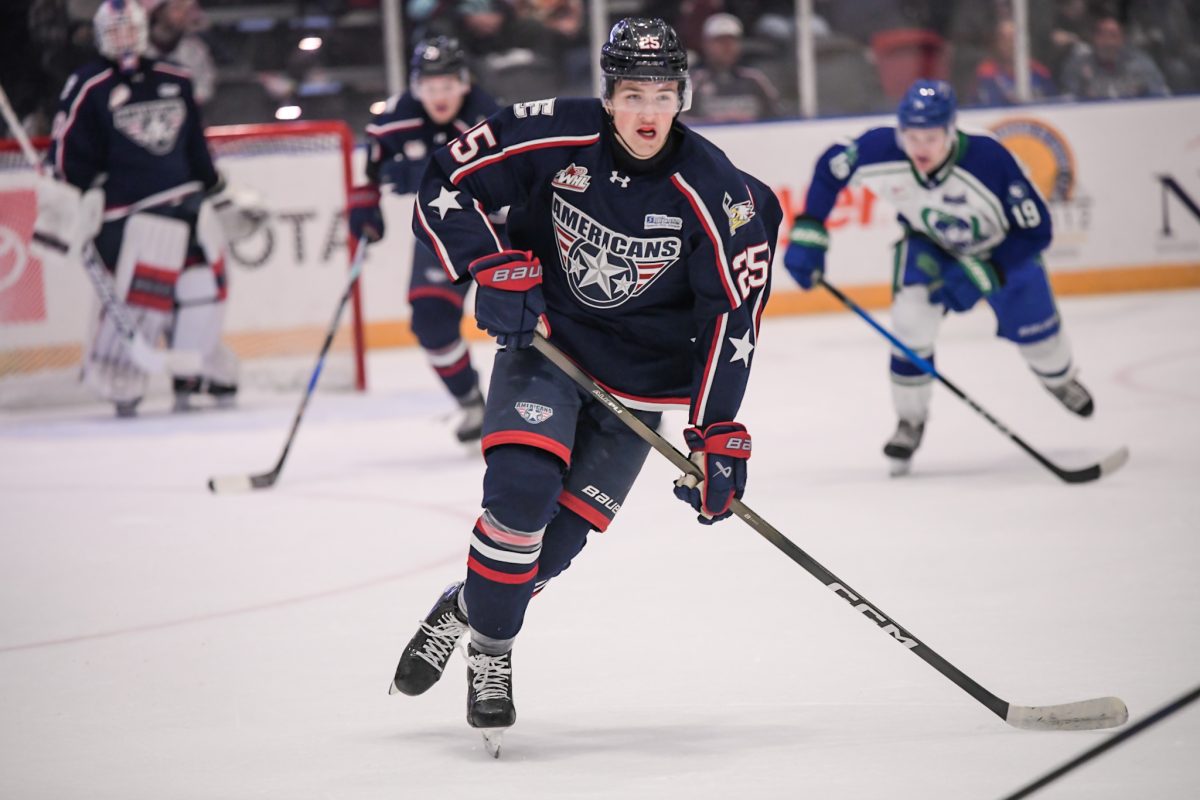
Position: D, Shoots: L
H/W: 6-foot-2, 203 Pounds
Date of Birth: 2008-02-25
Ranked 32nd overall in our final draft ranking, Jakub Vanecek endured a successful rookie campaign in his first season playing in North America. Selected in the first round of the 2025 CHL Import Draft, by the Tri-City Americans, the Czech blueliner immediately slotted right in top the team’s top-four and led their blueline in scoring, collecting an impressive 14 goals and 21 assists in 59 games this season. He also finished tied for third in goals among all first-time eligible defenders. He was also selected for the WHL Top Prospects Game that was held back in February. Internationally, Vanecek already boasts a strong international resume, having represented Czechia at the Under-17 World Hockey Championship and the Hlinka Gretzky Cup this past summer. He was also the only 2008-born player to make his country’s World Junior team and had an impactful Under-18 tournament, notching three goals and two assists in seven games.
Vanecek is a well-rounded defenceman that possesses a wide range of tools to be an effective defenceman at the professional level. At 6’2”, his height falls right in line with the current NHL trend of drafting size along the blueline, and his mobility and anticipation enable him to create advantages at both ends of the ice. He confidently leads plays out of his own zone, using his mobility and awareness to go blueline-to-blueline consistently, and even flashing the occasional give-and-go play to gain the zone. Away from the puck, he is a keen activator that reads developing plays well. He knows when to join the attack in transition or move down the offensive blueline to make an aggressive pinch or look for a back door scoring opportunity. He has a great eye for slipping into pockets of space when supporting the rush and will drive the puck to the net if he recognizes an open lane.
Defensively, Vanecek can be a clinical play stopper when he’s on his game, with his transitionplay standing out the most. He proactively establishes gaps through the neutral zone, uses timely poke checks to knock pucks off attackers, and jumps into lanes to disrupt passes. In his own zone, he maintains good positioning but could add more aggression when he’s defending down low, and he could afford to scan more when defending a sustained cycle or retrieving a puck. Even when mistakes occur, his motor allows him to recover quickly, often resetting play before issues can compound. That reliability, paired with his versatility, earned him trust in a variety of roles, including both special teams and key late-game situations.
Overall, Vanecek offers a versatile and well-balanced profile that should make him worthy of selection in the top two rounds. Between his willingness to get involved in the attack without overcommitting and his effectiveness in denying play when it goes the other way, there is a lot of runway to grow and develop his game at both ends of the ice. He projects to be an effective bottom-four defenceman, but adding more physical elements to his defensive game and refining some habits could really help him push
Skating
Vanecek moves well for size. His strides lack explosiveness, but he’s able to build speed which enables him to separate from forecheckers and carry play up ice confidently. His use of crossovers is another component of what makes him successful in transition, allowing him to navigate traffic, slip past forecheckers, and drive play into the offensive zone with control. Adding more east-west movement as a pack carrier would make him a more effective carrier as he continues to develop his game at higher levels.
Because he’s not the most aggressive defender, Vanecek’s skating ability drives his success in killing plays. He’s really efficient in his movements, mirroring the footwork of opponents to maintain tight gaps, taking away passing lanes, and steering plays to the outside. His footwork allows him to recover when needed when guilty of a turnover or positioning error, using quick pivots and edgework to track back, close space, and eliminate scoring threats.
Vanecek showcases some nice straight line speed starting this breakout, as he passes out wide and accelerates through the neutral zone.
Another example of Vanecek’s straight line skating, as goes end-to-end off the retrieval and gets a backhand shot off.
Vanecek corrals a loose puck at center and takes a crossover-heavy route to accelerate past a lone defender and drive the net.
A small montage of clips from the same game highlighting Vanecek’s agility and lateral movement, which is what makes him a disruptive neutral zone defender.
Grade: 55
Shot
Vanecek is a calculated shooter with a surprisingly diverse arsenal of releases in his toolkit. From the point, he shows a strong ability to navigate layers of traffic, consistently finding lanes and getting pucks through to the net. Rather than leaning heavily on a big one-timer, he favors a quick snapshot with minimal setup to catch defenders and goaltenders before they can fully react. That said, he can uncork a heavy one-timer when needed, and he can generate velocity without requiring a lengthy windup.
When attacking downhill, he displays the ability to pick corners, often beating goaltenders cleanly to the far side with well-placed attempts. One of the more unique aspects of his shooting ability is how comfortable he is on his backhand. It’s not uncommon for him to use it when driving pucks below the dots and generate offence off the rush.
Vanecek beats the goalie off the rush with a quick outside-leg wrister.
A pair of snapshots that find the back of the net through heavy traffic, including a clutch 6-on-5 game-tying goal in the final minute of the third period.
Another clutch goal from Vanecek, as he one-times a shot from the right point to give Tri-City a late lead in the third period.
Vanecek made a quick move to his backhand after activating up the middle to beat the goalie in tight.
Grade: 52.5
Skills
Vanecek is an effective offensive player, but lacks the creativity and deception that separates him from other puck-moving defenceman in this draft. He tends to take linear routes attacking up ice, relying more on skating than manipulation to generate advantages. Despite how frequently he’s involved in the play and handling pucks in the offensive zone, he doesn’t consistently lean on his hands to make plays. There are flashes, but his primary method of beating pressure is through his mobility.
Vanecek’s pass reception skills are a clear strength. Operating within a give-and-go heavy approach through the neutral zone, he handles passes seamlessly without breaking stride to keep play moving up ice. As noted in his shooting profile, his comfort on the backhand adds another layer to his skill set. He’s capable of driving the puck to the net using either side of his blade and making plays in tight, offsetting some of the predictability he has when advancing play out of his own end.
Vanecek manages to slip through a pair of defenders with some quick handles and tries to drive the net but settles for a wide backhand shot.
One of the more creative sequences you’ll see from Vanecek. He fakes a backhand pass to his teammate, turns to escape an overextended forechecker, and chips a puck to himself to escape a second check before his clearance attempt hits his teammate.
Vanecek pinches down the center point with a nice move to get around a high forward.
Grade: 50
Smarts
One of Vanecek’s most impressive tools is his anticipation and timing across three zones. He exhibits a strong understanding of finding space and being in good position to corral a return pass without slowing down the play, and uses the middle lane with confidence every time he skates the puck up ice. Vanecek is a decisive yet cunning activator who frequently follows up connected outlet passes with eager movement up ice in anticipation for a transition give-and-go or to simply add another supporting layer to the attack. He uses the weakside effectively to generate opportunities from dangerous areas and isn’t afraid to use the middle of the ice as a carrier in transition or as a trailer off the rush. It’s rare to see him make a bad read in his desire to contribute offensively.
Vanecek’s defensive instincts have improved a lot of over this season. Earlier on in the season, he was guilty of ill-advised pinches and converging prematurely on perimeter attackers through the neutral zone. As he continued to develop, he started to leverage his agility to stand up plays along his own blueline and utilize an active stick to knock pucks away. He’s capable of linking defensive stops into quick counterattacks up ice, and there are sequences where his ability to recover on a play stands out after engaging offensively. While Vanecek can show good poise and manage pucks well under pressure at times, he still needs to work on scanning more frequently on retrievals, as he can struggle to map out pressure and make avoidable turnovers. Refining these details will be important in elevating the reliability of his game, which can make for a better projection.
Vanecek gets to the middle on this breakout and then works a give-and-go with a teammate along the near wall, capping off the play with a quick outside-leg release off the far post and in.
Vanecek pinches down the far wall on this cycle, and orchestrates a nifty give-and-go, leading to centring pass from behind the goal.
Vanecek anticipates this breakout and makes a smart pinch to intercept this breakout inside the blueline, followed by a rotation up to the point where he finds the back of the net.
These three sequences (separated into two videos) encapsulate Vanecek’s 200-foot effectiveness when at the top of his game, combining an intense motor, adaptability, and instinctive activations to create advantages at both ends of the ice. In the first one, he jumped up into the attack and powered his way to the net on his backhand, and then hustled back to kill the counterattack at centre ice. On the second sequence, he steals the puck off a wide attacker and goes blueline-to-blueline. On the third play. he harasses a high attacker into a turnover to create a counterattack, jumps up to support the rush, and crashes the net for a goal.
Missed scanning opportunities cost Vanecek on a pair of defensive zone retrievals in this clip. On the first he struggles to corral the puck and forces a play up the far wall right to a pinching forechecker. He gets a little luckier on the second clip, as he scans left and tries to shovel the puck along the end boards but misses it and gets checked into the corner. His partner comes in to bail him out which leads to a successful breakout.
An early-season example of a positioning misread from Vanecek (top of the screen), as he poorly times this crossover at the defensive blueline and easily concedes this zone entry, leading to a scoring chance.
Grade: 55
Physicality/Compete
Vanecek’s physical play and compete level can be a bit understated in the way he plays. His contact game is rooted in using body positioning to seal guys along the walls and hold defenders to the outside when they’re trying to work the cycle rather than imposing himself physically. He avoids unnecessary contact and rarely steps to engage opponents. Most of his defensive game is centered around his skating ability and well-timed stickwork. While this is effective at this level, it could limit his ability to be a more disruptive defender against stronger and more mature competition.
Where Vanecek makes up for his lack of physical play, he makes up for it with his compete level, which may be the most underappreciated aspect of his game. He will maintain the same motor and work ethic, regardless of his shift length or game situation. His best sequences are when he leverages mobility to break up plays on the backcheck, going for a full-on sprint to cut off attackers and tie them up with a hefty push or a timely poke check. When he commits a turnover, he aggressively chases down the play and regularly recovers possession to turn play up ice again.
It’s this combination of effort and mobility that underpins his effectiveness, but adding a more assertive dimension would enhance his defensive impact and make him more difficult to play against.
An excellent display of Vanecek’s compete level, as he hustles on the backcheck and disrupts the attack on three separate shifts in the same game. He even draws a penalty on the second one.
Nearing the end of a two-minute shift, Vanecek throws this puck to an open wing, but he works to recover the puck back, pinning an opponent to the wall, pivoting off a second forechecker, and poking the puck to a teammate.
A small montage of Vanecek’s physical play, closing attackers off along the boards and playing the body down low.
Another example of Vanecek recovering from his own misplay. After getting checked at the blueline, he tracks back and puts himself in position to block two slot chances with his arm and skate respectively before regaining the puck and exiting the zone.
I really like Vanecek’s poise and proactive physical details on this defensive zone retrieval. He shoulder checks to map the forechecker, turns his body, and throws a reverse check to establish body positioning while handling around a second layer of pressure to escape out of the corner to start the breakout down the middle.
Grade: 55
OFP: 53.75
A note on the 20-80 scale used above. We look at five attributes (skating, shooting, puck skills, hockey IQ and physicality) for skaters and six for goalies (athleticism/quickness, compete/temperament, vision/play reading, technique/style, rebound control and puck handling). Each individual attribute is graded along the 20-80 scales, which includes half-grades. The idea is that a projection of 50 in a given attribute meant that our observer believed that the player could get to roughly NHL average at that attribute at maturity.