


Points or Categories?
At first glance, Ivan Demidov versus Cutter Gauthier might seem like a relatively straightforward dynasty decision. Demidov is one of the most gifted young offensive players in hockey and possesses the type of high-end skill that makes it easy to envision him developing into a perennial point-per-game player. Gauthier has already established himself as an excellent NHL scorer, but if we're simply asking which player has the greater pure offensive ceiling, I think the answer is Demidov.
Fantasy hockey, of course, isn't always that simple. Once we move beyond points and start accounting for goals, shots and peripheral categories, the gap begins to close quickly. This is where the distinction between the player with the greater offensive ceiling and the player with the more complete fantasy profile becomes particularly important.

The Case for Demidov
There is plenty of evidence supporting the idea that Demidov can become an elite offensive player. His rookie season offered a tantalizing glimpse of what is coming, particularly because the production came without especially favorable deployment. Demidov averaged only 15:30 per game, fifth among Canadiens forwards behind Nick Suzuki, Juraj Slafkovsky, Cole Caufield, and Phillip Danault. He also spent much of the season alongside Oliver Kapanen, who is a perfectly fine young player, but probably isn't the type of offensive linemate who is going to maximize Demidov's production. Despite all of that, Demidov produced 62 points in 82 games.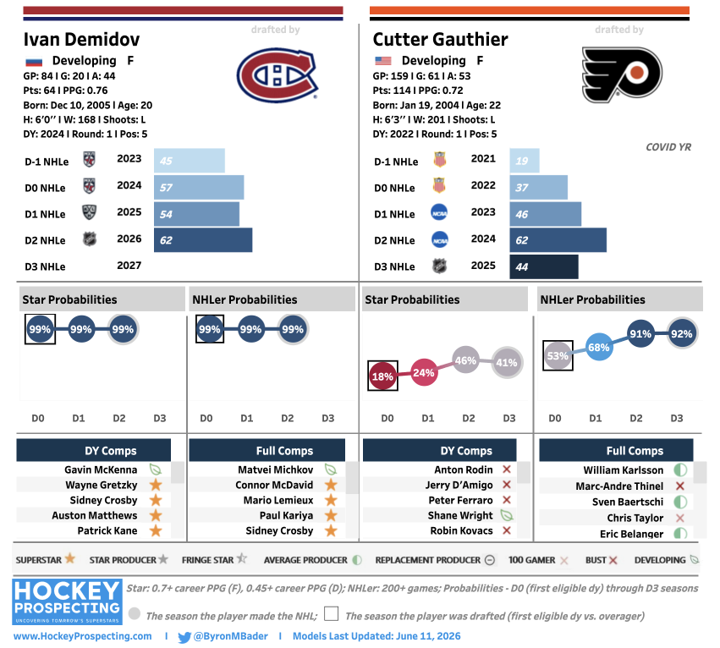
That makes the potential for a sophomore jump particularly intriguing. Demidov is already producing at a high level while playing under 16 minutes per night, and there is an obvious path toward substantially more ice time. More even-strength minutes with Montreal's better offensive players, combined with an expanding power-play role, could create a significant increase in production even without Demidov becoming dramatically better individually.
Hockey Prospecting provides perhaps the strongest argument for Demidov's long-term ceiling. Byron Bader's model uses historical scoring development and NHL equivalency to identify players whose trajectories resemble previous NHL stars, and Demidov has been an absolute darling of the model. His star probability has remained at 99% throughout his tenure in the model. His NHLe progressed from 45 in his D-1 season to 57 in his draft year, 54 the following season, and 62 in the NHL. The model's comparables are almost comical, including Connor McDavid, Mario Lemieux, Paul Kariya, Sidney Crosby, Patrick Kane, and Auston Matthews. Obviously, that doesn't mean Demidov becomes one of those players, but it illustrates just how unusual his historical scoring profile has been.
The contrast with Gauthier is striking. At the same stages, Gauthier's Hockey Prospecting star probabilities were 18%, 24%, 46%, and 41%. The model clearly underestimated what Gauthier would become, which is important context, but Demidov entered the NHL with a substantially stronger historical offensive projection. That makes this battle particularly interesting: Demidov has the superior statistical projection, while Gauthier has already demonstrated an ability to outperform his.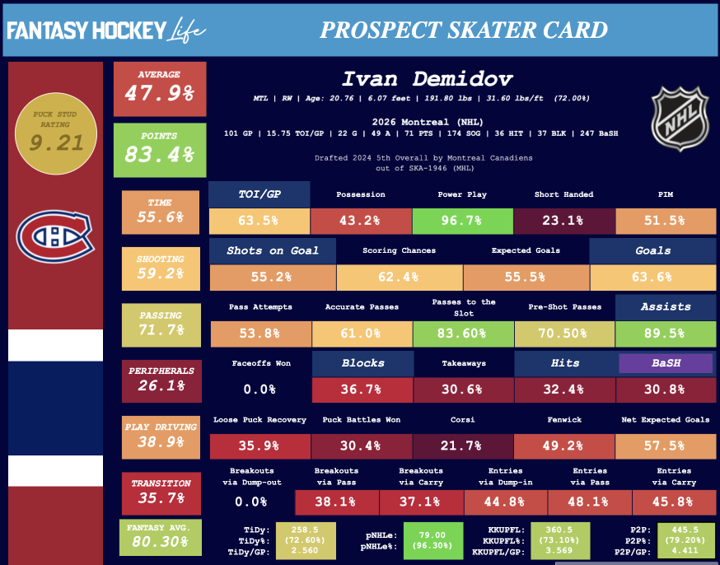
The Fantasy Hockey Life skater card reinforces the offensive argument while also showing where Demidov's fantasy limitations may lie. His points profile sits in the 83rd percentile, passing in the 72nd, and assists in the 90th. His estimated pNHLe is even more impressive at 79, in the 96th percentile. The passing details are particularly encouraging, with passes to the slot in the 84th percentile and pre-shot passes in the 71st. This looks like a player capable of becoming the primary creator on an NHL scoring line.
Evolving-Hockey's results provide another layer of support. Despite relatively modest even-strength usage, Demidov finished in the 87th percentile overall and 84th percentile offensively, generating substantial positive value at both even strength and on the power play. That combination of strong results and limited deployment may be one of the most compelling parts of his profile. He was already this effective without receiving the minutes or linemates we would normally associate with a team's premier offensive player.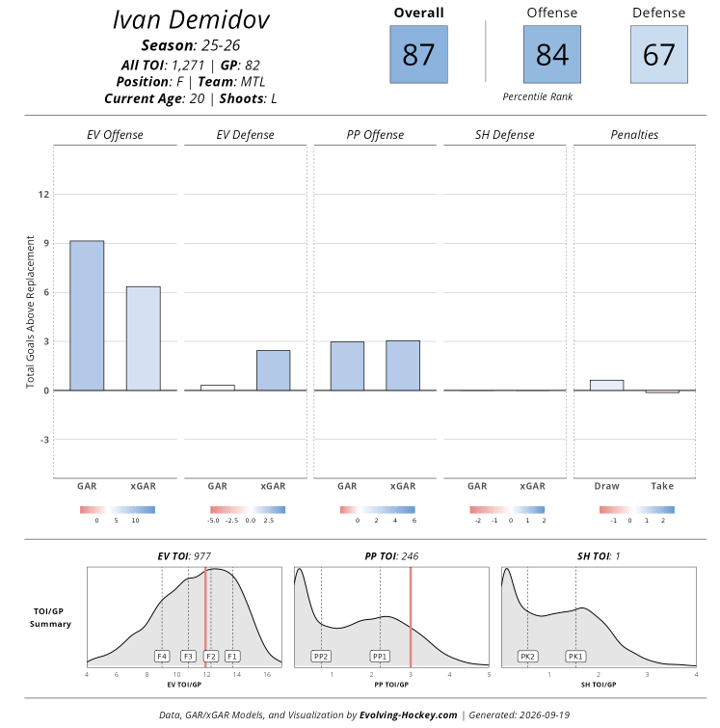
The weakness is also pretty obvious, and it matters for this particular comparison. Demidov's Fantasy Hockey Life card places his peripherals in only the 26th percentile, including hits in the 32nd percentile and blocks in the 37th. His shot generation is more middle-of-the-pack, with shots on goal in the 55th percentile. That's not necessarily a problem for Demidov as a player, but it matters enormously when comparing him with Gauthier in multicategory fantasy leagues.
Montreal should provide the environment necessary to maximize Demidov's strengths, and there is still considerable low-hanging fruit simply in his deployment. The Canadiens are assembling an impressive young offensive core, and Demidov should eventually move well beyond 15:30 per game while receiving more opportunities alongside Montreal's best offensive players. If we're simply projecting future points, Demidov is the player I expect to win this battle. The question is whether he can win it by enough to overcome what Gauthier provides everywhere else.

The Case for Gauthier
Gauthier's argument becomes much stronger once we stop treating fantasy production as synonymous with point production. He scored 41 goals and 69 points in 76 games last season while generating 285 shots on goal, and that combination immediately gives him a different fantasy profile than Demidov. I expect Demidov to eventually produce more points, but I also expect Gauthier to score more goals and probably take considerably more shots. The question is how large those gaps become.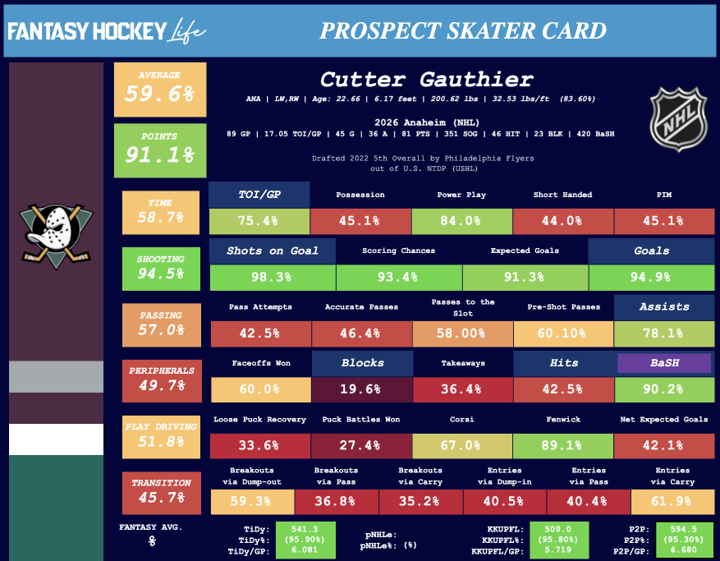
The Fantasy Hockey Life skater card illustrates just how extreme Gauthier's shooting profile has become. He ranks in the 95th percentile for shooting, 98th for shots on goal, 93rd for scoring chances, 91st for expected goals, and 95th for goals. His overall points profile is already in the 91st percentile. This isn't simply a player who happened to score 41 goals. Nearly every underlying measure associated with generating goals supports what we saw in the box score.
Evolving-Hockey tells much the same story. Gauthier finished in the 94th percentile offensively, with enormous positive impacts in both even-strength goals above replacement (GAR) and expected goals against replacement (xGAR) and additional value on the power play. Interestingly, the defensive results were poor, with an 18th-percentile defensive rating, so I wouldn't make his two-way game a major part of the argument. The stronger case is that his offensive results were legitimately dominant and supported by the underlying process.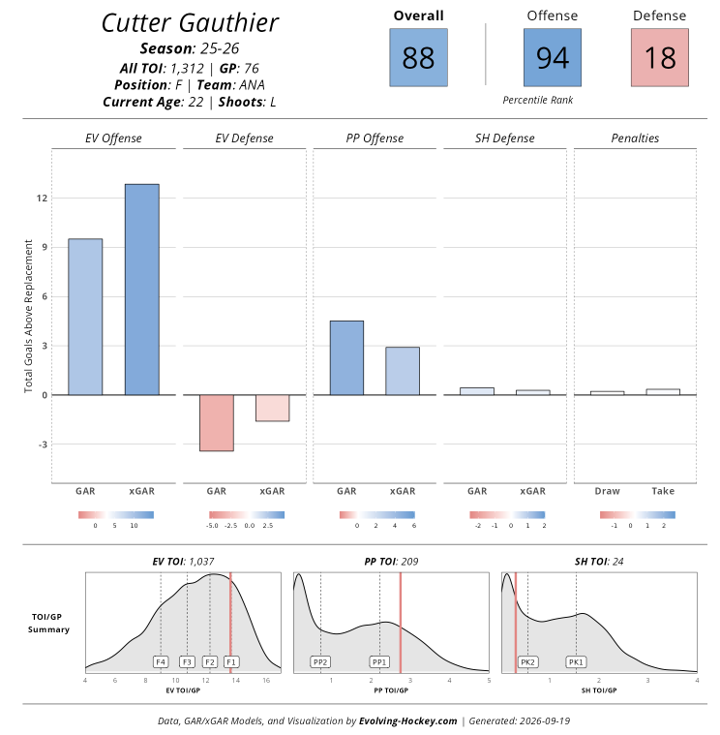
There may still be some room for his environment to improve as well. Gauthier averaged 17:15 per game, fourth among Ducks forwards, so unlike Demidov, there isn't an enormous amount of obvious untapped value simply from adding several minutes of ice time. He also already received 2:48 of power-play time per game, producing 19 power-play points, including 11 goals. His most common linemates included Beckett Sennecke and Mason McTavish, talented young players but not necessarily linemates who have already reached their offensive peaks. As Anaheim's young core matures, the quality of the environment around Gauthier could improve even if his deployment doesn't change dramatically.
The bigger question for me is how much higher Gauthier's goal production can realistically go. Forty-one goals at age 22 is remarkable, but once a player is already scoring 40, projecting another enormous leap becomes difficult. Fifty is certainly possible with this shot profile, but I wouldn't build my dynasty valuation around Gauthier suddenly becoming a perennial 50-goal scorer. What matters more is that the underlying numbers suggest he has a legitimate chance to remain a high-volume, high-end goal scorer.
And the shots provide an enormous fantasy floor. Goals can fluctuate with shooting percentage, linemates, and puck luck, but a player who generates nearly four shots per game continually creates his own opportunities. Even if Gauthier falls from 41 goals into the mid-30s in a particular season, 280-plus shots remain extremely valuable in most multicategory formats.
His category profile isn't perfect. The Fantasy Hockey Life card puts his overall peripherals around the 50th percentile, with hits in the 43rd percentile and blocks in only the 20th. So this isn't really a traditional multicategory monster who piles up hits and blocks. The category advantage over Demidov is much more specific and, arguably, more valuable: goals and shots.
That's ultimately the strongest case for Gauthier. Demidov may become the superior point producer, and I expect him to be. But Gauthier doesn't need to beat Demidov in points. If he can remain reasonably close while annually threatening 40 goals and 300 shots, Demidov may need a fairly substantial points advantage to overcome what Gauthier provides in those categories.
The Battle
This ultimately comes down to what we're actually trying to predict. If the question is which player I expect to score more points at his peak, I'm taking Demidov. Hockey Prospecting strongly supports that conclusion, the scouting supports it, and his rookie NHL results only strengthen the argument. Perhaps most importantly, he accomplished what he did while averaging under 16 minutes per game and spending much of his time with Oliver Kapanen. There is considerable room for his production to grow simply through increased ice time and better deployment.
Gauthier presents almost the opposite case. There is less projection required because so much of what we're hoping for has already arrived. He scored 41 goals and generated 285 shots at age 22, and both Fantasy Hockey Life and Evolving-Hockey suggest the underlying process supports that production. I expect Gauthier to score more goals than Demidov and take substantially more shots. I'm just not sure how much higher his production can go from here. He already averaged 17:15 per game, received significant power-play time, and scored 11 power-play goals.
That creates the central question in this battle: How many more points does Demidov need to score to overcome Gauthier's advantages in goals and shots?
If Demidov becomes a 100-point winger while Gauthier settles around 75 or 80, the answer is probably easy. Demidov creates enough separation in points that the category advantages become much less important. But what if Demidov scores 90 and Gauthier scores 80? Or 95 versus 85? If Gauthier is simultaneously scoring 40-plus goals and approaching 300 shots, that gap becomes much harder to overcome in a multicategory league.
That's what makes the comparison so interesting. Demidov has more obvious untapped offensive upside. His historical projection is better, his deployment can improve substantially, and I expect him to become the superior point producer. Gauthier, however, has already demonstrated an elite fantasy skill that Demidov may never match: extremely high-volume goal and shot production.
The answer therefore changes with the format. In a pure points league, I don't need to think very hard about it. Demidov is my player. But once goals and shots become independent categories, Gauthier doesn't need to match Demidov point for point. He just needs to stay close enough.
The Verdict
In a points-only dynasty league, I'm rostering Ivan Demidov. His prospect profile is exceptional, Hockey Prospecting overwhelmingly favors his long-term offensive trajectory, and his rookie season becomes even more impressive when considering his relatively limited ice time and less-than-ideal linemates. I believe he ultimately has the higher point-producing ceiling, perhaps substantially higher.
In a multicategory dynasty, however, I'm rostering Cutter Gauthier.
The distinction isn't really about Gauthier providing value everywhere. His peripheral profile is actually fairly ordinary. It's about two categories that can be enormously valuable in fantasy: goals and shots. Gauthier has already demonstrated 40-goal ability and elite shot generation, and the underlying numbers suggest both are supported by the way he creates offense.
Demidov may eventually score 10, 15, or even 20 more points than Gauthier. At some point, that difference becomes large enough that I'd prefer Demidov regardless of format. But if Gauthier remains within striking distance while providing substantially more goals and something approaching 300 shots, I prefer his profile in the multicategory leagues I play.
If I'm forced to choose one without knowing the league settings, I'll still take Gauthier, but it's closer than I initially thought. Hockey Prospecting is probably the strongest argument against that decision. Demidov's historical offensive profile is extraordinary, and unlike Gauthier, there is still a considerable amount of obvious production to unlock through increased ice time and better deployment.
That's what makes this battle so compelling. Demidov is the player I expect to score more points. Gauthier is the player I expect to score more goals and take more shots. How your league rewards those differences should determine which one you want.