


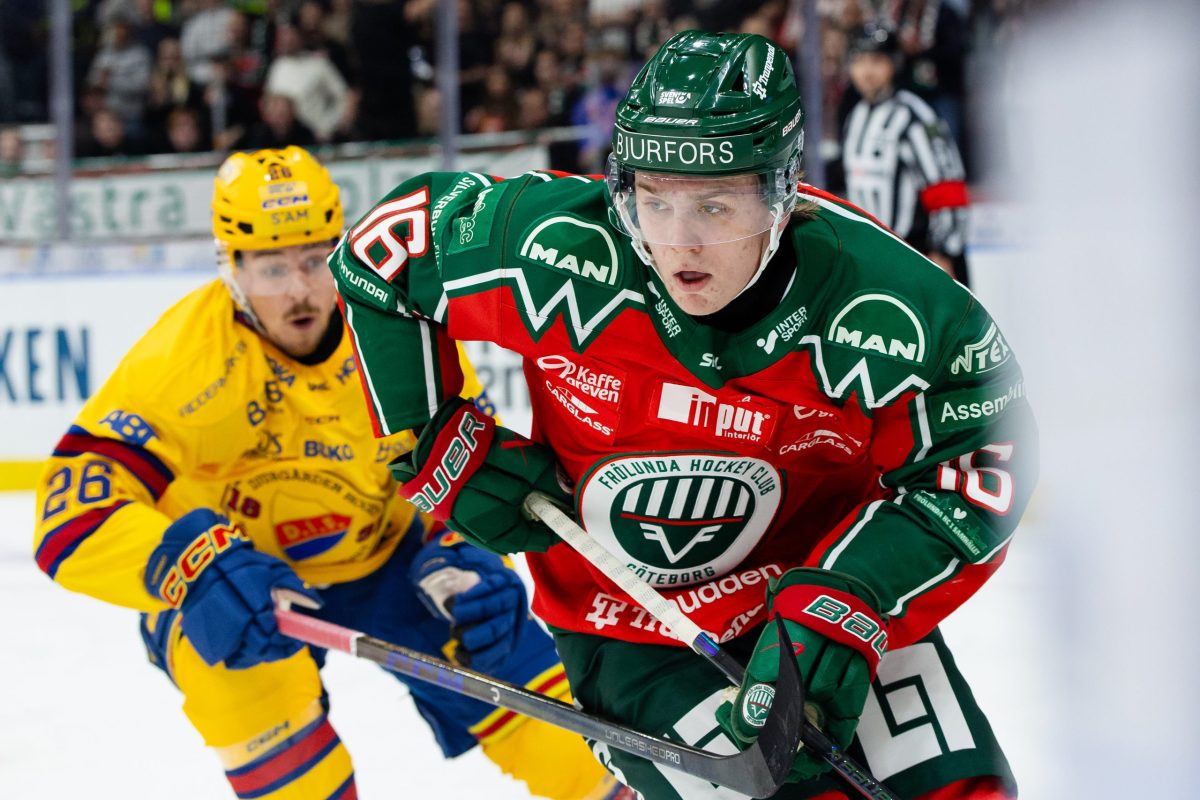
Photo: Michael Erichsen
Bosse Meijer - C, Frolunda HC (SHL)
5' 10" 168 lbs, Shoots: Left
Meijer is the next high-profile name in the long lineage of Frolunda-developed prospects. He has drawn comparisons to Gabriel Landeskog his entire hockey life and, playstyle-wise, it matches pretty well. He’s a fierce competitor who never backs down from a challenge. He’s willing to risk his body for the puck. He’s a leader who leads by example and, as played out as this cliche is, he’s got that dawg. He enamored himself to me pretty quickly when I first saw him play at the WHC-U17 in 2024 for that same reason. Now, in his draft year, he’s locked down a full-time gig with Folunda’s senior team and has put up the points while showing off the best parts of his game.
The most impressive part of Meijer's game in the early season has been his play away from the puck. He plays a strong and committed two-way game and fights tooth and nail to win battles along the wall. He’s physical, though not overpowering. His physical strength may never be overwhelming at the NHL level, but his tenacity and board-play habits makes up for it. Meijer plays with a ton of pace. He’s always scored in buckets at the junior level, but it’s pleasantly surprising how well his offensive game has translated to higher levels. He’s already adept at playing an off-puck offensive game. He attacks the middle on the rush and locates and makes quick, well-timed cuts into soft ice for scoring chances. He’s very skilled and thinks fast with the puck and can get around sticks and bodies in tight spaces.
There are things about Meijer that could hurt his draft stock - some within, and some outside of his control. For starters, there’s his lack of size as a pivot. While his playstyle makes up for it, there will always be GMs and evaluators who will overlook him because his height in feet starts with a 5. Something he can control (and will likely settle down over time) is not skating into more pressure than he can handle and turning the puck over. His decision making with the puck is usually very good, but it happens at least once per game from what I've seen. A touch more explosiveness to his first few strides wouldn’t hurt either, despite his already fast and quick skating. Nitpicky stuff, but it’s what we have to do as scouts.
Meijer looks like he could be the type of versatile middle 6 center every team in the NHL can’t get enough of. He’ll work his tail off on both ends of the puck and can provide good value in all three zones. He’s starting the year high on my board and I don't see him falling if he keeps this level of play up.
Meijer (#16 White) exhibited his strong offensive transition ability, drawing two defenders towards him before firing a pass out wide at the blueline, then going to the net and tying up a defenders stick allowing the following pass to get through for a much deserved 2nd assist.
Meijer (#16 White) with a hammer of a one-timer on the powerplay.
Meijer (#16 Red) with a strong effort on the forecheck and subsequent puck battle, then muscles his way inside for a shot attempt. No one can say he doesn’t play the game the right way.
Milan Sundström - C, MoDo Hockey (HockeyAllsvenskan)
6' 2" 198 lbs, Shoots: Left
Despite a paltry Hlinka Gretzky tournament, Sundström has done nothing but impress since. The young centerman is a consensus top 15 pick, just teeming with potential, and it’s easy to see why. At 17 years old, he already stands at 6’2” and weighs nearly 200 pounds. He’s got NHL bloodlines by way of his father Niklas Sundström. He was one of just two players granted exceptional status and the U20 Nationell last season, and put up 20 points across just 12 games. Sundström is already playing pro for hometown club MoDo Hockey and, despite the already solid point production, this is proving to be a more than adequate challenge for him.
Sundstrom is a highly skilled, highly intelligent center who can make something out of nothing with the puck on his stick. However, the most noticeable thing about him at the pro level is his commitment to learning to play hockey away from the puck. His play reading and positioning keeps him in a good spot to assist play more often than not. Sundström‘s work rate off the puck isn’t one of a high energy, high motor two-way forward - it’s that of a cerebral one. Rather than diving headfirst into a battle, he prefers to hang back and scan the play to see if he can find the perfect moment to strike. This is also partly because he’s been used to having other players do the heavy lifting for him, so his board play skills are not quite pro-ready.
Sundström has a knack for playmaking and has tremendous offensive talent with the puck. It’s obvious if you’ve seen him play at the junior levels. Even at the pro level, he can solve problems in tight and get past neutral zone defenders quickly and efficiently. He has the projectable ability to make simple, quick passing plays to advance play in the right direction. However, Sundström hasn’t made the most of his puck touches in the O zone and struggles to attack the middle of the ice, especially at even strength. He’s struggled against stronger, more physical defending, so he’s been more of a perimeter playmaker and hasn’t dared to do more as of yet. Even fighting for soft ice has been a challenge. It took the better half of his draft season for LA Kings prospect and MoDo teammate Elton Hermansson to figure out how to play offence at even strength, so Sundström should get there in time.
If the picture I’ve painted is a bit murky, it’s because Sundström is far from a finished product and still has a long season ahead of him to improve. He’s got a late birthday, so plenty of developmental runway to go. Not to mention, he’s practically gone straight to the HockeyAllsvenskan from the U18! Despite my frustrations with him, Sundstrom has the highest upside out of any forward in the region and should hear his name called very early next summer. If everything breaks right, he could be a top 6 offensive center in the NHL.
Here’s Sundström (#24 Red) showing off some undeniable skill with the puck in transition and in the O zone to set up a scoring chance.
This shift is a testament to Sundstrom’s (#24 Red) commitment to playing a better off-puck game. He picks the defenders pocket, fires a pass to a teammate so the offence gets set up, fights for position in front of the net and almost tucks home a rebound. Progress!
Sundström (#24 Red) showing some lackadaisical awareness, not ready for the oncoming defender and getting rubbed out a little too easily along the boards.
Vilgot Lidén - LHD, Leksands IF (HockeyAllsvenskan)
5'11" 194 lbs, Shoots: Left
Lidén has been on my radar for a couple years, but last year gave me the most reason to be excited. He was Leksands IF U20’s de-facto 1D and one of Sweden’s best puck movers at the U18 level internationally. He’s always played up a level and looked fantastic, and this year is no different. As late-2008 with nothing left to prove at the junior level, it was all but certain that Lidén would be playing at the pro level right out of the gate.
It may not look like it based on counting stats, but he looks very comfortable at the HockeyAllsvenskan level. His smooth skating and passing vision has allowed him to keep up with the speed and pace of the pro game and keep play moving in the right direction.
Lidén’s standout trait is his mobility. It’s been the hallmark of his game since he was making waves in the Almtuna junior program in his hometown of Uppsala. He hasn’t got blazing, explosive speed, though he is quick. However, his four-way mobility lets him cover a ton of ice in a hurry and neutralize offensive threats before they reach the defensive zone.
Lidén keeps an active stick on the defensive side of the puck to stop plays at the blueline, either by breaking up passing plays or via pokecheck on puck carriers. Once play becomes more static, his size and lack of power prevents him from being a serious difference maker along the wall or at the netfront. He’s scrappy and willing to battle, but he needs to get stronger.
Lidén is a reliable puck mover who drives excellent transition results by skating the puck or by stretching the ice. While he’s a willing activator and likes to pinch up on the play, Lidén isn’t a particularly dangerous offensive zone playmaker. He’s got vision and more than enough skill in his stick, but doesn’t have the deception or manipulation to make himself a legitimate threat with the puck. Additionally, sometimes his aggressive pinches can leave him in no man’s land when play goes the other way due to a lack of awareness. On retrievals, his same lack of awareness can bite him and lead to some extended zone time for the opposition.
With only a few pro games under his belt, I’d say Lidén has been really impressive so far this season. While the NHL tends to undervalue undersized, mobility-first defencemen like him, I have him very high on my regional list. That said, NHL CSS has rated him as a B level talent, which feels appropriate.
Here’s a great example of Lidén’s (#22 White) mobility and gap management from blueline to blueline, smoothly skating backwards and angling the puck carrier to the outside.
Lidén (#22 White) shows off his vision and his puck protection skills with a nifty move to keep the pressure on the opposition.
Lidén (#22 White) getting a little overconfident in his skating and handling ability, handing the opposition a grade-A scoring chance.
Sleeper: Love Lorentzon - C, Skellefteå AIK (U20 Nationell)
6' 0" 172 lbs, Shoots: Right
Lorentzon likely isn’t someone who will be popping up on many early season lists. He didn’t exactly put himself on the radar with his Hlinka Gretzky tournament – though to be fair, not many Swedish prospects did. Since then, however, Lorentzon has been lighting it up. He has scored a point per game in the U20 Nationell and has even made his champions league hockey debut with the Skellefteå AIK senior team. For his efforts, he was given a WL grade by NHL CSS. To me, that is undervaluing an intelligent centre prospect with above average offensive tools.
Lorentzon’s off-puck smarts are among the best in the region. He reads play at a high level and supports play with strong off-puck positioning in all situations. Lorentzon gets play moving in the right direction with the puck on his stick, leveraging his processing speed and solid skating to out-think and out-maneuver defenders through the neutral zone and into the offensive zone on the fly. His playmaking ideas are creative, occasionally dynamic, and his passing vision is excellent. He’s got quick hands and exhibits a ton of deception on the puck, something that takes his good-not-great shot to another level of effectiveness.
The most frustrating thing about Lorentzon is that, in spite of his strong two-way game, he is far too soft away from the puck too often. Preferring to stick check rather than body check is one thing, but actively avoiding contact when taking the body would be the best and most obvious play to stop an opponent in their tracks is tough to swallow. The majority of scouts will write you off for that kind of thing, and an NHL coach won’t play you in the bottom 6 if you don’t check. It’s a shame cause he does show a strong off-puck work ethic, smart back checking and has moments where he plays the right way (a.k.a. finishes his checks), but those moments need to solidify into better habits. If he can do that while continuing his inside-driven playmaking, I could see Lorentzon making a strong case for himself as a middle 6 two-way center at the NHL level one day.
Lorentzon (#29 Yellow) with one of the strongest shifts I’ve seen from him this season. Coast to coast puck movement, constantly positioned in support of the play, strong forecheck, and sets up a goal in front of the net.
Here’s a creative hand-off in tight by Lorenzten (#13 Black) to pick up his first professional point.
The biggest black mark on Lorentzon’s (#29 Yellow) play. Spinning away from an opponent and letting him walk into the slot and rip a shot.
Re-entry candidate: Olle Lundström LHD, Skellefteå AIK (SHL)
6' 4" 198 lbs, Shoots: Left
Of all the re-entries in the region, Lundström is by far the most fascinating early-season story to follow. The nephew of former Bruins prospect Lars Jonsson has been with the Skellefteå program since he was a pre-teen… except, until two months ago, he only played forward. This makes it all the more impressive that the big man has not only adjusted to the position in such a limited time but has scored over a point per game in the U20 and already played sizable minutes in SHL games. This has, understandably, put him on just about every scout’s radar. Skelleftea AIK is famous for their ability to develop defencemen, but this is a daring feat even for them!
Aside from lack of depth at the position, it’s easy to see why U20 manager Pontus Petterström was so keen on converting Lundström to defenceman. Standing at 6'4”, he’s the biggest player on the U20 team and by far the biggest defenceman. Along with his imposing size, Lundström is a rambunctious and physical player. He likes to get under the skin of his opponents and rough them up in the corners. He’s physically strong with lots of room to grow. There’s more than meets the eye than just size, however. Based on Lundström’s profile, you wouldn’t expect him to be such a willing offensive contributor. However, when you watch him, you’ll find he’s eager to rush the puck up ice himself and get involved in play below the blueline. His experience at forward has given him a lot of confidence in his small area skill, and he loves to show it off. He moves the puck well through passing and skating. His passes have a lot of zip, and his shot is a rocket. Lundström has seen plenty of time on the power play, which has helped him rack up the points. He plays a ton of minutes each night in all situations, showing off the best parts of his game, as well as the worst.
Predictably, Lundström is incredibly raw at the position and has a laundry list of things to work on before he’s ready to be an everyday player at the SHL level, let alone the NHL. Of course, his reads and instincts aren’t there yet and that’s entirely expected. While he gets around the ice well enough thanks to his long strides, there isn’t much, if any, explosiveness to his game. Additionally, his footwork and backwards mobility is still a work in progress. He concedes his blueline and gets beat to the outside quite often, even at the U20 level. Unsurprising, considering he’s still learning the position and the associated skills with it. With his size and strength, he needs to show more aggressiveness in battles behind the net as well as in front of it.
In spite of all these areas of improvement, Lundström looks like a defenceman who could get his name called at the draft this summer. He’s got intriguing tools, both offensive and defensive, and some very translatable aspects to his game. He could be a bottom-pair physical puck-mover in the NHL if he keeps growing and developing like Skellefteå AIK believes he will with a chance to be something more.
Here is Lundström (#40 Yellow) showing off his hands, north-south skating, and confidence skating the puck up the ice himself. Not bad for a guy who was a forward two months ago!
Lundström (#44 Black), playing pro, with a nice pass to the middle of the slot from the blueline to set up a scoring chance.
Here is Lundström (#40 Yellow) showing off his rawness and inexperience at the position. Needs to work on his reads, footwork, and lateral mobility.
Already Drafted Prospect: Malte Gustafsson (NYI) - LHD, HV71 (SHL)
6' 4" 203 lbs, Shoots: Left
Gustafsson’s stand out draft season was overshadowed by the many high-profile North American defencemen from the 2026 Draft class, falling to the Islanders at 13th overall. It’s looking more and more like NYI made out like bandits with that pick. At just 18 years old, Malte Gustafsson already looks like a veteran blueliner in one of the toughest pro leagues in the world. He’s already lapsed his SHL production from his draft year in just eight games.
Gustafsson has the look of a modern two-way NHL defenceman with a bit of old school flair. He’s got size, vision, smooth skating, quick hands, and booming physicality - the total package. While the defensive zone is his bread and butter, he’s making an impact all over the ice and in all situations. He never concedes his defensive blueline without a fight as evident by his signature early gap-ups which he closes with a bang. He’s gained confidence in his playmaking, his passes are crisp, he’s utilizing his big shot from the point more, and he’s even jumping up on the rush more often.
He’s far from perfect, however. Despite his good, aggressive gap management, his back skating could use a little more love. He also needs to make better decisions with the puck and make those decisions quicker, a lingering issue from his draft year. This stands out a fair bit in high-pressure retrieval situations, where he’s made some unfortunate turnovers. The SHL is a very competitive and fast league, and it’s only going to get tougher in the NHL. Without hand-waiving away his warts, it’s important to acknowledge that this is common with young defencemen playing at higher levels. As Gustafsson ages and gets more experience, he will learn to recognize the simple solutions and make decisions quicker. He is extremely young, not turning 19 until June - two months after the last SHL regular season game has been played.
There is no doubt in my mind that Gustafsson will be a top four stud for the Islanders for a long, long time. If he wasn’t behind Matthew Schaefer in the depth chart, he could even play on the top pair.
Malte Gustafsson (#78 Yellow) showing off a bit of everything that makes him special. Breaks up a play at his own blueline, jumps up on the rush, accepts the puck and gains the zone.
My favourite part of Gustafsson (#78) and the most NHL-ready part of his game - his gap control.
Gustafsson (#78 Yellow) succumbing to the pressure in his own zone and turns the puck over. Thankfully he cleans up his own mess.