


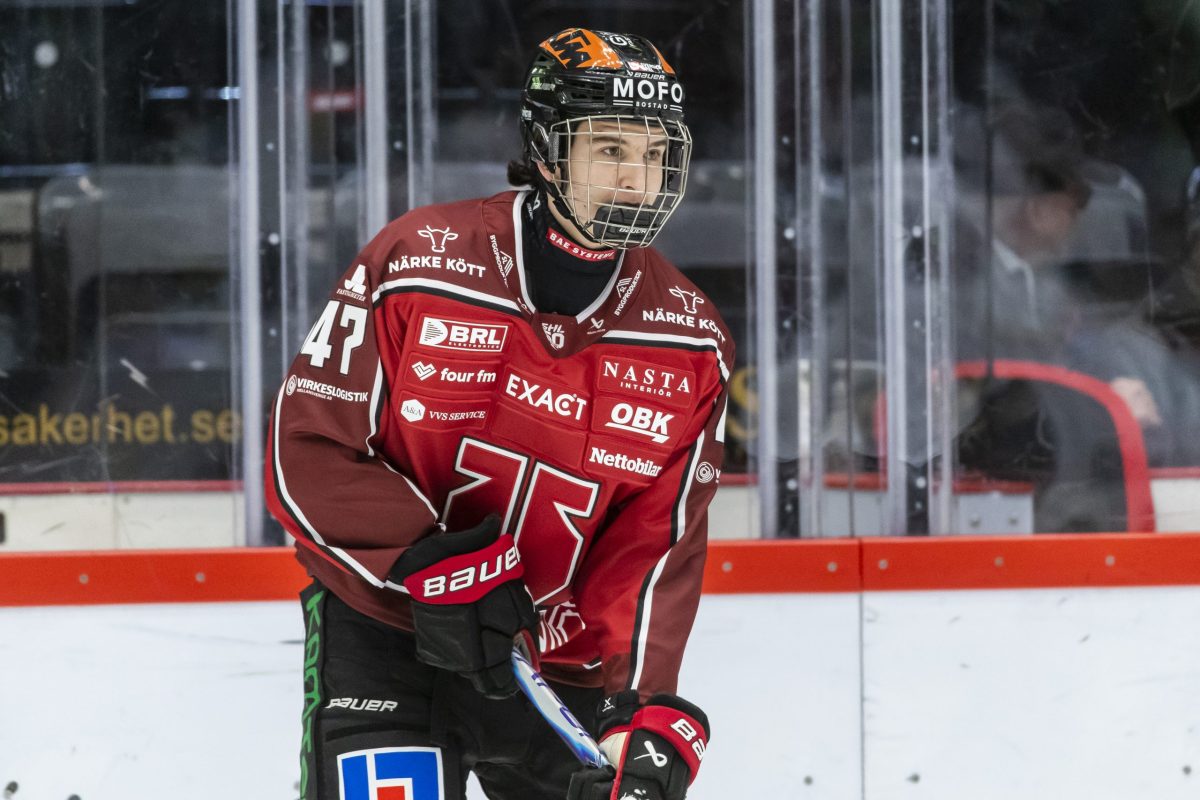
Photo: Johan Bernström / BILDBYRÅN
Alexander Command
2026 NHL Draft Eligible
Position: C, Shoots: L
H/W: 6-foot-1, 185 pounds
Date of Birth: 2008-06-16
Alexander Command is a player that has been skyrocketing the rankings this season. I would be lying if I didn't say that he has become one of my favorite prospects in this draft year. In my opinion, he’s Örebro HK’s most promising young player, showing rapid development through the club’s junior ranks and earning valuable exposure at higher levels of competition. With a combination of offensive instinct, pace, and work ethic, Command has positioned himself as a name to watch for in the second half of this season.
In the 2024/25 season, Command spent the majority of his playing time in Örebro’s J18 where he produced eye-opening numbers for anyone who didn't have him on their radar, producing 23 points in just nine games in the J18 Regional series and 33 points in 17 games at the J18 National series. His performances earned him opportunities in the J20 series, where he added eight points in seven games, adapting quickly to the increased tempo and physicality of play. His club performances wouldn't go unnoticed as he earned a spot on the Swedish U17 national team which would mark his debut in the blue and yellow jersey.
Building on that momentum, Command has taken another step forward in the 2025/26 season. Competing in the U20 series, he has posted 26 points in 18 games, continuing to play a key offensive role for Örebro. His development has also been recognized at the professional level, as he’s made his SHL debut. Even though he hasn’t logged many minutes yet, it’s still a significant milestone that reflects the club’s confidence in his progression.
What about his international performances so far this season? I would say excellent so far, Command was in my opinion the best Swedish player at the 5 Nations tournament in Ulricehamn.
Skating:
Command’s skating is a clear strength in his and a major driver of his effectiveness at higher levels of competition. His stride is technically sound, built on a strong lower-body base that allows him to generate speed efficiently. He skates with good knee bend and balance, keeping his chest stable and head up, which enables him to process the play while moving at pace.
Acceleration is one of Command’s most notable skating assets. His first few steps are quick, allowing him to separate from defenders in short areas and gain positioning in puck battles, that being said, his explosiveness is not yet at the highest level among draft eligibles, and there’s still room for improvement
He transitions smoothly from his initial strides into full speed, which makes him effective on zone entries and when pressuring opponents on the forecheck.
In terms of top-end speed, Command may not rely solely on pure straight-line explosiveness, but he reaches a strong, competitive cruising speed and maintains it well through extended shifts. His stride remains pretty controlled at higher speed, showing good edge control and posture. Command’s edge work and agility stand out in game situations. He is comfortable skating on both inside and outside edges, allowing him to change direction quickly and adjust his routes in traffic. This agility is evident when he cuts into open ice, escaping pressure along the boards. His lateral movement is smooth and gives him balance and control in tight spaces.
His transition skating, moving from defense to offense and vice versa is another positive aspect. Command accelerates quickly out of turns and pivots effectively when tracking back, helping him close gaps defensively. He shows good awareness in his backward to forward transitions, which supports his ability to stay engaged in the play and maintain pace with developing sequences.
From an endurance and consistency standpoint, Command’s skating holds up well over the course of games. His stride doesn’t deteriorate significantly late in shifts, suggesting solid conditioning and efficient energy usage.
Overall, Alexander Command’s skating projects well for continued progression. It combines strong fundamentals, effective acceleration, and reliable edge control, giving him a skating base that translates successfully as the level of competition increases. While further gains in explosive power could elevate his top-end speed even more.
Here’s an example where we can see Command build up his speed with a few quick crossover steps before going in on the forecheck with long, controlled strides, showing how his skating translates well to the SHL level.
Command showcases his strong transition skating by supporting play in the defensive zone, taking the pass up ice, and using lateral crossovers with combined stickhandling to get past the defender and quickly create a scoring chance.
Around the 45-second mark of the clip, Command enters the forecheck with a few quick steps to build speed and separation, showing effectiveness in tight areas in the offensive zone by using strong edgework to create space and escape pressure.
Command shows strong edge control and balance through his direction changes, staying low with a stable base. His movements are smooth and controlled, highlighting confident edge work and lower-body coordination.
GRADE: 55
Shot
Command’s shot has shown clear progress from last season to this one. While it remains a secondary element of his offensive game, it’s being used with more confidence this season. He’s getting pucks off his blade more quickly, showing improved balance through his release, and displaying a stronger willingness to shoot when opportunities present themselves.
Make no mistake, he’s not a volume shooter, but his mechanics allow him to execute efficiently when he gets the opportunity. From a power perspective, his shot currently grades slightly above average, and his one-timer is effective on the power play despite not rating among the top tier in raw power. His accuracy is a positive trait, as he generally keeps attempts on net and avoids low-percentage shots, there’s always a thought behind his shot which reflects his strong offensive awareness.
At higher levels, I would say that the key developmental factors will be greater shooting confidence and added strength. With continued physical growth, his shot projects as a reliable secondary scoring tool at the professional level.
After Sweden gains possession off the faceoff, Command moves into shooting position on the power play, sets up his one-timer, and fires through traffic for a goal.
This represents clear progress from last season. Command’s increased confidence in shooting the puck is evident, as he releases a wrist shot from the outside that finds the back of the net.
GRADE: 52.5
Skills
Command has become a more dangerous offensive player this season, particularly when operating from the outside lanes. He plays with calmness under pressure, allowing his hands and feet to stay connected even as defenders attempt to close gaps. He rarely rushes his decisions with the puck, instead showing patience and forcing defenders to commit first.
When attacking wide, Command excels at creating separation, relying on intelligent positioning and timing rather than pure speed to create shooting lanes. His puck-handling allows him to maintain possession through pressure, using his body and controlled puck movements to protect the puck and extend plays. That control also supports his playmaking, as he shows good awareness, drawing defenders before moving the puck to open up options for his teammates.
Compared to previous seasons, Command has taken a clear step forward in confidence and assertiveness, something I mentioned under the “Shot” section. He’s more comfortable carrying the puck through traffic and making plays under pressure, which has resulted in more consistent offensive zone possession. While he may not overwhelm defenders with flashy moves, his composure, puck management, and playmaking ability make him an offensive threat.
Command skates on the outside of the defender, staying composed with the puck and forcing the goaltender to make the first move. When a gap opens over the goaltender’s shoulder, Command executes a quick, calculated wrist shot that finds the back of the net.
Here, he shows composure along the outside, protecting the puck under pressure and drawing defenders before making a controlled pass that sets up a teammate for a goal.
Command shows confidence with the puck in this sequence, handling it calmly under pressure and maintaining possession along the outside. He displays good awareness and patience, keeping plays alive rather than forcing rushed decisions, and also uses his positioning to stay involved offensively.
Around 20 seconds into the clip, Command enters the offensive zone in support of the forecheck and gains possession under immediate pressure. He scans quickly, shifts his weight, and uses his edges to sell a move one way before cutting back the other, briefly relieving pressure before making a quick pass to a teammate.
Command is involved in multiple puck possession sequences in this clip, with play shifting between teams. Early in the sequence, he makes a loose first play in his own zone but quickly regains control of the situation. When operating along the outside, he shows composure under pressure, using body positioning and edge control to protect the puck. He stays balanced on his skates, makes small adjustments to maintain space, and keeps his game simple by moving the puck with a simple, controlled pass to relieve pressure and keep the play alive.
GRADE: 52.5
Smarts
Command shows a good understanding of the game and generally makes smart decisions with the puck. He plays with patience and composure, knowing when to slow the play down and when to move it quickly. Rather than forcing plays into pressure, He allows situations to develop and uses defender positioning to his advantage. His reads are usually on time, and he shows an ability to stay one step ahead of the play.
In the offensive zone, Command reads pressure well and positions himself in areas where he can remain involved without stalling the play. He supports puck possession by making simple decisions and helping to keep plays alive, rather than trying to do too much. Through the neutral zone and in transition, he shows good awareness of spacing and support, often putting himself in a position to be a reliable passing option.
On the power play, Command plays within the team’s system and understands his role. He shows good timing, knowing when to hold the puck to draw pressure and when to move it quickly to keep the play flowing. He makes smart decisions regarding his release, getting pucks to the net when in position rather than forcing plays. While there is still room for growth in consistency, he reads the game well and uses his skills effectively, projecting as a reliable option within a team system.
On the power play, Command holds onto the puck, drawing pressure before moving it to a teammate. With traffic in front, he steps into a smart one-timer on goal. At even strength, he finds space through the neutral zone and attacks wide. He stays composed, spots a teammate driving the slot, and delivers a perfectly timed pass that leads to a goal.
Here, Command makes quick, efficient decisions, moving the puck before the defender can close and finding open space as the play develops. His timing and positioning help keep the play moving without forcing anything. Under pressure, he uses the boards effectively to move the puck to a teammate and relieve pressure.
In this sequence, Command reads the play in the neutral zone, stepping into the lane to steal the puck and immediately turning it into a breakaway.
Command capitalizes on his opponent’s sloppy play, quickly collecting the loose puck. With a sharp turn and great awareness, he delivers a smart behind-the-back pass to his teammate, creating plenty of open space as a result.
This extended sequence showcases Command’s smart decision-making. He escapes pressure on the zone entry with a smart pass deep into the zone, then quickly transitions to defense when possession changes, using his stick well to prevent his opponent from getting a shot off. He then joins his team’s counterattack and nearly scores with a smart redirection in front of the net.
GRADE: 55
Physicality/Compete
This aspect of his game is something I really enjoy watching when Command is at his best. He plays with a consistent level of compete that shows up throughout his shifts. He engages willingly in puck battles and does not shy away from contact, especially along the boards. He’s not afraid to go to the dirty areas or absorb contact to make a play. While he’s not an overly physical player or someone who bases his game on physicality alone, there are moments where he plays with an edge and is willing to make the game hard on opponents.
Rather than relying on pure strength, Command uses body positioning and balance to stay involved and win possession, allowing him to hold his ground under pressure. He shows a good work rate away from the puck, tracking back responsibly and staying engaged in defensive situations. When plays break down, he’s quick to reinsert himself into the action and support his teammates.
Overall, his physical engagement is controlled and effective. While physicality is not the foundation of his game, his willingness to play hard in the right moments adds another layer to his overall effectiveness.
This sequence highlights Command finishing a check on the puck carrier to force a turnover. Later in the offensive zone, he finds himself battling along the boards against three opponents, competing hard for possession and managing to dig the puck free to a supporting teammate.
Command opens the sequence with a strong hit before engaging in a puck battle. Near the end of the clip, he steps up again and looks to deliver an even bigger hit, showing his willingness to use his body and play with a physical edge.
GRADE: 55
OFP: 54
A note on the 20-80 scale used above. We look at five attributes (skating, shooting, puck skills, hockey IQ and physicality) for skaters and six for goalies (athleticism/quickness, compete/temperament, vision/play reading, technique/style, rebound control and puck handling). Each individual attribute is graded along the 20-80 scales, which includes half-grades. The idea is that a projection of 50 in a given attribute meant that our observer believed that the player could get to roughly NHL average at that attribute at maturity.