


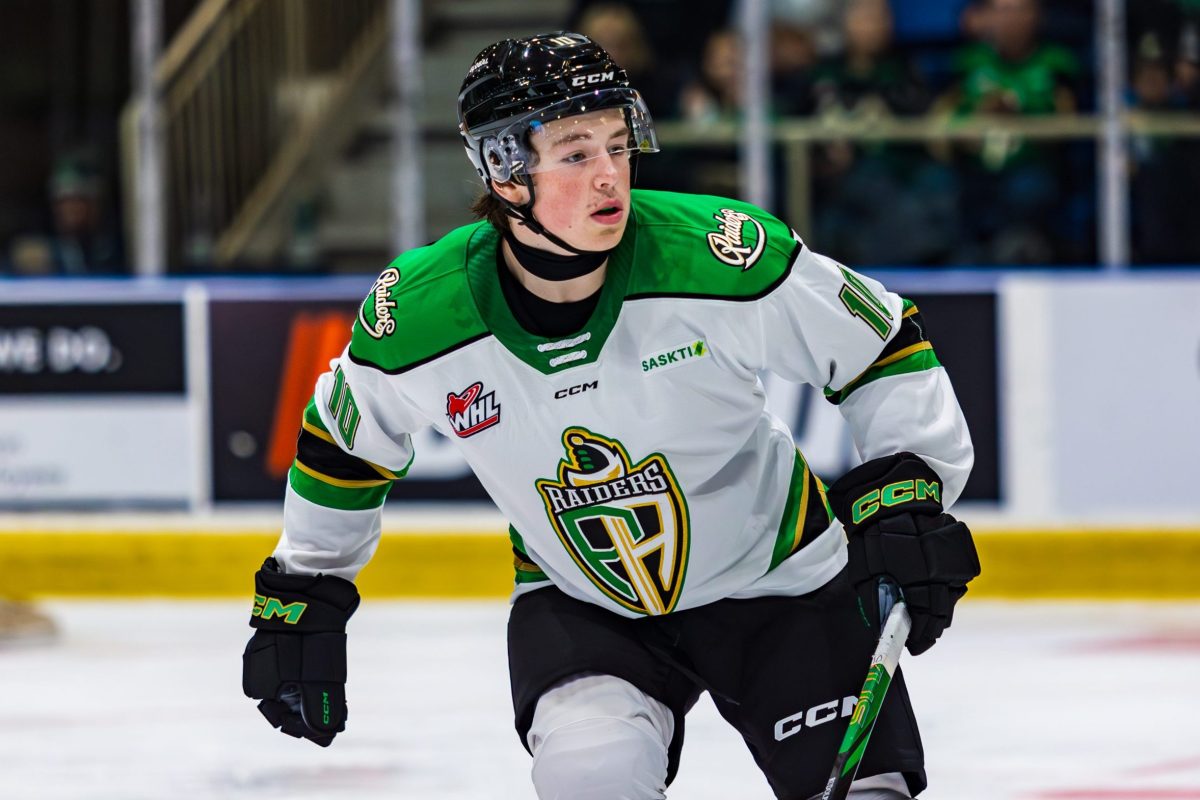
 Daxon Rudolph
2026 NHL Draft Eligible
Position: D, Shoots: R
H/W: 6-foot-2”, 206 pounds
Date of Birth: 2008-03-06
Daxon Rudolph has been a household name in the Western Hockey League ever since the Prince Albert Raiders selected the right-shot defenceman with the first overall pick in the 2023 WHL Prospects draft, ahead of several other notable D from western Canada that will be called early on in this year’s NHL Draft such as Keaton Verhoeff, Ryan Lin, and Carson Carels. The big blueliner has already represented Canada internationally at three different tournaments, with gold medals at the Under-17 World Hockey Championship and the U18 World Championship (playing as an underager) and a bronze medal at the Hlinka Gretzky Cup last summer. He was also selected to play at the CHL/NTDP Prospects Challenge last November and will appear at WHL All-Star Game.
In his rookie season with the Raiders, Rudolph collected 41 points (plus an additional 12 points in 11 playoff games), ranking third among all 2008-born WHL blueliners behind Lin and Verhoeff. This season, Rudolph has emerged as the number-one defender on one of the WHL’s strongest teams and currently sits third in scoring among all WHL defencemen league-wide, fueled in large part by a 13-game point streak from late December to early January in which he recorded 24 points.
The production this season may indicate he is an offensive defenceman, but he is equally as reliable in his own zone. He has the size that NHL teams look for in a defender and is a powerful skater. He disrupts passing lanes, blocks shots, and maintains an active stick to deliver timely poke checks and stick tie-ups. He’s a north-south puck-moving defender that can lead play up ice with his powerful skating. Although he’s not the most dynamic or creative defender, he flashes high-end passing in the offensive zone and often looks for give-and-goes when breaking pucks out or playing in transition.
As a 6-foot-2 right-shot D with his toolkit, Rudolph has a lot of things going in his favour, and NHL teams should be all over this type of defender. He may have a safer projection than other defenders with similar production at this level, but he has one of the higher floors in this year’s class. It’s easy to envision him as a second pair guy that can play on both special teams' units as he continues to develop his game. He could be a go-to offensive guy if a team gives him the opportunity but could also serve as an insulator for a more dynamic offensive defender. His motor and pace are not ideal at this stage of development, and his game can be a bit vanilla at times, but coaches won’t have trouble putting him out on the ice at any point in a game as his game evolves just because he plays a reliable defensive game and can create offence from the backend. The one thing he’ll need to improve is capturing that “hard to play against” identity to his game, as he lacks that physical engagement scouts look for in a defender with his frame, and he’ll also need to clean up his decision making on breakouts.
Skating
The word “powerful” is the first word that comes to mind when analyzing his mobility. He’s not the quickest, or the shiftiest, but his fluid stride and long extensions enable him to cover a lot of open ice when advancing play, and he can shift his weight to escape pressure on breakouts. He uses crossovers efficiently when he’s defending to close gaps and kill plays, but I’d like him to work these into his attacking patterns more often, where his routes are very linear. He gets the puck where it needs to be when carrying up ice and has the strength and power to not get knocked off easily. Along the blueline, Rudolph uses quick pivots to fake out and maneuver around pressure, often pairing with activation or downhill carries along the walls, but because he’s not an elite skater, his recoveries are not the most explosive. There are moments when he can get caught on his heels when defending speed or adapting to a quick counterattack. Overall, he has the mobility teams look for in a 6’2” defender and it shouldn’t hold him back from a projection standpoint.
A play from early on this season highlights his north-south mobility. He doesn’t collect a ton of speed on this end-to-end carry, but he’s able to weave his way through the entire team and drive straight to the net for a great individual effort.
Watch how Rudolph explodes off this breakout pass, creating separation from his man on the entry, and accelerating towards the net before snapping the return pass without breaking stride for a give-and-go goal.
Rudolph pinches down the far wall and breaks a defender’s ankles with a quick pivot before working the puck up high.
A pair of defensive stops from the CHL/NTDP Prospects Challenge highlighting his crossover skating.
Rudolph makes a strong pivot and takes a few steps towards the outside before letting a shot go from the far wall.
Rudolph gets caught defending on his heels during this quick counterattack and tries to compensate by extending his stick, leading to a penalty.
Grade: 55
Shot
Already surpassing the 20-goal mark just over halfway through this season, Rudolph ranks third in the league among all defenders this season (behind Jonas Woo and Bryce Pickford). He sits just outside the top five in total shots on goal for all WHL defenders and is well ahead of any other draft-eligible defenceman in this statistic.
While most high-scoring defensemen are known for a big, booming one-timer, Rudolph leans more on his hard, wrist shot to find the back of the net. Rudolph opts more for accuracy than a big, powerful release, as he can pick corners with ease and is adept at finding lanes through traffic with his snappy release.
The Raiders primarily position Rudolph on the left flank instead of quarterbacking his unit (for those who are curious, the top of the zone is occupied by 16-year-old Brock Cripps) and he tends to lean more on his one-timer there. The slapshot itself doesn’t have a ton of velocity and often lands low or square to the goalie’s midsection, but he also uses it for redirections. He’s not prone to forcing shots from the point but because he is a high-volume shooter, he does have his fair share of blocked shot attempts.
A pair of nearly identical goals, as Rudolph walks down the high slot and fires a bullet of a wrister labelled for the top shelf.
A pair of slap shots from Rudolph, both denied by the goalie.
Grade: 52.5
Skills
Rudolph won't blow you away with puck skills or deception, but he can pull some interesting moves off from time to time that’ll make you think there’s more to his on-puck game that’s yet to be unlocked. His hands are not the quickest, and because he’s largely a north-south carrier, you won’t catch him trying to stickhandle his way through the entire team with the goal of finding himself on the highlight reels every night, but there are flashes of him using his hands to beat defenders off the rush and he works the occasional shot fake when walking the blueline. Because he plays such a give-and-go heavy game, he does a great job controlling passes that don’t land in his hip pocket when he’s in motion.
This goal encapsulates the ceiling of Rudolph’s skills game, as he recognizes a gap between the two middle defenders and attacks right to the net finishing with a slick backhand over a sprawling goalie.
Rudolph orchestrates a give-and-go up the middle in transition, and caps it off with a nifty skate-to-stick reception on the return pass without breaking stride.
Rudolph pinches down the wall, evades a hit, and tries to toe-drag around a second defender but his shot hits a stick and trickles wide.
Grade: 55
Smarts
Rudolph is a smart defender and an above-average distributor. In transition, he rarely passes up opportunities to join the attack if he’s not leading the play up ice. He initiates most of the breakouts on his pairing and loves working give-and-goes into his exits and entries. He carries pucks up ice effectively and has sequences where he goes blueline-to-blueline and makes it look easy.
His ability to identify passing options on breakouts is one of his biggest areas of improvement, as he can cough pucks up ice under minimal pressure or try for more difficult passing options when safer ones are available.
Though there isn’t a ton of skill and creativity in his game, Rudolph flashes some of the best offensive zone playmaking out of any defender in the draft. His ability to find seams and recognize passing lanes through layers of defensive coverage can be downright otherworldly. Outside of his playmaking, he aggressively pinches down the boards to extend zone time and knows when to activate with and without the puck to create scoring opportunities.Despite not playing with the physical edge you’d look for in a 6-foot-2, 200-plus pound defender, Rudolph makes up for it with his habits and positioning behind his own blueline. His ability to steer attackers to the perimeter and seal carriers along the boards to kill possessions make him one of the stronger rush defenders in this draft class. He controls his gap well in 1-on-1 situations and maintains an active stick to deny attackers from driving the middle and knock pucks out. His lack of physicality can work in his favour at times as you’ll never catch him taking himself out of the play by chasing a big hit along the walls or stepping to throw a big check in an overzealous manner.
A pair of goals that highlight flashes of an activation game inside the offensive zone. On the first, he powers through stick contact to get to the circle and uses the screen to score in the short side corner. On the second one, the play is nearly identical except he finishes inside the far post.
Another smart read with the weakside activation before finishing with a nifty move to the backhand.
The next two videos show Rudolph's vision in the offensive zone. In the first one, he sends a rink-wide pass to the opposite circle to assist the opening goal in Game 2 of the Prospects Challenge. The second clip is off the zone entry where he draws nearly the entire team before finding a seam between two sticks to set up a scoring chance.
Rudolph picks up an assist after spotting a wide-open teammate at the net front and connecting a pinpoint accurate back door pass for the tap-in.
Rudolph works a give-and-go into this zone exit before skating the length of the ice, leading to a scoring chance for his teammate.
Rudolph starts the give-and-go at centre ice and gets behind the defence for the return pass to create a high-danger scoring chance.
A bad look for Rudolph here while defending the 2-on-1, as he slides completely out of position and fails to take away the passing lane here. He struggles to recover on the subsequent scramble in front and it leads to a goal against.
By far the most disastrous start I’ve seen from Rudolph in over a dozen viewings. Three egregious passing decisions under zero or minimal pressure all leading to defensive zone turnovers in the opening four minutes.
Grade: 55
Physicality/Compete
If you’re expecting a throwback defenceman that delivers crushing open-ice hits when watching Daxon Rudolph play, you’re going to be left disappointed. Despite having the frame for this style of play, Rudolph rarely throws his weight around in open ice, as the most prominent elements of his defensive game are his timing and positioning. His physical game revolves around proactive contact to establish body positioning on retrievals and sealing attackers along the boards when defending the rush. Around the net front, Rudolph is a solid defender, as he does a good job eliminating threats and getting in front of opponents looking for rebounds.
He displays a good work ethic from shift to shift, but there does seem to be a lack of intensity or urgency when he’s defending. Rudolph does not operate with a ton of pace and his motor doesn’t stand out. The lack of aggression in his game makes him look soft at times, and there have been sequences where smaller checks outrace him to loose pucks or take advantage of Rudolph’s higher centre of gravity to shield pucks and keep him on their backside, which can be frustrating considering Rudolph’s has the frame and could afford to leverage it and play harder pressure in these situations. Showing more willingness to step up on guys or ride opponents up into the walls or the end boards would make him a much more enticing defender.
The grade that will be assigned to Rudolph for this category leans more on his projection than any other grade to him because of how much runway he has to develop physically. As a 200-plus pound defender who has yet to turn 18 years old, it’s evident that he has the frame to be a force at higher levels. If he’s able to elevate his motor and add more physical engagement to his game while maintaining the same habits and positioning that make up his defensive identity, he could be a very difficult defender to play against.
These are the kinds of plays you’ll see from Rudolph when defending in-zone, he cuts through his opponent’s hands to separate him from the puck and Team CHL is able to get the puck out. A smart, clean, efficient stop here.
Rudolph throws a nice reverse hit to establish positioning on this DZ retrieval and fends off some contact on his backside before rimming the puck to an outlet to begin the breakout.
This play exposes the soft side of Rudolph’s physical game. He tries to drop the shoulder but then gets bumped out of this puck battle against a 5’8” forechecker, who immediately centers the puck for a high-danger chance.
Grade: 55
Total OFP: 54.75
A note on the 20-80 scale used above. We look at five attributes (skating, shooting, puck skills, hockey IQ and physicality) for skaters and six for goalies (athleticism/quickness, compete/temperament, vision/play reading, technique/style, rebound control and puck handling). Each individual attribute is graded along the 20-80 scales, which includes half-grades. The idea is that a projection of 50 in a given attribute meant that our observer believed that the player could get to roughly NHL average at that attribute at maturity.