


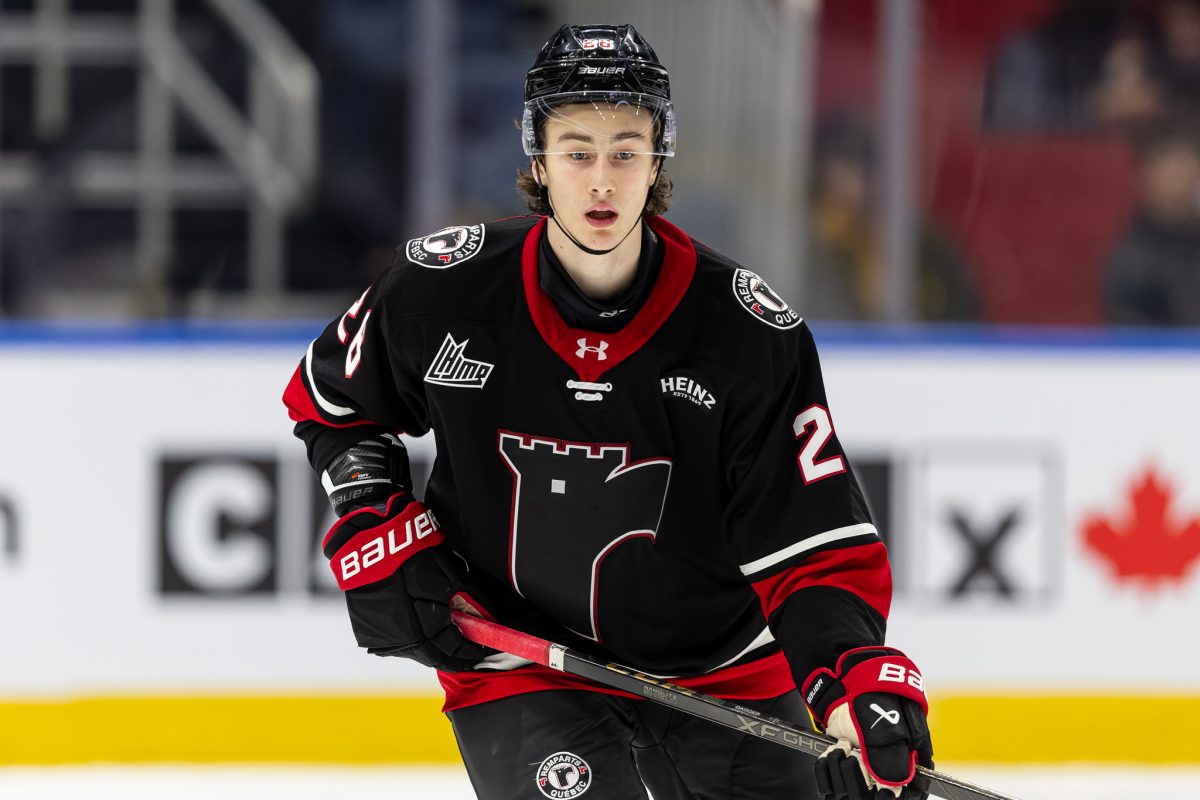
Maddox Dagenais (#26)
2026 NHL Draft Eligible
Position: C, Shoots: L
H/W: 6-foot-4 / 196 pounds
Date of Birth: 2008-03-27
Two years ago, Maddox Dagenais made history when he was drafted first overall in the QMJHL, doing exactly what his father, Pierre, did nearly 30 years earlier before playing several years in the NHL. Having a father that has played in the NHL is not an indicator that a player will do the same, but it helps having someone as close with this kind of experience guiding you towards the NHL. Dagenais clearly was gifted with some of his father's “hockey genetics”, and the path towards the best league in the world looks more than realistic.
In his first season with Quebec, Dagenais accumulated a total of 26 points in 43 games, missing the middle of the season because of an untimely injury that hit just when he was getting use to the speed and the intensity of the level of the QMJHL. When he returned from his injury, his progression stagnated but it was only a question of time before he got back on track on his development.
Fast forward to this season and Maddox Dagenais’s game has reached another level. He is faster, bigger and hungrier for the puck. He works hard on the ice and he is often rewarded for it. He has a bigger role this year, averaging 18 minutes per game, including some powerplay time. Of course there are still some visible flaws in his game, but most of them could easily be improved with time and development. His season is going pretty well with 56 points in 55 games, already doubling his points total from last season with a few games to play. It seems like his game just keeps getting better and better with each passing month.
Overall, Dagenais is a big forward that loves to be involved in the play, more often than not the first one on the forecheck and he is starting to look more and more comfortable with his 6’4” body. And for a 6-foot-4 player, oh boy, he can skate! Offensively, he has a shoot first mentality with solid scoring instincts, but his playmaking ability is improving, making him a dual threat for the opposing team. While he mostly lines up at center, there’s a chance that he could be better suited to the wing as a pro. Even if Dagenais is not completely dominating each game right now, it’s more the potential in Dagenais’s game that looks appealing. He can’t stop improving this season and it is always good to see a development curve progressing as well as his. Look for him to rise higher on our next ranking at McKeen’s Hockey.
Skating
Everyone loves to see big players move well on the ice, combining a physical edge with speed. It’s the case for Maddox Dagenais. The inconvenience of having such a size is that there is more mass to move but Dagenais’s legs are very strong and it shows with his explosiveness on the ice. While his first strides could still improve further, he builds to a tremendous top speed for a larger player. His strides are pretty efficient too, not losing a lot of energy in each movement. This speed gives him the consistent ability to beat defenders one on one.
Dagenais (#26) has an ease to find open space in transition and exploit this space with speed to get a shot. Once he is going in the neutral zone with the puck, he is truly hard to stop.
Yes, Dagenais was already moving in the right direction, but the quickness with which he closed the distance between him and the defender was impressive. It was only possible because of his explosivity.
Where Dagenais improved the most this year is his speed management. He understands better when to use his speed or when to slow down the play. Dagenais loves to use his speed and puck handling to move the puck from one end to the other. He is a solid puck carrier in transition and it creates plenty of scoring chances on the rush for him and his teammates. Additionally, he is always moving his feet on the ice and by doing this, he always has a speed edge on his adversaries. One way he is using this is by getting some speed in the neutral zone and exploding before receiving the puck and passing around the defender to get a breakaway or a scoring chance.
Dagenais is a talented puck carrier, and combined with his speed, he can get some dangerous scoring opportunities on the rush. Even with his maneuver in the middle, he was still fast enough to destabilize the opposing defender with his speed.
Dagenais knew in the clip that he couldn’t beat the defender with speed, and by slowing down the play, he gave a chance to his teammates to join him in the offensive zone.
This is one of the few examples of how Dagenais uses his speed to be alone in front of the net. The reason why this breakaway was possible was only because, by passing the puck at his defender, he turned around and kept his momentum to explode in the neutral zone and attack the defender head on.
There is still work to do with Dagenais’s skating. Like shown in those videos, he uses his speed well in transition, but in the offensive zone, it’s more difficult for him to get the space to use his speed. He is mostly a North-South skater, and his lack of mobility might be a reason why. He can struggle around the boards with quick pivots when pressured, relying more on his physical strength than his ability to evade the pressure with his mobility. His agility seems to be lacking at times, with some issues in his edge control and hip rotation. However, this weakness in Dagenais’s game is constantly improving, and there are more positive flashes lately. If he could improve his mobility by the time he gets to play against professional players, his skating will be a big strength for him and thus our grade represents that possibility.
There is an example where we can see some weakness in agility. Yes, the result was a goal, but the pivot in the corner was too slow and against better opponents, he would have just been pinned against the wall, and the play would have died there.
Grade: 57.5
Shot
Dagenais’s shot is his most solid asset in his game, but there is also some work to do to improve how and when to use his shot. On one side, the tools are all there for him to make his shot a powerful weapon that can quickly change a game. His shot has a lot of velocity and is often very hard for the goaltender to read. On the other side, Dagenais struggles to get himself in dangerous shooting lanes when carrying the puck in the offensive zone. He often shoots whenever he has the puck in the offensive zone, resulting in a low danger scoring chance. Dagenais could become a menacing goal scorer in the future if he gets rid of this bad habit of shooting from bad angles.
Here are two examples of something that happens too often in a game. Dagenais has the bad habit to shoot too fast from impossible angles, often getting blocked by a defender or easily by the goaltender.
Fortunately for Dagenais, other than these bad shots, his shot technique is one of the best of all the players available in the 2026 NHL draft. His weight distribution when he shoots gives to his shot a lot of power, and he can do it at high speed. Also, his arsenal is diverse, as he can score from a quick wrist shot, a powerful one timer, or even a surprising backhand shot. He loves to shoot and defenders need to be ready because he can score from anywhere.
Whether it’s with a slap shot or a wrist shot, his shot is powerful. In the first clip, the goaltender did not even move his glove because the shot was too perfect. The power and the precision are there when he is in a good shooting position, and with a shot like that, he shouldn’t even hesitate to use it.
I would like to see Dagenais use his one timer on the powerplay more often. Sometimes, he seems to hesitate, thinking that there might be a better play somewhere, but his shot could create a rebound or generate a scoring chance if he hasn’t scored initially. In the end, the major issue with his shot is the decision-making with the puck. Dagenais has scored a lot of goals this season because he is not afraid to shoot and sometimes, he gets rewarded by shooting from a difficult angle. He currently shoots at a rate of 8 shots per game, but half of them are either blocked by a defender or missing the net.
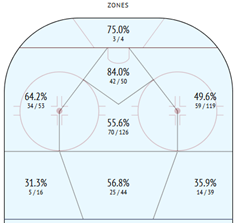
This image represents his strength, showing in percentage his accuracy in each zone of the offensive zone. There is a clear problem at the right side like shown in previous clips. Other than that, most of Dagenais’s shots come from the slot, so you don’t want to let him alone in front of your goalie.
Grade: 57.5
Skills
This part of Dagenais is full of potential even if it’s not always working right now. He has the speed to evade pressure and the physical abilities to keep other players away from the puck, but he often struggles to use his hands to create some space for himself. The timing just isn’t there, as he often gets blocked or poke checked because he moved at the wrong time. When he slows down with the puck, he can’t use his hands to pass through a player. He has to rely on his physicality, but this is also still a work in progress. It may be because he is not used to his own body size, and if it’s the case, it will change sooner than later.
Dagenais needs to improve his puck protection when he slows down along the boards. This often happens because he is putting his body in front of the puck too slowly, allowing the opponent an opportunity to steal the puck.
The right idea is in his head, and he seems to understand where to attack the open space. However, the move is a bit too slow and the defender stops him.
When his ideas work, though, he can create some really nice scoring chances.
Again, it’s not because Dagenais doesn’t know what to do with the puck. His body language clearly shows that he knows what he is doing, that he sees the open space in front of him, and soon will be able to exploit it. There are a few moments where he just pushes the puck slightly away from the defender in open space, avoiding the stick and players to continue towards the net. Dagenais is a great puck carrier, and it shows in transition. He loves to take the puck in his own zone or in the neutral zone to bring it himself with speed in the offensive zone. On the rush, he handles the puck well in tight areas and can generate some dangerous scoring chances. I like when he combines his speed with his puck handling, just going full speed in the offensive zone. There are also some power forward abilities in him at times, and that could become a strength for him at a higher level.
Here are some examples of how Dagenais efficiently uses the space in front him.
When he enters the offensive zone with speed, there are many options for him that can create solid scoring chances. These clips show how well he uses his skills, all of them translatable to the pro level.
Grade: 52.5
Smarts
Presently, Dagenais has every tool he needs to succeed at a higher level, but he needs to understand how to use them all in the most effective way. In an uncommon way, Dagenais is better away from the puck than he is with the puck. Like mentioned earlier, he is always moving his feet on the ice to be in a favourable position, and this kind of play is translatable. In the offensive zone, he goes to open space in hopes to receive the puck, knowing that he has the shot to score. I really like how he reads the play, often winning puck battles by arriving first at the puck because he is aware of his surroundings.
These two clips are great for illustrating how Dagenais sees a play taking shape. He moves well and always tries to evade the defender, often getting open to receive a pass.
With the puck, however, there are some questionable moments. Like shown in the shot section, it seems that Dagenais shoots unconsciously, as if he is forced to shoot the puck the moment he has it when he is deep in the offensive zone, whereas there were many pass options available. He also needs to scan more of the ice when he gets the puck along the boards. Too often, he misreads the play and makes a bad pass because he didn’t fully take in the information around him.
However, when he is not close to corners in the offensive zone, Dagenais often makes the right decision. Without keeping it simple every time, he moves the puck quickly and precisely, creating some passing lanes in the other team’s zone. This is one part of Dagenais’s game that has improved a lot as the season has progressed, and it shows in his playmaking ability. Even if Dagenais is primarily a shooter, there is a good playmaker hiding beneath his high-volume shooting habit. He often sells the shot to open a lane for a pass, and he has the vision and the skill to put it right on the tape. These passes are happening more and more often, and we can say now that he is a dual threat in the offensive zone.
There are just a few examples of Dagenais’s vision, but he is clearly more than just a shooter. He is patient with the puck and really exploits the open ice in front of him. Once he learns how to open more passing lanes with his speed and his puck protection, his playmaking ability could become a strength for him.
Grade: 55
Physicality/Compete
With a size as imposing as Maddox Dagenais’, expectations towards his physical game are always high. It’s always easier in junior for a 6-foot-4 player to physically dominate the other players, but it has to be used wisely and at the right time to translate well at a higher level. Dagenais isn’t dominant physically right now despite his size; he seems to forget at times that he can push away most players along the board to win puck battles. However, the potential here is very interesting, not to mention that this part of his game is improving each game. He is getting stronger and more solid on his feet and he will surely be a hard player to play against later in his career. Right now, Dagenais doesn’t hit often, but when he does, it seems painful for the other player. His hits are efficient and at the right time, never getting himself out of the play only to hit. However, when battling for the puck along the boards, Dagenais tends to fall easily whenever he is pushed down. It might be his center of gravity and his lack of stability, but he needs to be more solid on his feet and rely on his physicality to win puck battles.
Dagenais looks massive at times, and he can deliver some pretty hard hits. Combined with his speed on the backcheck, the opponent needs to keep their head up!
This is a rare moment where Dagenais protects the puck well with his body and reverse hits the opponent that was about to hit him. He gets a scoring chance from this simple play.
Because Dagenais is always moving his feet, he is always at the heart of the action. He is often first on the forecheck after his team dumps the puck in the offensive zone, ready to fight for the puck. Even if his puck protection and his stability are not perfect yet, Dagenais is still a relentless player that works hard. Even if he’s knocked down, he gets up quickly and is ready to work.
That clip is perfect to show many aspects of Dagenais’s game. His feet are always moving (well, as long as he isn’t on the ground), and he is right where the action is. He even gets rewarded with a good shot on net at the end.
Even after getting pushed to the ground, Dagenais is the first player to take the puck in the corner. This demonstrates great diligence.
He does show an active stick that helps to clog passing lanes, but he needs to be more efficient in puck battles to improve his win percentage. Defensively, Dagenais works decently to get the puck. There are a few shifts where he backchecks very hard, it’s always nice to see his two-way game improving.
Very solid play by Dagenais here, a superb interception after a hard backcheck. Coaches and scouts love that kind of play!
There are a few examples of why moving his feet allows Dagenais to take away the puck easily. He is slowly developing an interesting two-way side in his game.
Grade: 52.5
OFP: 54.875
A note on the 20-80 scale used above. We look at five attributes (skating, shooting, puck skills, hockey IQ and physicality) for skaters and six for goalies (athleticism/quickness, compete/temperament, vision/play reading, technique/style, rebound control and puck handling). Each individual attribute is graded along the 20-80 scales, which includes half-grades. The idea is that a projection of 50 in a given attribute meant that our observer believed that the player could get to roughly NHL average at that attribute at maturity.