


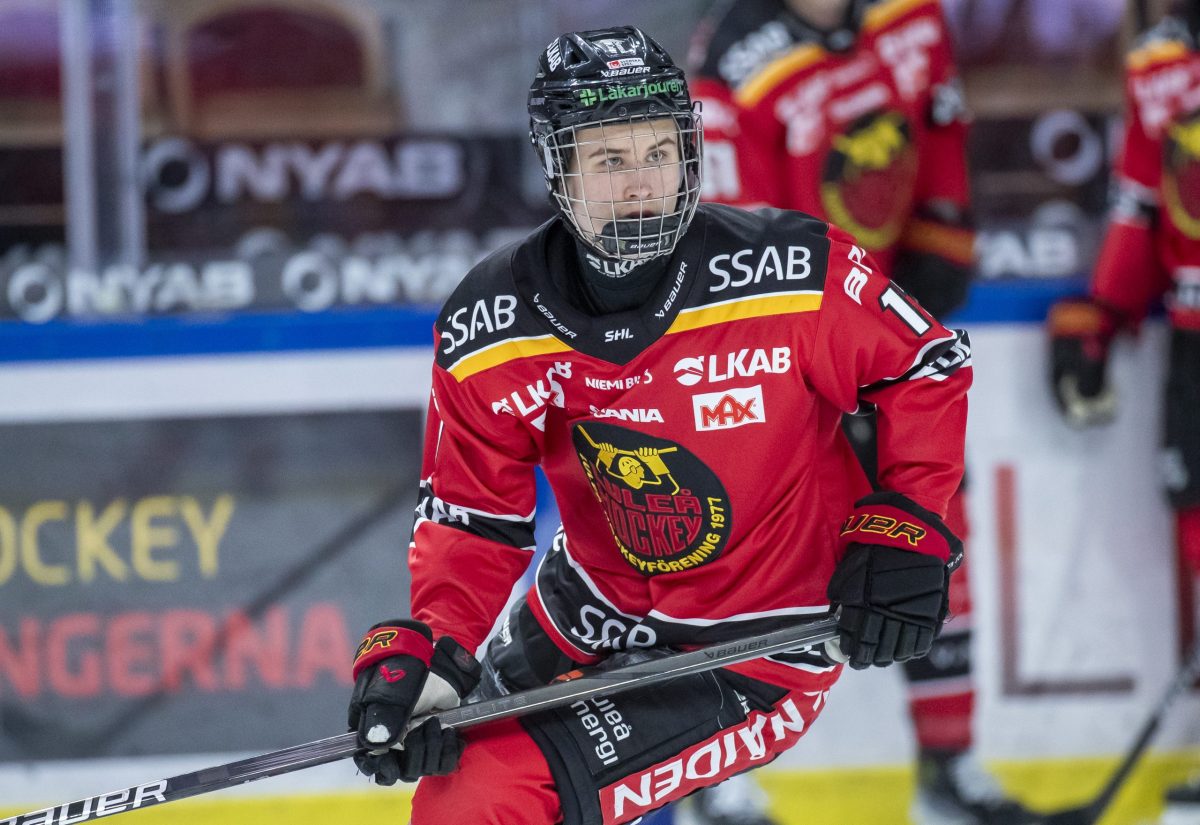
Photo: Pär Bäckström / BILDBYRÅN
Dynasty Stock Watch
Vegas Golden Knights Edition
Team Outlook
From the moment they entered the league, the Golden Knights have operated aggressively. Vegas has never been shy about trading prospects, picks, and futures to chase immediate contention, and that philosophy has largely paid off with sustained competitiveness and a Stanley Cup. The flip side is predictable: the organization has one of the thinnest prospect pipelines in the league.
For dynasty managers, that does not mean the system should be ignored. In fact, it often creates inefficiencies. With so little depth, any prospect who shows real momentum can climb quickly, while others may carry residual name value that no longer aligns with realistic fantasy outcomes. This edition highlights three Golden Knights prospects whose stock may still be rising quietly, and three whose current perception may exceed their long-term fantasy utility.
Buy Candidates
Pavel Moysevich, G
Why Buy?
Moysevich has quietly positioned himself as one of the more intriguing long-term goaltending bets in the Vegas system. His game is built on strong positioning, controlled movement, and calm puck tracking, allowing him to manage play efficiently rather than relying purely on athleticism. Those traits often translate well as competition increases and tend to produce more sustainable results over time. The organizational context adds a compelling layer. Vegas has a well-documented history of cycling through goaltenders rather than overpaying to retain them, creating internal opportunity on a more predictable timeline than most organizations. The Golden Knights do not have a deep goaltending pipeline, and Moysevich's steady progression gives him a clearer runway than his name recognition might suggest. For a patient dynasty manager, that organizational pattern is worth weighting heavily.
Hockey Prospecting assigns him a 74% probability of becoming an NHL regular, a strong number that reflects both his tools and his developmental trajectory. At 6-foot-7, his size alone will continue to generate opportunities, as organizations at every level tend to invest in large goaltenders with clean fundamentals. The primary caveat is competitive context. Moysevich has logged just 31 KHL games across two seasons, and this year he is operating primarily in the VHL, the rough Russian equivalent of the AHL. Until he sustains performance against KHL-level competition or higher, there is a developmental question mark worth monitoring. The tools and the opportunity structure are both present, the next step is proving they hold up where the game gets harder.
Jakob Ihs-Wozniak, RW
Why Buy?
Ihs-Wozniak is a longer-term swing, but one whose underlying tools make him worth monitoring closely. He plays with pace, shows confidence attacking defenders, and has demonstrated flashes of offensive creativity that suggest room for growth. His game is still raw in spots, but the foundation points toward a winger who could scale with continued development. The most encouraging sign this season has been his 17 SHL games, and while just two points on the scoresheet does not jump off the page, the exposure itself is meaningful for a prospect still finding his footing at the top level. In a system that lacks forward depth, that kind of early deployment often signals organizational belief that extends beyond the stat line.
The underlying numbers tell an optimistic story. His pNHLe has jumped from 29 last season to 48 this year, a notable leap that reflects genuine developmental progress rather than a statistical mirage. His loan stint in the HockeyAllsvenskan following his SHL time has produced encouraging offensive totals, suggesting he is responding well to extended responsibility and consistent deployment. He remains a patient hold rather than a near-term contributor, but prospects who show this kind of measurable jump in projection while simultaneously earning NHL looks are exactly the type that are worth acquiring before the broader market catches up.
Mateo Nobert, C
Why Buy?
Nobert brings a blend of intelligence, pace, and playmaking that fits well within modern NHL systems. He processes the game quickly, supports possession effectively, and can facilitate offense without needing to dominate touches. His Fantasy Hockey Life skater card reinforces what the eye test suggests, he grades out positively in play driving, transition, and expected goals, with his standout skill being playmaking, particularly his ability to generate high-danger passing opportunities. That profile often leads to strong underlying results even when box score production fluctuates, and this season he has backed it up with improved scoring in the QMJHL.
The key with Nobert is timing. His name does not carry much market weight, but his skill set gives him a genuine chance to outgrow his current valuation. Especially considering he is an in a thin Vegas pipeline, players who can drive play, facilitate offense, and consistently create high-quality chances tend to find themselves elevated sooner than expected. As a depth acquisition with a clearly defined and translatable skill set, Nobert represents a smart buy before the broader market catches up.
Sell Candidates
Akira Schmid, G
Why Sell?
Schmid's NHL exposure and past flashes of strong play continue to buoy his market value, but the long-term outlook remains murky. Across 80 NHL appearances, he has consistently failed to outperform his expected goals metrics, and that pattern is difficult to overlook. In Vegas, he has been afforded good to stellar defensive protection, making his tendency to underperform those environments a more damning signal than it might appear on the surface. Consistency has been elusive, and his role has frequently fluctuated between short-term opportunity and organizational stopgap.
For dynasty managers, the concern is sustainability. Vegas has shown little hesitation in cycling through goaltenders when performance dips, and Schmid's profile does not offer enough separation to inspire confidence in long-term stability. His size and experience will likely continue to generate NHL opportunities, but opportunities alone do not translate into fantasy value if the underlying performance does not support them. If his name still carries value based on prior NHL runs, this is a reasonable window to sell before his role settles into something less fantasy-friendly. Let others enjoy the roller coaster.
Carl Lindbom, G
Why Sell?
Lindbom is a different case than Schmid. He does not carry a negative track record, and there is still genuine promise in his game. His technical foundation gives him a real developmental floor, and that residual optimism is precisely what makes now a smart time to sell. The concern is not that he has failed, it is that his ceiling has become increasingly defined. Hockey Prospecting assigns him just a 22% probability of becoming a full-time NHL regular, and the realistic projection at this stage points toward a backup or 1B role at best.
For dynasty managers, the calculus is straightforward. His remaining upside is modest, and the market may still be pricing in more than the data supports. Vegas has shown little patience for developmental projects when proven options are available, which further limits his runway. If another manager is still holding onto earlier optimism, this is a reasonable window to move him before that perception catches up with his actual ceiling.
Trevor Connelly, LW
Why Sell?
Connelly is the most exciting prospect in the Vegas system, and also the most volatile. His skill level is evident, he has the hands, creativity, and confidence to generate offense, particularly in space, and his pNHLe has climbed to 82 this season based on his AHL success, a number that will turn heads and likely drive a strong return in most dynasty formats. The comparables attached to him, Eric Staal, Nick Schmaltz, and Matthew Boldy, are genuinely lofty, and that name recognition alone may be inflating his current market value beyond what the realistic distribution of outcomes supports.
For dynasty managers, the question is whether the upside justifies the risk. Questions around consistency, decision-making, and translatability continue to cloud his long-term outlook, and Vegas has historically shown little patience with development projects unless they clearly force the issue. The pNHLe spike gives you real leverage right now. Use it. Let someone else absorb the volatility, take the return, and redirect that capital toward a prospect with a safer and more defined profile.
Summary
| Player | Role | Key Insight |
| Pavel Moysevich | Buy | Steady goaltender with a clearer runway than name value suggests |
| Jakob Ihs Wozniak | Buy | Long-term winger swing with offensive tools |
| Mateo Nobert | Buy | Smart, play-driving center who could outgrow his valuation |
| Akira Schmid | Sell | Inconsistent goalie with uncertain long-term role |
| Carl Lindbom | Sell | Developmental goalie whose progression has stalled |
| Trevor Connelly | Sell | Skilled winger with volatile projection and unclear pathway |