


Team Outlook
There is no question that Matthew Schaefer has completely altered both the trajectory and timing of the competitive window for the Islanders. His historic season has accelerated the organization into more of a win-now phase, reshaping how they evaluate and deploy talent across the roster. With cornerstone pieces already in place at each position, Mathew Barzal, Bo Horvat, Schaefer, and Ilya Sorokin, the foundation is strong, but the supporting cast remains a work in progress.
This places the Islanders in a unique transitional phase, balancing immediate competitiveness with the need to develop and integrate younger talent. The prospect pipeline is not among the league’s deepest, but it carries increased importance as the organization looks to round out its roster with cost-controlled contributors. From a dynasty perspective, this creates both opportunity and volatility. Identifying which prospects can meaningfully support the current core, and which players may be overvalued relative to their long-term projection, will be key to gaining an edge.
Buy Candidates
Dmitri Gamzin, G
Gamzin is quietly emerging as one of the more intriguing goaltending prospects outside the NHL. Playing in Russia, he has shown strong composure and technical ability, with a calm, controlled style that projects well to higher levels. There are also some strong indicators beneath the surface. Hockey Prospecting gives him a 97% chance of becoming an NHLer, with notable comparables including Igor Shesterkin and fellow Islanders goaltender Sorokin. He was not drafted until age 21 and has already played 79 KHL games, which suggests his timeline may be shorter than that of a typical goalie prospect.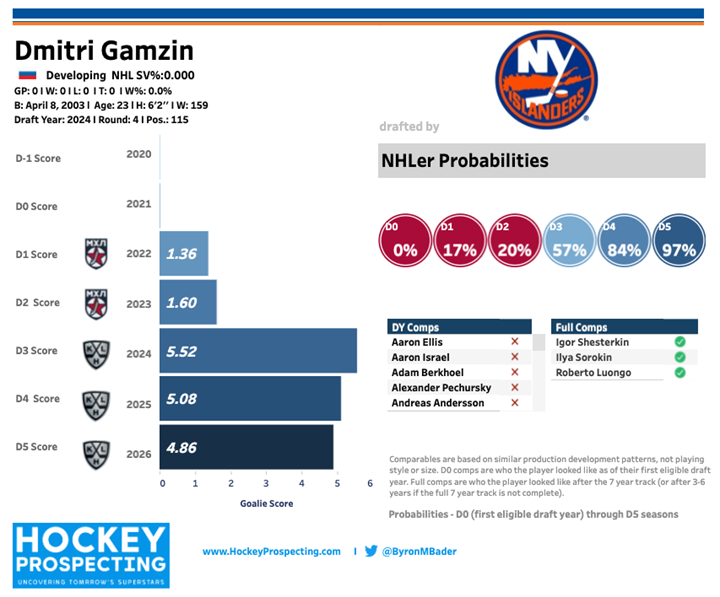
Goaltenders always carry inherent risk, but Gamzin’s profile is trending in the right direction. With Marcus Gidlof traded to St. Louis in the trade that brought Brayden Schenn to the Islanders, Gamzin’s stock gets a slight boost as the top goaltending prospect behind Sorokin in the Islanders’ system. The organization also lacks a clear long-term answer in net beyond its current group, giving Gamzin a realistic path to future value. If he were ever dealt to a weaker goaltending system, as Gidlof was, his stock could rise even more. This is the kind of profile that can reward dynasty managers who buy in before broader recognition sets in.
Kashawn Aitcheson, D
Aitcheson brings a highly projectable blend of physicality, mobility, and offensive upside that fits the mold of the modern NHL defenseman. While he has long been known for his edge and willingness to punish opponents, it was his offensive game that took a meaningful step forward this season. As captain of the Barrie Colts, he has helped lead the club to the Eastern Conference semifinals in the OHL playoffs as the second seed behind Brantford. He moves pucks efficiently, can support the attack, and now looks more capable of providing secondary offense than he did a year ago. His pNHLe via the NHL Rank King application is nearing 80, which feels like an unlikely outcome, so I would not buy expecting that level of offense at the next level.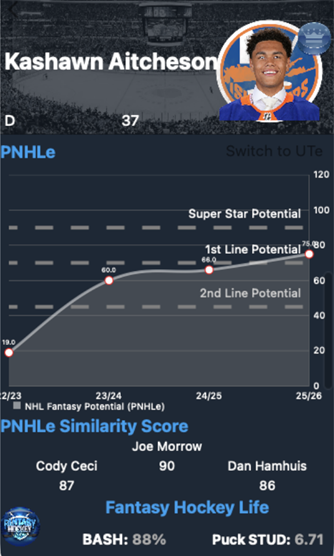
From a fantasy standpoint, his appeal is especially strong in multi-category formats. Defensemen who can contribute across blocks, shots, and hits (BASH) often outperform expectations, and Aitcheson is trending toward that type of profile. Even if not every hit connects, the ones that do are often the kind that change momentum and force opposing forwards to keep their heads up. He plays with the sort of intimidation factor that can alter how opponents attack his side of the ice. One of his comparables is Cody Ceci, which feels like a reasonable stylistic match, though Aitcheson appears to show better decision-making and less panic with the puck at this stage. As his overall game continues to round out, his value is likely to keep rising, making him a strong buy before that progression becomes more widely recognized.
Victor Eklund, LW
Eklund remains one of the more exciting prospects in the Islanders’ system, and arguably one of the most dynamic offensive talents in their pipeline. He combines high-end skating with an aggressive, pace-driving style that allows him to attack defenders, generate chances off the rush, and keep pressure on in the offensive zone. While his SHL production dipped this season, he showed well at the U20 World Junior Championships, helping Sweden win gold and reinforcing the idea that he can elevate in high-pressure settings. Since arriving in North America, he has also made an immediate impression with AHL Bridgeport, which only adds to his appeal within a prospect pool that could use more speed and creativity up front.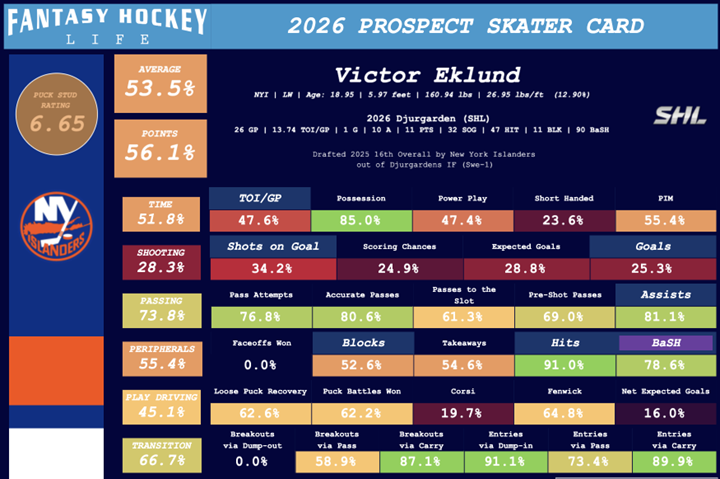
What makes Eklund especially valuable in the Islanders’ system is that he brings skills their pipeline does not have in abundance. His Fantasy Hockey Life skater card points to elite transition play in the SHL when carrying the puck in and out of the zone, along with strong Fenwick numbers, loose-puck recoveries, and puck-battle results. He also offers some BASH value, with solid hit and block rates for a forward. There is still room for growth in terms of consistency and decision-making, but the combination of skill, pace, and competitiveness gives him a real chance to emerge as a top-six option and one of the organization’s more important forward prospects.
Sell Candidates
Cole Eiserman, LW
Eiserman’s value remains heavily tied to his elite goal-scoring reputation, and while that shot is very real, it may also be inflating his dynasty price. He can beat goalies in multiple ways and is dangerous whenever he finds space in his spots, but the rest of his game still carries notable concerns. His off-puck play remains underdeveloped, and there are holes in his transition game and puck-battle ability. He is not especially physical, and for a player whose fantasy appeal is so tied to scoring, that creates more risk than his name value may suggest.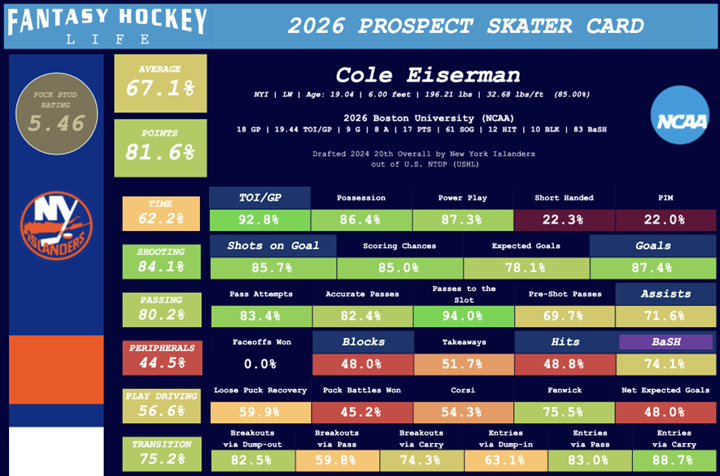
The concern for fantasy managers is that if Eiserman tops out as more of a one-dimensional trigger man than a complete offensive driver, he may struggle to earn the kind of all-situations role needed to maximize his upside. If all he really does at a high level is shoot, he could end up limited to 14 minutes a night with much of his value tied to power-play deployment. That creates a wide range of outcomes, from a useful specialist to something more disappointing, with names like Filip Zadina, Daniel Sprong, or Anthony Beauvillier coming to mind as stylistic caution points. Given that he has had time to round out the weaker areas of his game and the progress has been modest, this may be the ideal time to sell while the goal-scoring hype still drives the market.
Kamil Bednarik, C
Bednarik is a strong real-life play driver, but his fantasy outlook appears far more limited than his name value may suggest. He works well within the flow of play, can support possession, and brings traits that should help him earn trust from coaches, especially in matchup and penalty-killing situations. The issue for dynasty managers is that those strengths do not always translate into meaningful fantasy value. At this point, he looks more like the type of player who could become an effective bottom-six center than someone with a clear top six offensive path.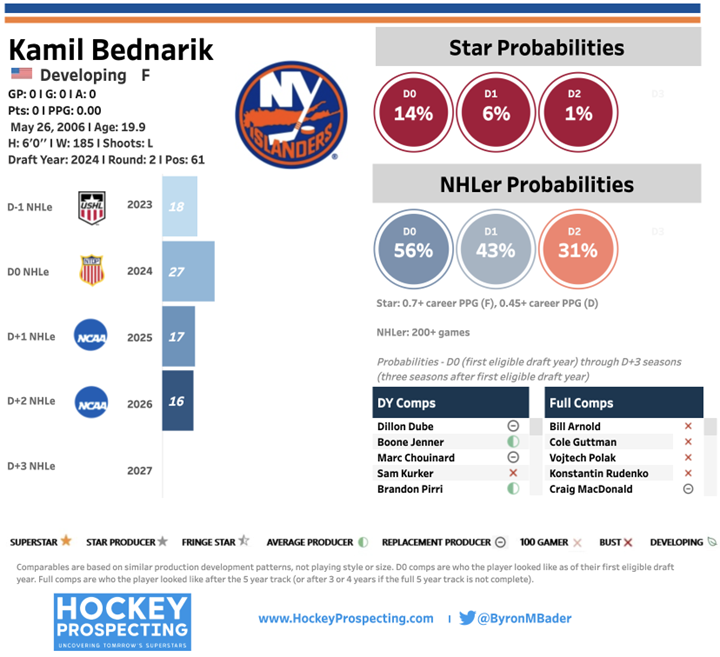
That concern is reinforced by the production profile. While there have been flashes of skill and playmaking, he has not translated that into more than half a point per game in the NCAA, and Hockey Prospecting gives him just a one percent chance of becoming a star, which feels about right. As the Islanders’ system continues to evolve, players without a standout fantasy trait are at risk of being passed over by higher-upside options. If another manager still views Bednarik as a potential offensive breakout, this may be the right time to cash out.
Quinn Finley, LW
In his third NCAA season, Finley regressed to under a point per game at Wisconsin, despite the team around him being much better. That matters for a player whose fantasy case is already built more on efficiency and complementary offense than on driving play through elite tools. He is a smart player who understands spacing, gets to the right areas, and can capitalize on chances, but there is still a question of how much offense he will be able to create for himself and others at higher levels.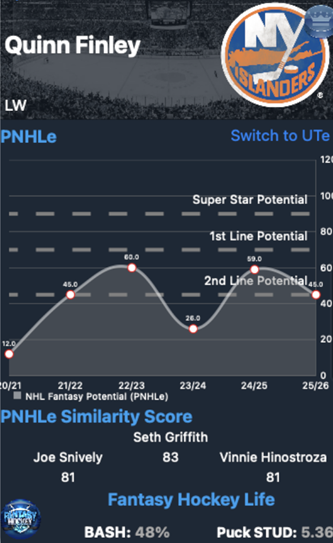
His pNHLe via the NHL Rank King application has dipped back to 45 after rising to 59 last season, reinforcing the idea that his long-term ceiling may be more modest than some managers hope. At best, he looks like a 50-60 point NHL winger, and even that may require the right deployment and supporting cast. If Wisconsin’s trip to the NCAA title game has boosted his profile in your league, this could be a good time to cash in before his value settles back into the range of a more limited NHL projection.
Summary
| Player | Role | Key Insight |
| Dmitri Gamzin | Buy | Emerging goalie with long-term upside |
| Kashawn Aitcheson | Buy | Physical, mobile defenseman with multi-cat value |
| Victor Eklund | Buy | Dynamic offensive winger with upside |
| Cole Eiserman | Sell | Elite shot but potential one-dimensional scorer |
| Kamil Bednarik | Sell | Lacks clear high-end projection |
| Quinn Finley | Sell | Likely complementary winger with limited ceiling |