


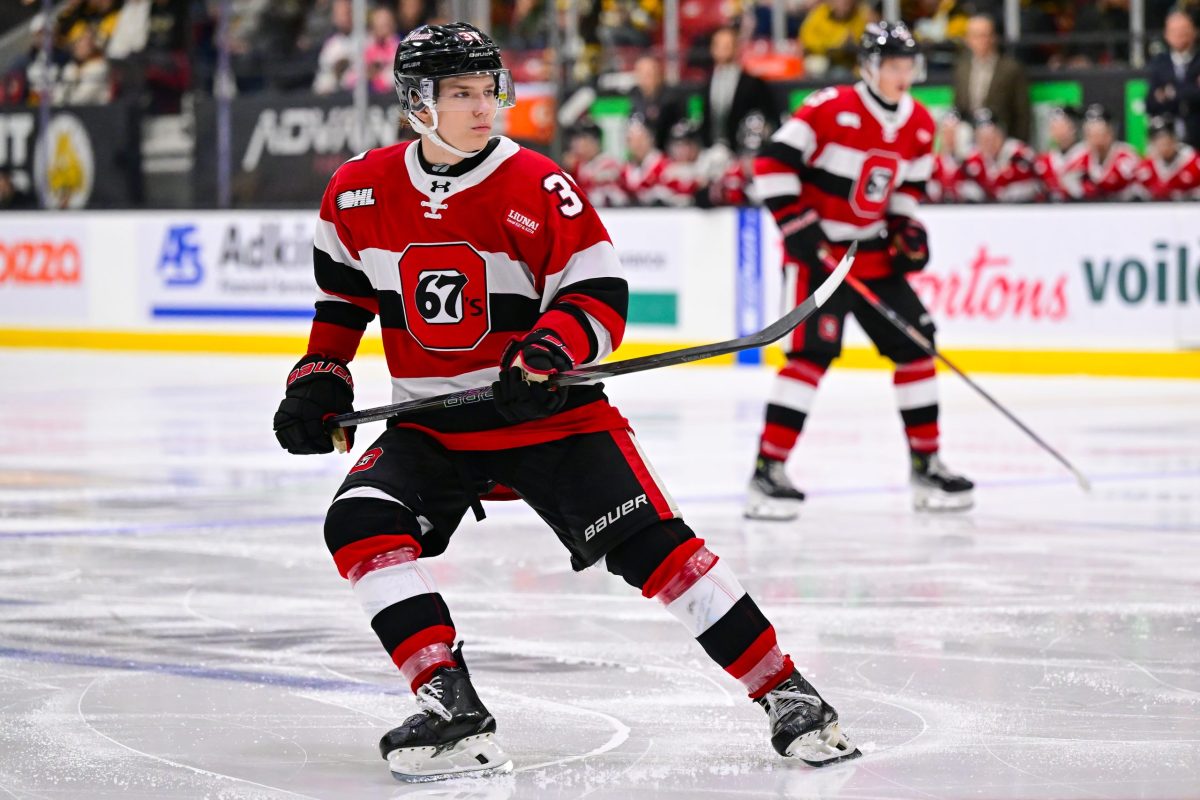
Position: C, Shoots: L
H/W: 6’0 / 181 lbs
Date of Birth: Sep 8th, 2008
Stats to Date: 59 GP - 25 G - 25 A - 50 PTS
Thomas Vandenberg returned home to Ottawa after a brief stop in Cedar Rapids, where he led the USHL Roughriders in playoff scoring. His homecoming was spectacular, recording a hat-trick and an assist against Ottawa’s rival, Kingston. While the 67’s came up short of their championship aspirations, Vandenberg was a bright spot all season, making clear improvements in his shot and strength in the first half of the year. His development came mostly in the first half of the year as he adjusted to the OHL, and as the second half progressed, it was clear Vandenberg was playing well but not improving at a leap-and-bound pace like before.
The U18S were a rough way to end the year for him, with just one point through four games, and overall he was uninvolved in the offence. However, he showed lots of promise in his own zone, defending with intelligence and intensity. He found a way to bring a positive impact despite the lower scoring numbers.
This season, Thomas added around ten pounds to his frame, which showed up when wrestling along the boards as well as in his shot, which gained considerable power. He still has more room to grow and add muscle, currently sitting at 6’0, 178 lbs. He does like to frequent the net front, doing everything from screening goalies to batting pucks home off the rebound.
Vandenberg’s best features include his powerful release, quick feet, and fast acceleration, as well as his intelligence without the puck on his stick. He also works hard on the forecheck and loves playing out of the dirty areas on the ice. He plays well low on the power play to create chaos netfront and high on the penalty kill, taking up a large amount of ground. He does struggle with decision-making when in possession of the puck, particularly on the rush, where he throws far too many low percentage passes to the slot. Vandenberg may also struggle adjusting to higher levels where his style of game is less effective against larger, stronger players, particularly in front of the net.
He’s committed to Providence College for the year after next. He’s well-suited for the league with his commitment to playing positionally sound defense and counterattacking with pace. Vandenberg will return to Ottawa for 2026-27 and will very likely put up some outstanding numbers in his DY+1 OHL season. As for an NHL projection, he looks to be a middle-six checking forward who can provide some offense and serve on both the PK1 and PP2. His pace, strong stick on defense, and relentless effort will serve him well in pro hockey.
Characteristics
Skating
Vandenberg’s skating is well above average, and the core reason is his footspeed. Vandenberg accelerates hard through quick steps and has another gear to beat defenders. He’s often able to create space on the rush by getting up to full speed and threading pucks to the slot. His defensive footwork is solid, using four-directional movement to pressure attackers to the outside. He does a good job of using his feet to block lanes and kicks pucks away from their intended targets regularly. His skating reminds me of a Jett Luchanko type, where the most impressive part is the ability to create separation in a straight-line race. Adding in more creative edgework to open space for him laterally would be the ideal next step in his development; something Luchanko hasn’t quite added to his game.
Here, Vandenberg shows off his quick changes in direction with a pivot to create separation. He ends up getting outmuscled and thrown off balance.
He might not be the most dynamic puck-carrier, but Vandenberg uses his feet to create space with quick body fakes. Since his game revolved mostly around straight line attacks, this trait is neccessary.
Vandenberg’s skating in transition is on full display here, but he loses an edge after making a nice move to the inside. He’ll need to work on his stability and strength.
Here’s a good example of how Vandenberg uses his footwork to limit space. As soon as he stops, he pivots and starts cutting down the angle for the secondary attacker. Forcing them out of the middle.
Grade: 55
Shot
Vandenberg has an interesting release where he drops pretty low in his shooting motion. It worked well for him, aiding him in finishing 6th in U18 OHL goalscoring. Vandenberg often shoots off balance and has success picking top corners. He’s proficient in knocking loose pucks home with quick hands on the doorstep. Vandenberg’s wrister packs a punch, and he rarely misses finishing on cross-crease chances when forced to use a one-timer. His sneaky shot while skating meshes well with his breakaway speed and will earn him many junior goals. Vandenberg can get tunnel vision shooting on the power play occasionally.
Vandenberg maneuvers to the perfect position to get his quick shot off, then makes no mistake burying the chance through bodies.
Here, he flexes his wrister with a laser to beat the Kingston netminder. Vandenberg showed he’s a shooting threat from deep this year, particularly late season.
Nice one-timer here. Since Vandenberg’s center of mass drops so low when he shoots, he often ends up on the ice afterwards.
Here’s a strong finish while speeding towards the net. He picks his spot and rifles the puck low, giving the goalie no shot.
Grade: 55
Skills
Vandenberg’s do hold him back from his potential a bit. He has a bad habit of carrying the puck too far away and not respecting defenders’ abilities to throw a poke check and knock loose pucks. He could benefit from limiting his upper-body movement when building speed, as it hinders his ability to maintain possession. Thomas is rarely able to come out of traffic cleanly and has a fairly low win rate in 1v1 battles. His stick skills are mainly limited to net front play, where he does a good job of putting rebounds and deflections in the back of the net. Overall, far too many plays die on his stick, and his game in transition relies more upon his quick puck movement and skating.
Vandenberg gets on this puck quickly and uses his quick hands to knock the rebound home. His hands on the doorstep are high-end.
Here, Vandenberg escapes pressure with a quick move and extends the possession with a safe pass back to his defenseman.
You don’t see Vandenberg attack defenders head-on in a 1-on-1, but here he does a good job of making a move and taking the puck right to the net. It’s still not an area that he excels in.
Beautiful toedrag to get inside on the powerhouse Kitchener Rangers’ defense.
Grade: 50
Smarts
In the offensive zone, Vandenberg uses his smarts to get open down low and along the wall, rotating his hips and shifting in and out of shooting windows to maximize his threat as a shooter. Thomas crashes the net opportunistically and regularly finds rebounds as soon as they come off the netminder. Below the goal line, Thomas’ playmaking smarts allow him to set up one-timers and test goalies with quick wraparounds. He’s a decently creative playmaker, but it seems he’ll lean more into being a shooting threat.
In transition, Vandenberg’s smarts are a little limited. He struggles with turnovers, particularly on controlled zone entries where he often attacks in a north-south manner, before throwing passes to the slot. By mixing in more lateral movement, he could keep defenses guessing, opening the door to show off his speed when defenders respect other options. He can also try to break through traffic by skating at full speed through it, looking to slip by the outside, and as Vandenberg progresses to pro hockey, this habit could hinder his efficiency carrying the puck in transition.
Defensively, Vandenberg is a tremendous asset. His stick in the defensive zone is always well-positioned, using it to take away lanes and then mirror the puck carrier’s, racking up a ton of breakups and takeaways. His defensive stick works in tandem with his strong mobility and efficient quick bursts of speed. Thomas hawks down rushes to pressure opponents out of dangerous areas, engaging physically to get his stick on the puck. Vandenberg also identifies the next highest threat to cover swiftly, effortlessly clogging up lanes on defense. He has a strong feel for the game on defense. Vandenberg projects to a checking line role and PK1 with his 200-foot, speedy game.
Thomas is good at keeping the puck moving to create advantages in space. Here he makes a nice feed on the go and drives to the net for the return.
Despite having his head up, Vandenberg misses the opponent and keeps the puck in an exposed position, allowing for an easy forced turnover.
Vandenberg shows off some quick thinking to get the puck off the boards and to his teammate in a dangerous scoring position.
Vandenberg sells a shot, looking to the net before making a cross-ice feed to his teammate. He knows his threat of scoring from that position on the ice allows him to draw in more attention.
Two common habits Vandenberg displays frequently are shown in this clip. The first being his support against the rush. Vandenberg seals off lanes laterally and behind the puck carrier to create turnovers near the blueline, causing odd-man rushes. The second being how Vandenberg can’t turn this situation into an offensive zone possession. He tries to attack in a straight line, and when caught up, he throws a blind pass to where his teammates are. He misses that the best play would be to dump it in hard, where the far side winger can skate onto the puck freely and establish possession.
Grade: 55
Physicality/Compete
Vandenberg won’t be the type of guy to level an opposing forward or start fights, but he uses his body effectively to separate puck carriers of possession. Thomas gives them no space to operate by stepping inside on them and attacking the puck, then boxing out and turning the puck up ice. He works hard along the boards in battles and chases down the rush to deny chances. On offense, he’s always adjusting angles and moving his feet to open up shooting lanes. Even deep into a long shift, as soon as Vandenberg gets the puck in his own zone, he immediately breaks up ice and starts the rush with a burst of speed. Most of his defensive highlights come from pressuring the puck carrier from behind, forcing a pass, and chasing down the loose puck to be the first one there.
Vandenberg isn’t the strongest, but he competes hard and has good contact skills before acquiring the puck, earning him a prospective grade of 55 for his physicality and compete.
Vandenberg consistently puts in good effort to earn pucks on the doorstep. He’s always the first guy onto loose pucks, putting forth a good effort level to earn his team possession.
Thomas mixes reverse hits into his game to create separation and time for himself. Here he delivers a brutal one, knocking the Norwegian opponent to the ice.
Here, Vandenberg gets involved in a scrum. He doesn’t engage in these too rarely and often abstains from roughhousing after the whistle.
Another example of using a reverse hit to give himself an advantage going into the battle.
In this clip, Vandenberg pesters the puck carrier to knock the puck loose and then springs onto it, taking possession. He’s great at being the first man on loose pucks.
Vandenberg shows off some nice defense, knocking a puck loose then immediatley starting the rush. As soon as he contacts pucks, he’s already looking up ice, ready to start the attack.
Grade: 55
OFP: 53.75
A note on the 20-80 scale used above. We look at five attributes (skating, shooting, puck skills, hockey IQ and physicality) for skaters and six for goalies (athleticism/quickness, compete/temperament, vision/play reading, technique/style, rebound control and puck handling). Each individual attribute is graded along the 20-80 scales, which includes half-grades. The idea is that a projection of 50 in a given attribute meant that our observer believed that the player could get to roughly NHL average at that attribute at maturity.