


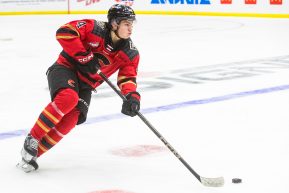
 Position: D, Shoots: L
H/W: 6’2”, 198 lbs
Date of Birth: 2008-06-23
Defencemen with a proven record of steady defense and offensive ability, along with size and physicality at the junior levels are coveted towards the top of the NHL Draft every year. One of the defenders that fits the bill this year is Carson Carels.
Hailing from Cypress River, MB, Carels was drafted 16th overall in the 2023 WHL Prospects Draft by the Prince George Cougars. He joined the Cougars full-time in the 2024-2025 season and made an immediate impact as their second leading scoring defenceman that year. He also participated in the World U-17 Hockey Challenge and IIHF U-18 World Championship.
This past season saw him become one of the best defencemen in the entire WHL. He was tied for fourth in points by a defenceman (73 points in 58 games), while providing strong defence and a physical presence not often matched by players who scored at similar rates. He was also one of the league leaders in minutes played per game at just over 25 minutes/game. Carels had a strong playoffs with the Cougars, getting to the second round while scoring 10 points in the same number of games. His season was also highlighted by a selection to Canada’s World Junior Championship team as one of only four draft eligible players on the roster. He also competed in the CHL/USA Prospects Challenge and the inaugural WHL Top Prospects game.
Carels will be a high selection in the 2026 NHL Entry Draft. His defence, transitional play, and physicality are all valued by NHL teams and there’s a strong possibility that he will become a top pair defenceman in the league. NHL Central Scouting never had him below third in their North American skater rankings this year. One of the few questions about Carels game at this point is how much of his offence will translate to the NHL. Let’s take a look at what makes his game so special.
Skating
Carels is an above average skater. He’s got good four way mobility and acceleration and can get himself out of trouble in the defensive end when he needs to. He also uses his skating to put himself into good position for shots as he arrives late into the offensive zone. His best skating trait is his ability to skate the puck out of the defensive zone. His transitional play allows him to lead the charge into the offensive zone to set up a teammate for a scoring chance or take the puck to the net on his own. The rush-led attack from Carels is possible because of his ability to build up speed in the defensive zone and then use edge work to create space in the neutral and offensive zones.
This first clip is a great example of Carels (#4 in red) using his acceleration and agility to gain the offensive zone and create space for a shot on goal. Early in the clip he uses his edges well to start to build up speed before he receives the puck, which allows him to push through the neutral zone before a defender can get to him. Once in the offensive zone, he opens up his hips to change his skating direction and create space for himself when the defender moves to protect the slot.
This next clip is typical of Carels (#4 in red) exiting the defensive zone without the puck at the start of the play. Upon seeing his teammate with puck possession, Carels accelerates hard to become a passing option, gaining speed as he receives the puck. He’s able to use that speed to pull two defenders to him as he enters the offensive zone. This creates space for a teammate to move into scoring position.
Similar to the previous clip, this is another example of Carels using his skating to create offence. Once again starting without the puck in his own zone, Carels (#4 in red) doesn’t immediately blow the zone once his team has possession. Instead he waits and makes himself a passing option. He uses a quick touch to push the puck past the closest defender and then accelerates through the neutral zone. The defender in the offensive zone uses a good gap and active stick to take the slot away so Carels flips his hips to protect the puck and allow time for teammates to get into passing lanes.
This last clip has Carels (#4 in red) picking up the puck after an opposition scoring chance and wheeling the puck from behind the net. Using the time and space, he’s able to accelerate through the defensive zone and get past the first defender. The neutral zone defender has taken away space, so Carels chips the puck off the wall to keep his speed instead of slowing down. This allows him to get past the defender and put the puck on net for a chance.
Grade: 52.5
Shot
As one of six WHL Defencemen to score 20 or more goals this past season, Carels shot is one of his strengths. He has a deceptively strong and accurate wrist shot which he uses to pick corners often. He has an affinity for the top left corner, up over the glove hand of goaltenders. While his shot is close to NHL ready, with a bit of work on his hand placement at the time of release, it could become even more of a weapon.
This first clip has Carels (#4 in red) receiving the puck in the offensive zone and taking available time and space to get closer to the net. He waits for the opposing player to get close enough to make it harder for the goaltender to see the puck, and then rips it top left corner for a goal. A well placed goal with great timing to keep the goaltender from getting a clear view on the shot.
This goal has Carels (#4 in red) receiving the puck and skating into a shooting lane on a four on four opportunity. Carels likes to use layers of traffic to take away the goaltender’s eyes, making it even harder to stop his accurate wrist shot. Another top left corner goal for Carels.
In this clip, Carels (#4 in white) doesn’t have as much time to load up his wrist shot with defenders nearby. Despite that, his shot still has enough velocity and accuracy to get past the goaltender high on the glove side.
Carels (#4 in white) also has a little flash and dangle to his game. While not a typical play, this overtime winner shows that Carels has enough skill to make a goaltender commit to a shot fake and then score.
Lastly, it’s nice to see a little bit of old school defenceman in Carels (#4 in white), with a booming slap shot goal. It’s a shot that seems to be disappearing from the game, so it’s nice to see Carels has worked on it enough to be able to use it to score.
Grade: 55
Skills
An area that can be considered one of the more underrated parts of his game, Carels is a very good passer. He’s very responsible with the puck on his stick and rarely misses with his passes. He was tied for fourth in assists by a defenceman in the WHL this past season and was the quarterback of Prince George’s powerplay. His ability to handle the puck while carrying it for zone exits and zone entries is also very good, as seen in some of the clips in the Skating section. While he doesn’t possess the same level of skill as some of the more offensively inclined defencemen in this draft, this is still an area where his traits, especially his passing, stand out.
Carels (#4 in red) has the ability to stretch a pass among the best of any player in this year’s draft class. Once he gets the puck in this clip, he starts to evaluate the positioning of the opposition. He skates the puck out from behind the net with his head up and fires a near perfect pass from the defensive face off circle to the offensive blue line, springing his teammate for a breakaway. The accuracy of this pass is very good as he had to thread it past three nearby opposing players.
This clip is a variation of the same theme. This play sees Carels (#4 in red) stretching his pass across the ice diagonally, past three defenders again, and springing his teammate for another breakaway. This particular pass ends up in a better spot for the forward, receiving it on his forehand, in order to maintain speed and momentum.
As mentioned, Carels (#4 in red) quarterbacked the power play for the Cougars this season. Prince George’s power play design usually had Carels relatively stationary at the top of the zone, acting as the top of the umbrella, but in this clip he sees some open ice and a chance to get the opposition’s penalty killers moving around. All of the opposing players end up watching him and he’s able to thread a pass past three defenders (again) for a one timer goal.
Another power play assist for Carels (#4 in white) here. In this clip, he’s standing at the top of the offensive zone in his usual spot. In this kind of formation, the skater up top is usually looking to pass to the flanks at the sideboards or trying to sift a puck through traffic on net for a goal or a tip by one of the net front forwards. But Carels sees one of his teammates separate from a defender near the net and starts a passing sequence that results in a goal.
The last clip in this section is another stretch pass from Carels (#4 in black). This particular pass comes from the bottom of the defensive zone face off circle with a defender keying in on him to break up any pass attempt. Despite the pressure, Carels is able to use the boards to bounce a pass to a teammate at the offensive blue line, leading to a zone entry.
Grade: 55
Smarts
This is one of the areas of Carels’s game that is already strong, while continuing to improve. His season started with a big jump in how he processed the game offensively, and as the year progressed, you could see Carels confidence in knowing what to do with the puck grew. His defensive reads defending the rush are already quite good and he snuffs out plays quickly. His reads in the defensive zone once the cycle is established aren’t quite as good but it’s an area that Carels should excel at in time as well.
The read on this first play by Carels (#4, in red; off-screen at the start of the video) is pretty high level. While some defencemen would take the offensive player without the puck, leaving the shooter to the goaltender, Carels diagnoses that the puck carrier is already out wide and he can use his positioning and stick to keep him there. Carels also sees one of his teammates backchecking to take the skater without the puck, so he commits to taking the puck carrier. From there he takes the skater into the end boards, stopping a dangerous chance.
The anticipation and confidence to make this play are what stand out here. Much like a Safety in football, Carels (#4 in red) diagnoses where the passer is going with the puck and intercepts the pass. A zone exit by the other team quickly becomes a three on two in the offensive zone for the Cougars.
This play is from the Hlinka Gretzky tournament at the start of the year. It’s a nice give and go that show Carels (#5 in red) offensive instincts had already improved from the previous season. Pulling two defenders to him and waiting for a passing lane make this a prime scoring opportunity for Team Canada.
Another passing play from Carels (#4 in red) here. This play highlights his vision in the offensive zone, from both puck carrying and passing perspectives. From the time he receives the puck, Carels is looking for a way to get the puck back to the middle of the ice. His ability to see an open teammate and make the pass instead of taking a shot that would likely be blocked is quite good here.
This clip sees Carels (#4 in white) use his vision and passing to create a zone entry. The key to this play is seeing that a pass is better than trying to rush the puck up the ice himself with the opposition players layering across the neutral zone. Once his decision is made, he makes a nice bounce pass off the boards to give the forward an opportunity to skate onto the puck while accelerating.
At first glance, the beginning of this play looks overly aggressive with Carels (#4 in white) skating himself out of position to make a hit, but it’s a calculated choice based on the puck carrier already being along the wall and having very few outlets with the puck. Once he has the puck back, Carels smartly does a shoulder check and sees the oncoming pressure. From there, he waits until the forechecker commits to making a hit and feathers the puck into the area that player had vacated, creating a zone exit opportunity.
Grade: 60
Physicality/Compete
If there’s one area of his game that coaches will never have to worry about with Carels, it’s his desire to compete. It’s arguably his best attribute. His motor is always running and it’s rare to see a shift where he doesn’t impact the game in a positive way. He’s already got great size and strength, and a mean streak to use those assets effectively. Carels will give you his best on the ice, shift after shift.
Carels (#4 in red) uses an active stick when gapping up to defend the rush and is often able to knock the puck away from puck carriers. In this clip, he’s able to do so but the forward has too much speed and gets past him. Carels follows the forward and the puck behind the net and checks the player to the ice, while also knocking down a teammate. Carels knows the play isn’t over and he recovers back to the front of the net in time to prevent a scoring chance.
This clip is pretty simple. Carels (#4 in red) snuffs out a zone exit by the opposition by absolutely destroying the player as he receives the puck at the blue line. Anticipation and timing are the keys to being able to make plays like this.
This play starts with Carels (#4 in white) defending his side of the ice as the puck carrier enters the zone. Once the player starts to slow up along the wall, Carels decides to use his physicality to take the puck away from him. While the forward is able to pass the puck, Carels is still able to get back into position to stick check the puck away. Carels singlehandedly takes offence away from two players in quick succession.
Another example of Carels (#4 in red) eliminating a zone exit by an opposing player. This time the forward doesn’t have his head up as he concentrates on maintaining possession of the puck and Carels lays him out with a clean and heavy check.
Admittedly, this check could be considered late and a penalty, but Carels always does a good job of letting opposing forwards know that spending time in his zone will not be easy when he is on the ice.
Grade: 60
OFP: 56.625
A note on the 20-80 scale used above. We look at five attributes (skating, shooting, puck skills, hockey IQ and physicality) for skaters and six for goalies (athleticism/quickness, compete/temperament, vision/play reading, technique/style, rebound control and puck handling). Each individual attribute is graded along the 20-80 scales, which includes half-grades. The idea is that a projection of 50 in a given attribute meant that our observer believed that the player could get to roughly NHL average at that attribute at maturity.