


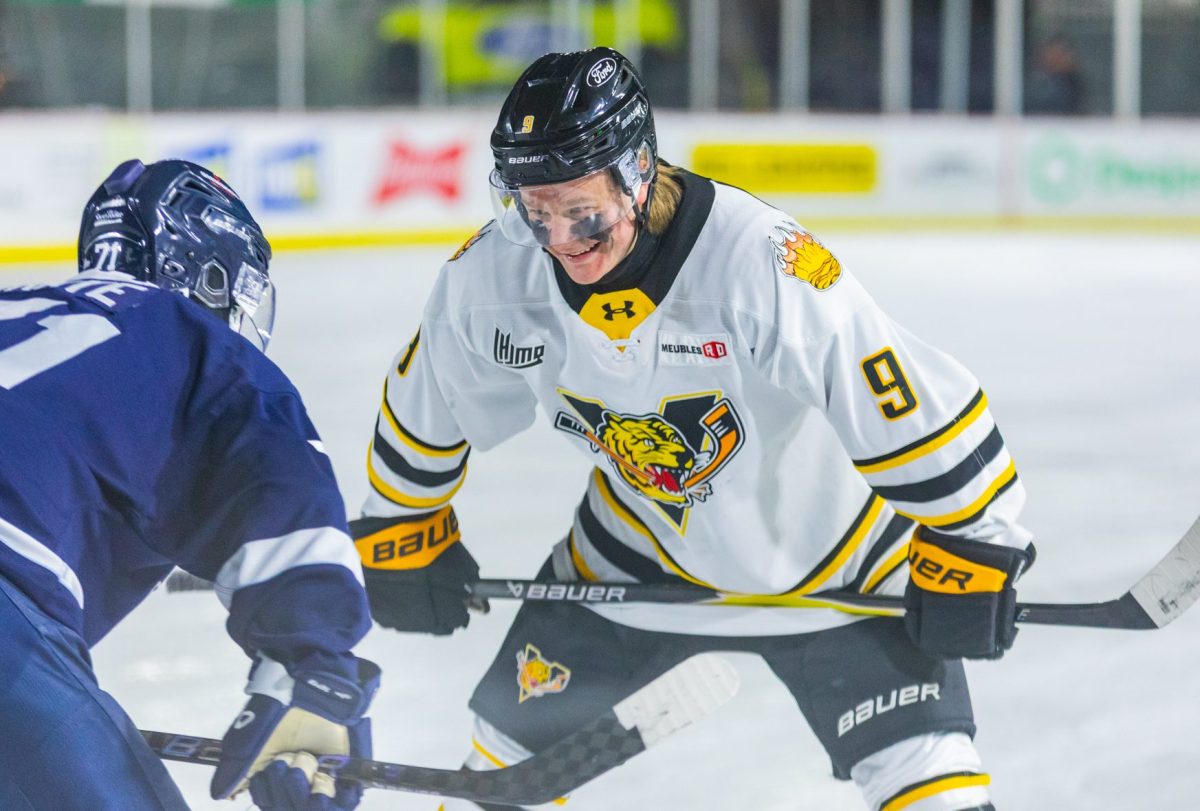
Egor Shilov
2026 NHL Draft Eligible
Position: C, Shoots: L
H/W: 6-foot-1, 181 pounds
Date of Birth: 2008-04-30
With the 2026 NHL draft shaping up as a class that lacks true high-end pivots, Egor Shilov has quickly emerged as one of the QMJHL’s top rookie prospects this season and one of the most intriguing and talented players available at his position. After winning the Districts Cup at the U17 level in 2024 and hearing his name called fourth overall by the Green Bay Gamblers in the USHL Draft, he decided to move to the U.S. to adapt to the North American game—a decision that has paid dividends in a significant way.
Shilov began last season dominating at the 16U AAA level with the Long Island Gulls before joining Green Bay in November, where he provided steady offense with an impressive 28 points in 39 games as a 16-year-old rookie facing older competition. His play in the USHL earned him a third-overall selection by the Victoriaville Tigres in the CHL Import Draft last summer, who also selected his longtime linemate, Alexei Vlasov, to convince him to play with them and it worked. Since their arrival, the duo has thrived from Day 1 and quickly climbed to the top of the QMJHL scoring leaderboard, drawing significant attention from scouts. What’s most impressive throughout Shilov’s journey is how well he has adjusted, improved, and ultimately dominated at every level over the past several years.
Shilov profiles as a cerebral and versatile center with elite vision and high-end puck skills. He excels at supporting possession, manipulating defenders, and creating high-quality scoring chances through anticipation, deception and creativity. He’s a true play driver that can dictate the flow of the game and a facilitator who can be trusted in all situations. He’s also got decent size and thrives on faceoffs. The only concern in his game is his tendency to slow the pace and avoid physical play, which could present some serious challenges at the professional level. That said, his tools are too compelling to ignore.
He’ll likely need a couple years to work on those issues and build better habits, but playing in the NCAA next season should definitely help as he’s committed to Boston University, where he’ll join several high-end players in Tynan Lawrence, Luke Schairer, and maybe returnees like Cole Eiserman, among others. Growing in this kind of environment makes his selection only so more enticing, because players at Shilov’s position and with this type of skillset don't run on streets. If he can add pace and some physical edge to his game, his projection becomes really intriguing, with legitimate top-six NHL forward potential in the years ahead. I can definitely see a scenario where Shilov develops into a solid, dependable No. 2 center on a championship team, provided that he adapts to a higher pace of play.
Skating
The overall opinion on Shilov’s skating is something of a mixed bag, largely for two reasons: first, it’s neither his strongest nor his weakest asset, and second, he tends to slow the pace rather than blaze past defenders. He’s a balanced, low-activity skater with a nimble, smooth stride that allows him to glide efficiently and gain speed through linear crossover, maintaining momentum while scanning the ice. You’ll see him move with an upright gliding posture, loosely reminiscent of Zayne Parekh, though without the same level of elite edgework and agility. Even if not as much elite, his edgework is still very strong, allowing him to execute tight turns without losing too much speed and to maintain possession rather than being forced into rushed decisions. One notable positive is his occasional use of a mohawk stride to generate lateral speed through transition. It helps him shift defenders, open passing lanes and extend puck possession in the offensive zone, particularly when walking the line under pressure.
Where Shilov’s skating falls short is in its lack of explosiveness, particularly in his first few steps. He doesn’t have strong first-step acceleration, which limits his ability to separate from defenders or recover when beaten. As a result, he rarely goes full throttle and instead prefers to pace himself, leaning heavily on anticipation, positioning and his ability to read the play to support pressure. These habits work well in junior hockey, but against bigger and faster competition, it may be more difficult for him to create space and drive plays this way. He would receive a better grade if not for his intermittent motor.
Egor Shilov is #9 in all clips.
Here, Shilov collects the puck and immediately transitions into a smooth mohawk stride, gliding laterally across the neutral zone with poise. He threads his way through a cluster of defenders with quick hands in-tight, showing impressive balance and control on his edges before driving toward the net for a shot. Even without top‑gear acceleration, Shilov consistently finds ways to complete successful entries and create plays.
Shilov stays close in support in his own zone, picks up the puck for the breakout, shifts the defenders before gaining the offensive zone, and walks the line before setting up his teammates with a drop pass on the drive. You can see how he quickly shifts gears and direction without losing much speed.
Here is an example of Shilov using smooth crossovers to gather speed in transition. He maintains his balance and momentum, though he hasn’t yet unlocked that extra gear.
Another sequence where Shilov demonstrates both his shiftiness and smoothness, though it also serves as a clear example of his tendency to lose speed and his lacking pace when skating into the offensive zone.
GRADE: 52.5
Shot
Although he profiles more as a playmaker and facilitator, Shilov possesses an underrated shot. It’s worth remembering that he was a more prolific scorer earlier in his development and those instincts don’t simply disappear. He’s highly impactful from anywhere in the offensive zone, equally capable of zipping pucks from the flank or the bumper spot, and he also thrives around the net thanks to his deft hands. While he often operates from the flank and can one-time the puck from there, he isn’t a pure spot-up shooter, since the majority of his goals come off transition plays and second-chance opportunities as the trailer driving the net. He can also flash a quick snapshot that can beat goaltenders cleanly from distance—a weapon I would like to see him exploit more off the rush.
Shilov scores a large share of his goals this way—by supporting the rush as the trailer and putting himself in the right place at the right time. Here, his teammate Alexei Vlasov sets him up with a beautiful no-look, behind-the-back pass, leaving Shilov with a wide-open net.
Here’s another example of him capitalizing in transition, by joining the rush, finding soft ice and making himself available to finish the play.
In this sequence, Shilov capitalizes on a fortunate bounce and uses the opposing defenseman as a screen to change the angle of the puck and unleash a lethal shot that finds the back of the net. With no other option available, he had no choice but to shoot, and this is exactly what happens when he pulls the trigger, which is exactly why he should be shooting more frequently.
We can see here that if you give him just a little bit of time and space, he can definitely thread the needle and score with little room. Even though he’s not a typical high-volume scorer, Shilov needs to be respected as a shooting threat.
GRADE: 52.5
Skills
This is Shilov’s area of expertise. He demonstrates dynamic puck-handling abilities, blending creativity, deception and composure to routinely beat defenders in one-on-one situations. His handling is incredibly smooth and elusive, allowing him to navigate traffic effortlessly while protecting the puck with his hips. Whether maneuvering through tight spaces or slowing the pace to create room, he maintains remarkable control of the puck. He makes effortless (and successful) uses of high-level dangles, slipping pucks under triangles, or deceptive between-the-legs feeds, among others, keeping defenders guessing and creating opportunities for himself and his teammates. His ability to carry the puck through the middle of the ice and thread through tight space is truly unmatched.
His vision and passing ability are also advanced. He consistently completes difficult feeds in tight spaces, often with limited time and room to operate. His patience with the puck enables him to create openings for teammates, threading precise passes through extremely narrow lanes. One concern with his puckhandling is his tendency to lose speed while dangling through the middle in an attempt to slow the play down—a habit that may be more easily neutralized at the pro level yet again. He also occasionally holds onto the puck too long or force plays, which can lead to some unnecessary turnovers.
This is a great example of Shilov’s ability to maneuver through traffic all around the offensive zone with ease and set his team up offensively. This is a routine play for him.
I wanted to highlight Shilov’s playmaking prowess here, as he delivers a crisp, pinpoint-accurate feed to his teammate’s blade off the rush, leading directly to a goal.
Here’s a highlight-reel play that reflects an ability Shilov displays every game: he confidently carries the puck from his own zone into the offensive end, slicing through the middle of the ice and past defenders with deceptive shoulder fakes and surgical puckhandling, before delivering a jaw-dropping behind-the-back feed for a goal.
That’s a great dish from Shilov after stripping the puck from his opponent’s loss, smoothly toe-dragging another defender and drawing three players toward him to find his open teammate in front of the net for a goal.
Another example of Shilov effortlessly entering the zone, evading pressure and finding the open trailing teammate for a perfectly placed goal from the high slot.
GRADE: 60
Smarts
This is a foundational element of Shilov’s game: his exceptional hockey sense and play-reading abilities. He’s a true offensive catalyst, capable of driving play as a primary puck carrier or supporting effectively as a secondary option. As noted, he displays impressive poise and patience with the puck, allowing lanes and opportunities to develop rather than forcing plays, consistently translating into high-quality scoring chances for his team. Shilov processes the game a step ahead, showing great off-puck awareness and positioning. He is consistently available in support, serving as a reliable outlet by staying within range of the puck carrier offensively, or by rotating high and covering for defensemen when needed. He’s highly aware of his defensive responsibilities and adjusts instinctively, often curling low to present a central breakout option when opposing forecheckers take away the walls. He also does a neat job defending neutral zone breakouts, denying the middle of the ice and steering rushes toward the perimeter. He’s more of a reactionary forechecker who relies on anticipation and positioning to block passing lanes and suppress options.
What further elevates his value is his versatility: he can be trusted in all situations at five-on-five and on both special teams units. Notably, he ramps up his intensity on the penalty kill, where he aggressively pressures puck carriers, closes space quickly and tracks effectively with an active stick. He also brings value in the faceoff circle, winning over 56% of his draws while showing steady improvement throughout the season. Beyond simple wins, he demonstrates the ability to deliberately direct faceoffs to teammates’ blades, creating dangerous quick-strike set plays from the circle.
Here’s a clever play by Shilov: noticing his defenseman about to start the breakout but with limited options on the flanks, he curls back toward the net front to provide an easy outlet, then completes a smart give-and-go to secure a successful breakout. He makes his defensemen’s job much easier.
This is a textbook example of Shilov’s lethal impact on the power play operating from the flank. His deception is uncanny as he sells the shot, shifts his angle and delivers a pinpoint feed without even looking. He’s patient with the space he has, expertly manipulating defenders and forcing lanes to open.
Once again, Shilov excels at drawing defenders in like a magnet and effortlessly finding open teammates off the rush without looking. What a drive!
Exhibit B, incredible feed from behind the net.
Here’s a prime example of Shilov’s defensive impact translating into offense. He uses a well-timed stick to disrupt an exit, carries the puck from the wall to the middle, and patiently navigates around the net, waiting for the perfect opportunity to finally create a high-quality scoring chance.
Here’s a series of Shilov’s impressive defensive plays in his own zone, using his stick with precision to deny entries and stifle the opposition’s chances.
GRADE: 57.5
Physicality/Compete
This is the area where Shilov is lacking and one that raises concerns for his professional projectability. He demonstrates a noticeably lack of physical engagement, rarely finishing checks and arrives late on the forecheck. In fact, he has recorded only four hits this season (per InStat), highlighting the missing physicality in his game. While he does occasionally use his frame to protect the puck or separate from defenders, these moments are sporadic and rather inconsistent. At times, it seems that his efforts are strategically conserved for breakouts. His compete level fluctuates over the course of a game and he often appears disengaged in battles along the boards. This lack of motor and willingness to engage physically makes him a polarizing player.
These two plays highlight Shilov’s ineffective forechecking and his reluctance to fully engage physically.
He’ll definitely need to bulk up a bit, because hits with this kind of power won’t do much at the professional level.
GRADE: 42.5
OFP: 54.125
A note on the 20-80 scale used above. We look at five attributes (skating, shooting, puck skills, hockey IQ and physicality) for skaters and six for goalies (athleticism/quickness, compete/temperament, vision/play reading, technique/style, rebound control and puck handling). Each individual attribute is graded along the 20-80 scales, which includes half-grades. The idea is that a projection of 50 in a given attribute meant that our observer believed that the player could get to roughly NHL average at that attribute at maturity.