


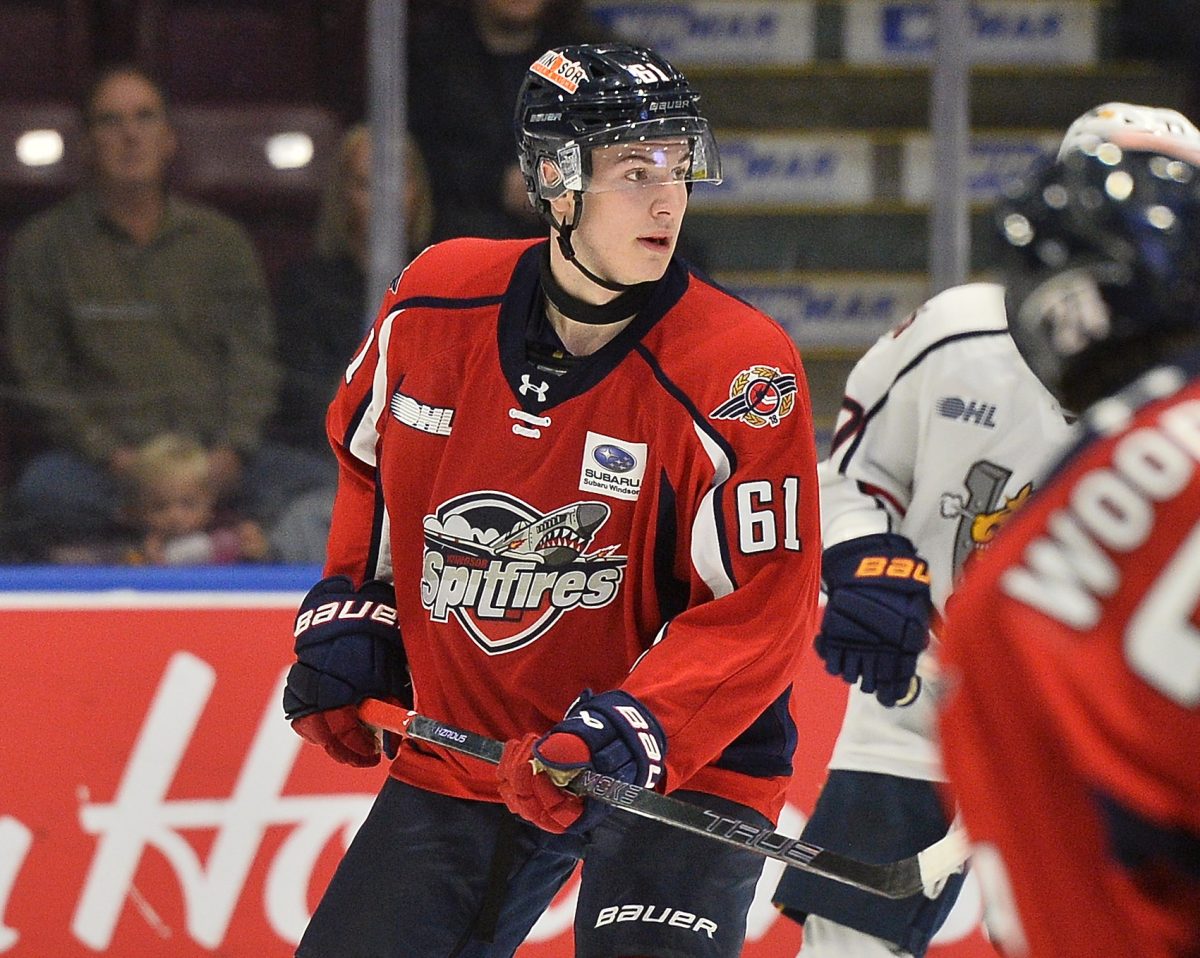
Ethan Belchetz
2026 NHL Draft Eligible
Position: LW, Shoots: L
H/W: 6-Foot-5 / 227 Pounds
Date of Birth: Mar 30th, 2008
Ethan Belchetz has followed up his impressive rookie OHL season with a high-scoring campaign, on pace for over 40 goals. The monstrous winger knows his role and executes his game plan well, making him a fairly easy projection to the NHL. He’s not a guy who will excel at driving play in transition or weave to the slot with stickhandling in the offensive zone, but rather a player who can connect plays and make one strong move to get his shot/pass off. I do feel like Ethan is a more intelligent player than he gets credit for, and while his reads with the puck are wildly inconsistent, I love his feel for the game and how he’s able to find soft spots in a defense. Belchetz plays in all situations for Windsor, helping their push for an OHL title, delivering a high volume of hits per game, dominance in the paint, and compete on the forecheck.
The improvements made to Belchetz’s agility over the offseason are evident. He’s leaner and more agile, adding some new tools to his forecheck and cycle game. Even at this point, I don’t believe he’s as physically mature as his height and weight would suggest. Ethan continues to look more comfortable in his frame, and with an NHL team invested in his development, I think we see a stronger, quicker Belchetz that’s lighter on his feet and doesn’t fade as the game progresses.
In an NHL arms race for big, physical players who can make an impact on the scoresheet, I see Belchetz as a likely top five pick in the draft come June. Teams will love the value in a 6’5” often-hitting winger with great goal-scoring instincts. In an interview he praised Brady Tkachuk’s well-rounded game, and I really like this projection. Tkachuk had a bit more of a trim frame and better athleticism in his draft year, but the similarities are there. They share similar speed, rely a bit too much on volume of touches, have a nose for the net front, and can mix it up after the whistle.
As for his development in the next few years, I’d love to see Belchetz make the jump to the NCAA next year. He was coveted by Michigan State University and the University of Michigan before deciding to take the OHL route, and both teams are adding potential 1st round picks and bringing back elite rosters for 26-27. He’d be playing with some premium NHL prospects on either team in a fast-paced setting, which could help Belchetz improve his ability to play and think fast, as well as get his conditioning into peak form.
Skating
Ethan Belchetz is by no means an incredible skater, but it has been encouraging to see the effort he’s been making to become at least average. The foot speed is pretty much what you’d expect from a 6’5, 225-pound, 17-year-old. He’s still getting adjusted to his frame and working to shed some extra weight to become trimmer. The results from his hard work this offseason are evident; he has an extra burst of speed in his stride and is more athletic. He still has some work to do in these categories and will benefit from having an NHL development staff on his side.
As the game progresses, Belchetz’s speed does fade a bit, perhaps an indicator he still has some physical runway ahead of him before he’s a pro. His edgework is mediocre, mainly relying on his passing and positional awareness to beat defenders; again, it has shown improvement but likely will not be a strong trait. A positive about Belchetz’s skating is he gets tremendous power on the first step of his crossovers, allowing him to spring into corners hunting for pucks or break free from coverage when driving to the net.
I don’t necessarily think Belchetz needs high skating to be successful at the next level; he plays with fluidity and is able to set himself up for success with off-puck movement. A key comparable for him, Brady Tkachuk, himself doesn't have great skating and relies on instincts and the dump and chase to get him pucks.
Here’s a brief glimpse of Belchetz building up speed. It’s a good example of the current deficiencies in his skating, lacking explosiveness or quick feet. It’s also a good example of how Belchetz makes his game work with a fluid give-and-go off the backhand and a body fake to drive low.
In this clip, we see some of Belchetz’s faster skating. He keeps the feet churning and is able to create separation.
Good stability here, fending off aggressive swipes from the defender while being leaned on.
One challenge that plagues taller players more so than shorter players is the effect of being tired. The stride of taller players breaks down a bit quicker. I have faith that Belchetz is not close to being in his final physical form; expect him to get more athletic over the next two years.
Grade: 52.5
Shot
Belchetz ranks first among all draft-eligible OHLers in terms of goal scoring as of early February and scores in a variety of ways. He gets a ton of power on his one-timer, and while he prefers to jam to the net for redirections or tap-ins, it is still always a viable threat. On the doorstep Belchetz uses his large frame to earn positioning and his high-end hand-eye coordination to redirect pucks home. While he obviously won’t be as dominant when playing against men in the NHL, he’s also very proficient at timing his strikes to the net to make himself available for tap-ins. Belchetz’s wrister is his preferred shot, and he shoots it a lot, sometimes a little too much, but such is expected from a player of Belchetz’s calibre in the OHL. Another positive translatable trait is Belchetz's instinct to follow-up shots. He does well in getting to the net after being stopped and charges into corners to retrieve his missed shots.
I think his diverse goal-scoring methods will translate to the NHL as a consistent ≈30 goal scorer, primarily finishing from his net front play.
Good shooting IQ from Belchetz here. He pulls his defender across, changing up the angle before firing back across the grain with a snappy release.
Belchetz with a great deflection here, he’s dangerous in front of the net.
This clip displays a good example of Belchetz’s quick release wrister. He gets some jam on it with good accuracy.
Here’s a powerful one timer from far out.
Belchetz quickly executes a wrister from deep after a sharp turn. He picks his spot well and gets it through traffic.
Here’s a good example of Belchetz switching up his shot angle to beat the goalie. He uses a lot of lateral movement, but doesn’t necessarily toe drag allowing him to not commit to the shot.
Grade: 55
Skills
Belchetz won’t be a guy that darts around weaving through defenders, but we’ve seen flashes of brilliance when making one reactive move and passing off or shooting. He rarely ever goes back to the same deke twice, making it all the more surprising when he reveals what tricks are in the bag in 1v1 situations. I don’t see great puck control, and often the moves are a little choppy, but his ideas are super fun. If he can up the acceleration a little bit, I can see him becoming much more difficult to deal with given his ability to go through the bodies of defenders and his massive frame. After completing dekes, his (inconsistent) ability to find a passing window quickly has masked the lack of quickness thus far, but in the NHL, he’ll need another level.
I’d also like to note his skill of tipping pucks in the slot. He’s definitely one of the better deflectors I’ve seen with pretty incredible consistency both in getting wood on the puck and putting it in a tough spot for the goaltender to save.
A grade of 57.5 is definitely more prospective. Looking at his game-to-game consistency, it might seem a bit high, as he struggles to maintain possession of the puck when stickhandling, but the flashes of upside are enticing enough for me to bet on him becoming an above-average stickhandler at the NHL (and especially for his size).
A nice crafty move here by Belchetz after a deflection. Beats the defender and passes off.
Again, a very resourceful flip to beat the Brantford player and gain the offensive zone, he executes this move quickly and gets moving after completing it.
Great touch and composure on this pass reception, the same can’t be said for the decision after.
Keeping balance after attempting a deke or hit can sometimes be an issue for Belchetz. In this clip, he shows good intentions trying to toe drag to the middle for a better lane.
Great finish on the breakaway here, sells the shot and finishes strongly above the blocker.
Here, he finishes on the backhand in the shootout getting it off his stick quickly following the move.
Great flash of skill here as Belchetz leaves his defender in the dust. The bag is deep.
Grade: 57.5
Smarts
Belchetz has the “it” factor when it comes to intelligence: a cerebral understanding of how to be in the right place at the right time. It’s a large reason why I’m so high on his floor and would be thrilled to pick him anywhere from 4 to 10 on draft day. He knows how to map out seams when driving to the net to find the perfect window for his teammates and get pucks on net. He presents his stick like a silver platter for a pass, acting as a reliable outlet to connect plays and return give-and-goes. Even with his high goal totals this year, if anything, I believe he’s underscoring the total he should be at after being stuffed in close a ton. Being able to get as many touches in the paint as he does will result in goals at any level with the strength and competitiveness he possesses, and it is something I value very highly in a potential power forward.
Defensively, Belchetz does a good job of placing his stick in dangerous lanes to limit passes. The internal map really shines in this aspect, as he’s not just taking away space but rather taking away players. It also serves him well in the shot-blocking department, but it’s still limited by his footwork.
My take on his shooting IQ is a bit more nuanced. I think he does shoot a bit too much as a result of often being caught flat-footed with the puck, but I love his ability to switch things up and rotate through angles to catch goaltenders. Very rarely when in motion with the puck does he ever shoot directly on net without moving laterally. This combined with his ability to follow up on rebounds will be a great combo at the next level.
Ethan’s playmaking game is still very rough around the edges. Far too frequently he throws possession away, passing to seemingly nobody up the middle or just firing the puck into the defenders' skates before bull-rushing them to regain possession. It’s very frustrating to see as a big believer in his intelligence as a whole because I think people often overlook other parts of his puck smarts after seeing him make a boneheaded pass up the middle in transition multiple times in one shift. One positive is he’s quite good at pre-scanning before getting the puck off the boards and hitting his teammates quickly.
Belchetz scans to find his teammate breaking in unguarded. He thrives off finding lateral passes on the rush and getting the puck off the boards to more dangerous areas.
Responsible rush defense here as Belchetz backtracks to find the puck before shielding off a defender to hand it over to Croskery.
Good play to find a teammate in the middle of the ice, getting the puck off the boards and into the back of the net.
Quick thinking helps Belchetz turn around this play with a stick lift and feed to a teammate down low.
Nothing special, just consistent execution and timing as Belchetz finds a soft spot with the defender inching over, gets his stick down for a pass, and when it doesn’t come he gets to the netfront just in time for a deflection goal.
Same with this fluid play where he hands off the puck in stride and drives to the net to cause trouble.
Belchetz understands how his large frame can help him box out defenders. Here, he finds a nice pass with a touch too much zip on it. I’d love to see him use this ability more.
Grade: 55
Physicality/Compete
Starting off with compete. This is a category I’ve vastly changed my opinion of after seeing him live in mid-December and watching 15 of his games scattered throughout his DY-1 and this season in preparation for this report. Belchetz is very engaged early in games and can have shifts where he dominates the forecheck and is engaged in the D zone taking away lanes with his long stick. He is always willing to support his defenders, intelligently positioning himself to retrieve pucks and start the breakout. I find in most viewings it fades a bit later in games in the late second to mid-late third period. After reviewing a DY-1 Belchetz where he wasn’t in quite as top-shape, his compete suffered, leaving me feeling that an even leaner Belchetz could look much more engaged consistently on a shift-to-shift basis.
Belchetz doesn’t throw too many super hard hits but rather imposes his will via a steady barrage of checks and pins. The volume at which he contacts the defender on the forecheck is very impressive, forcing them to move the puck or be pressed into the boards while Windsor’s other forecheckers go to work. There are shifts where he throws himself at anything that moves, bouncing from one check to the next, forcing opponents to make mistakes. Belchetz uses his frame effectively to give himself advantages in puck battles and when protecting possession. However, he doesn’t nearly force defenders to work around him enough; I would like to see him put his shoulder down and drive to the net with the puck more often. His balance will only get better, and with improved knowledge of how to use his frame, an NHL top six will be getting a difference maker on the dump and chase.
Belchetz has some bite to his game and gets involved in scrums regularly. He’s not afraid to drop the gloves, as seen in some clips below, and stand up for a teammate. He’s had his share of dirty hits this year as well, adding to Windsor’s already woeful discipline, but he commits very few stick infractions. Overall, he’s not a guy who will lose you games by taking dumb penalties, but rather one who will take one when the time is right to change the tempo or stand up for his own.
Good O zone activity here by Belchetz. He gains possession with a hit, collects his miss, and follows up after the whistle with some physicality.
Good job by Belchetz to use his large frame to get down and take away the shooting lane.
Here’s a good example of Belchetz bouncing around the offensive zone to put the body on the Rangers’ players.
A common play seen when watching Belchetz. He puts the body on a defender trying to break out the puck and forces an error.
Belchetz drops the gloves after the whistle and uses his lead arm to pretty much fold his opponent to the ice.
Belchetz springs to the rescue of his injured teammate, destroying his opponent with 3 strong rights.
Finally, in this clip Belchetz throws a big hit on an unsuspecting opponent. He does have a bit of a mean streak when frustrated.
Grade: 57.5
OFP: 55.25
A note on the 20-80 scale used above. We look at five attributes (skating, shooting, puck skills, hockey IQ and physicality) for skaters and six for goalies (athleticism/quickness, compete/temperament, vision/play reading, technique/style, rebound control and puck handling). Each individual attribute is graded along the 20-80 scales, which includes half-grades. The idea is that a projection of 50 in a given attribute meant that our observer believed that the player could get to roughly NHL average at that attribute at maturity.