


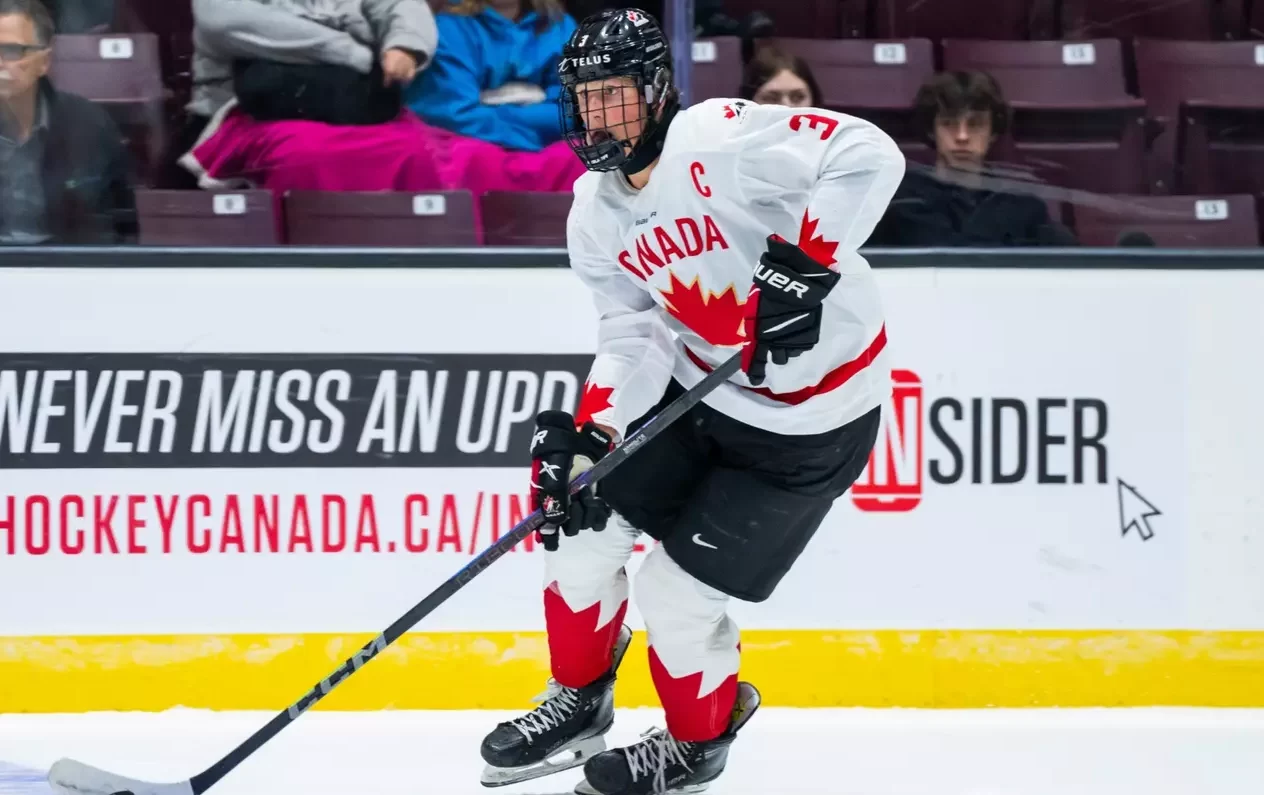
Keaton Verhoeff
2026 NHL Draft Eligible
Position: D, Shoots: R
H/W: 6-foot-4, 212 Pounds
Date of Birth: 2008-06-19
Keaton Verhoeff earned heaps of hype after his impressive DY-1 year with Victoria last season. Few defensemen possess the tools he does before their 17th birthday, and fewer still are able to put up 20 goals as a 16-year-old in the WHL. His performance transformed into a summer of speculation for him as the prospect of taking his talents to the NCAA seemed to be all but a guarantee with the new NCAA eligibility rules. North Dakota ended up grabbing him and his Victoria teammate, Cole Reschny, for the 2025-2026 season.
Now that he is more than halfway through his freshman season in Grand Forks, he has continued showing that offensive prowess at his monster size. He is doing well production-wise, putting up numbers that currently have him as the leader in points by freshmen defensemen in the NCAA. Additionally, he was selected to Canada’s World Juniors roster as a 17-year-old, being one of 14 players to do so since 2010. He performed admirably for a Canadian squad that grabbed its first medal in three years. Verhoeff only played five games but put up 4 points, showing off some great traits in the offensive zone.
Keaton Verhoeff’s tools and frame are extremely desirable for NHL franchises that seemingly never have enough point-producing, right-handed defensemen. Standing at 6-foot-4and weighing well over 200 pounds, he has the mass to be a physical difference maker. In the offensive zone, he is raw, but creative and smart, showing flashes of an explosive power-play defenseman. Though there are shortcomings in his skating and in his defensive game on rushes and in the defensive zones, he will most certainly be going back to college next season to continue to polish his game. Depending on how well he can round out his game, some solid comparables for Keaton Verhoeff’s future could be a Seth Jones or Noah Dobson, an offense-first, right-handed defenseman with a big frame. He has all the tools to be the number one defenseman that was forecasted in his DY+1 season; it just might take some extra development to get there.
Skating
Keaton Verhoeff’s skating has been somewhat of a mixed bag during his draft year. On one hand, his stride is powerful, and he has been able to generate average speed in transition and in the offensive zone. However, his backward skating has been an issue, to say the least. Verhoeff does not seem to get the most out of his stride just yet, he has a lot of power in his stride (he is 6’4, of course he does), but he hasn’t had the extension or explosivity we have seen from other two-way defensemen. He gets an average amount of speed in a straight line because of this, and he has been beaten to the puck many times in the speedy NCHC conference. At the blueline, this slowness continues, he has struggled to get separation with his skating when pressured on the power-play and at even strength. Verhoeff’s four-way mobility is slow and definitely clunky, but his 6-foot-4 frame and active stick cover up some of the plays where he would get beaten. His edgework has been fine overall; he can be deceptive when jumping up into the offensive zone, and those plays come about because of his edges. Those negative aspects of his skating can be fixed, many raw defensemen before him have fixed their issues as well, and he has shown flashes of being a big difference maker in the offensive zone due to how he approaches the offensive zone possessions, due to the aggressiveness of his skating.
I am less optimistic about Verhoeff’s skating in his own zone. His backward skating does need more work for sure, which is shown clearly when he defends rushes without turning to skate backwards. I believe this is coming from a lack of balance that leaves him looking like he is stronger going right-over-left than vice versa. Once again, this “clunky” and unbalanced nature of his skating can be fixed, and he has shown some promise in some shifts, but the overall picture leaves him as an average to below-average skater in his freshman season.
This play from the World Juniors shows off Verhoeff’s straight-line skating pretty well. He generates power from his stride, but as you can see, he doesn’t get the speed or separation he should be getting.
Verhoeff shows off some of his edgework and skating skill level in tight spaces here. This is where he can take his skating to the next level and be a serious offensive threat at the blue line. This can also be used to show off his stick skill.
Here are some of the issues with Verhoeff’s skating wrapped up into one 20-second clip. He can panic at the blue line at times and give up on a play in the neutral zone, topped off by an overall lazy attempt to break it out himself that leads to an opposing goal.
Here is another rush defense from Verhoeff that shows some good and some bad. He leaves a significant gap but I love the constant moving of his feet and pressure that causes to opponent to turn back and lose an edge. You can also see some lack of balance that holds him back and a bit of “getting stuck” when he is at a standstill.
Here is a clear vision of Verhoeff’s backwards skating, his crossovers are overall strong and I wish I saw more of this skating at the NCAA level. He seems to one side to the other but another year at UND should fix that.
Though Verhoeff’s skating is not elite right now, we have seen bigger defensemen like himself improve their skating
GRADE: 55
Shot
Keaton Verhoeff can really rip a puck. That was evident in his DY-1 year with Victoria when he put up 20+ goals as a 16-year-old in the WHL, however, it has translated to the NCAA in spectacular fashion. Only eight defensmen in college have more goals than he has so far this season. Verhoeff’s release is already near elite, his wrist shot has been a nightmare for goalies who have a hard time corralling it, let alone stopping it. The shot selection is something he needs to work on as he is still extremely eager to fire a shot as soon as he gets the puck instead of opting for a pass or a better chance. Verhoeff’s knack for driving into the middle of the ice to support the attack in the offensive zone has been shown in essentially every game. He has been excellent and keeping chances alive by activating into the play as a fourth forward and firing loose pucks on net. Off the faceoff, he is very deadly as well, increasing his potential as a power-play QB in the future. Verhoeff has all the tools to become the best goal scoring defenseman from this class; he will simply need to get smarter with his selection of shots and need to round out his skating to truly take advantage of the all the lanes that he sees.
Verhoeff shows why he is absolutely lethal on the power play with this goal. Finding open space, catching and shooting in one motion, finding space over the shoulder glove side.
Here are two clips of nearly the identical play, he finds space along the left wall and quickly fires a wrist shot. One shot goes in, one doesn’t.
Here is a nice Verhoeff slapshot from the blue line that shows how deadly he can be off the faceoff, no matter how far out he may be.
Here is when Verhoeff needs to have a better shot selection. He’s on the power play and looks off to options to his left to fire a puck that gets blocked and leads to a clear by the opposing PK.
GRADE: 60
Skills
Keaton Verhoeff’s skill game and stick talent was something that set him apart in the WHL as a large defenseman and he has carried over to the NCAA for the most part. In the offensive zone, it is another extension of his game, helping create space to fire higher quality shots or to find a lane to pass. However, in all three zones, he has had a tendency to get too cocky with the puck and lose possession when he tries to do too much. His hands are fine, but they are not fast enough for the NCAA level and is just currently adjusting. It has hurt Verhoeff’s transition game as he looked to become a reliable puck moving defenseman. Though Verhoeff’s stickhandling mistakes have been well documented, I believe he will ultimately develop above average stick talent in the NHL due to the confidence he has gained from NCAA. Another year will do wonders for some of the flashes we have seen when he is jumping in the offensive zone.
Here is a ridiculous dangle during a zone that gives him a really great chance to score with a minute to go against Bemidji State. He will frequently jump into the zone to make these sorts of plays upon zone entries and on the power play.
Here is a clip that shows both a mishap at the blueline and behind his own net. Both times he loses the puck he would have been better off just dumping or passing the puck. His decision-making needs to be better, and at the NCAA level, these mistakes get punished.
I showed this clip in the skating section, but it shows his stick handling very well here as well.
GRADE: 57.5
Smarts
Keaton Verhoeff’s offensive intelligence would be classified as pretty high. His highs are incredible, getting remarkably aggressive in the offensive zone with smart plays or just pressuring at the correct time to keep offensive cycles going. Verhoeff’s mindset in the offensive zone is fantastic already. However, there are issues of consistency and trying to do too much with the puck. For every high-flying offensive highlight that Verhoeff can add to an offensive zone possession, he occasionally fails to recognize or will not try those skills that were just shown a minute ago. I believe Verhoeff’s IQ in the offensive zone will continue to improve and be one of the better assets of his game as he goes forward.
In the defensive zone, I am a little less optimistic. Generally, his mistakes in rush defense are generally explained away with his below average backwards skating. The angles Verhoeff takes on those rushes do not help at all. He will often have a tough time stopping pressure on the rush and I do not see him improving this deficiency enough to become even above average. However, Verhoeff’s in-zone defense has steadily improved a lot throughout his freshman season. He has become more aggressive along the wall, behind the net, infront of the net and overall has used his big frame with more purpose and efficiency. Occasionally he will be slow and floating during opposing offensive possessions but I believe the strides he has made in his own end will help him round out as an above average in-zone defender.
Verhoeff shows how potent he can be on offense in two clips as he enters the zone and creates a ton of space for Strinden who buries it. In the second clip he gets the zone entry started and then follows the play and becomes an option for a back door.
Verhoeff shows his aggression and good stick checking skill here in his own zone. He attacks at the right time and kills an otherwise dangerous play infront of the net.
Verhoeff jumps into the play at the perfect time and fakes a shot that he slides to Martin who no one else sees.
Verhoeff’s rush defense is again looking not great here. He doesn’t go backwards at all and has a difficult time stopping the one attacker or even closing off his passing lane.
Though Verhoeff gets beat to the puck on a rush, he gets the puck and is able to set up a transition
GRADE: 55
Physicality/Compete
Keaton Verhoeff is at his peak when he is aggressive with his skates, stick and mind. However, that is not always a guarantee. Verhoeff’s compete and physicality are average now but can jump and improve with the betterment of his skating prowess. His effort can be seen very vividly in the offensive and defensive zones, but he will often give up on plays on the rush and in the neutral zone as well. Verhoeff's compete in the offensive zone helps extend plays, as he will jump up into plays and get engaged along the wall, he’ll even get to the net for plays as well. In the defensive zone, Verhoeff’s compete and physicality have shone through more and more as the season has gone along. Killing plays in front of the net, along the wall, when he is aggressive he is a great foible to stopping an opposing offensive possession. However, I don’t ever find my self comfortable calling Verhoeff a “shut-down defenseman.” His defensive zone plays need to be shown more consistently and he overall isn’t the skating talent required to be a shut-down guy. Verhoeff’s physicality has been average, but he will not be viewed as a big hitting defenseman either. He doesn’t have the dexterity or angles to make open ice hits or be effective physically on the rush, he really is only effectively physically around the walls, infront of the net or when making plays in the offensive zone.
Here is an example of the best version of Verhoeff on the rush, he doesn’t destroy the opponent with the hit but the rush is killed in just two moves.
Verhoeff pinches too early and gives up on a play after getting beat by the forward who makes the play behind the net.
Verhoeff shows his physicality along the wall in this clip, though it is not all that powerful yet, partially that lack of power can be explained by his skating.
GRADE: 55
OFP: 56
A note on the 20-80 scale used above. We look at five attributes (skating, shooting, puck skills, hockey IQ and physicality) for skaters and six for goalies (athleticism/quickness, compete/temperament, vision/play reading, technique/style, rebound control and puck handling). Each individual attribute is graded along the 20-80 scales, which includes half-grades. The idea is that a projection of 50 in a given attribute meant that our observer believed that the player could get to roughly NHL average at that attribute at maturity.