


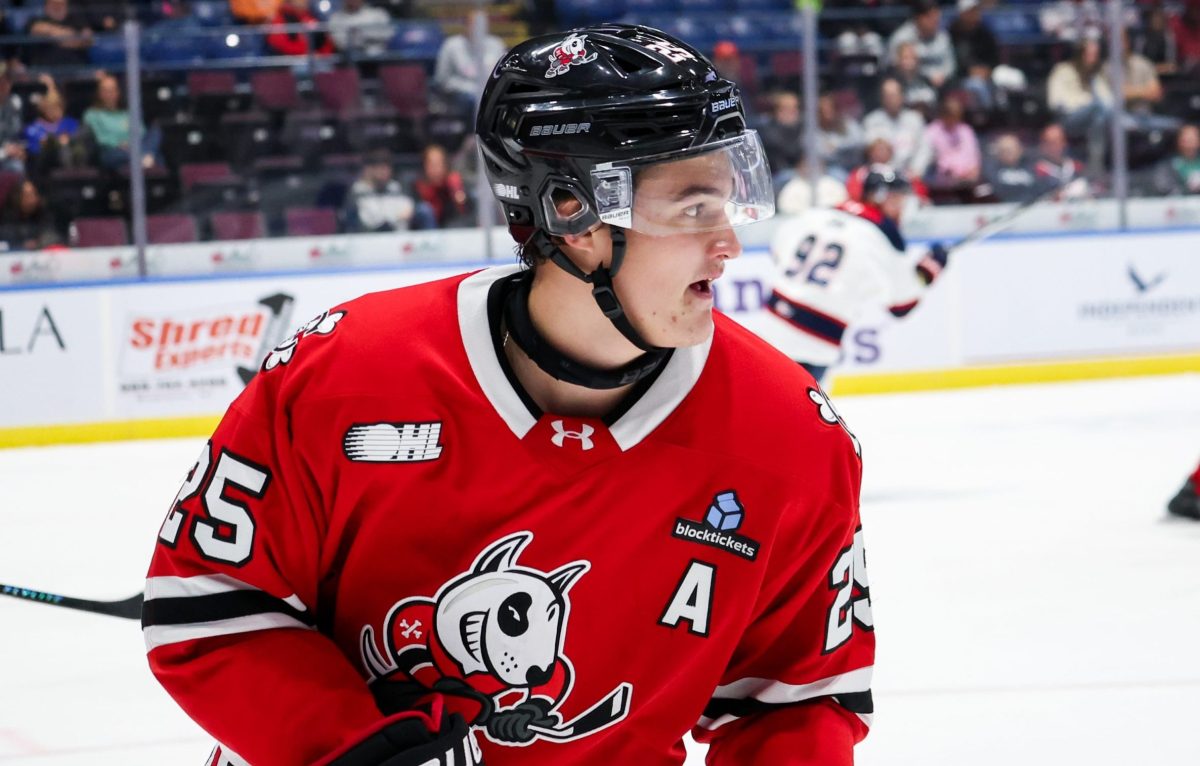
Ryan Roobroeck
2026 NHL Draft Eligible
Position: W, Shoots: L
H/W: 6-foot-2, 209 pounds
Date of Birth: 2007-09-25
Coming into the 2025/26 season, Ryan Roobroeck seemed to be a unanimous potential top ten selection for the 2026 NHL Draft. He was coming off a strong showing at the U18’s, where he helped Canada capture a gold medal, and a 40-goal season in the OHL with Niagara. With a pro frame, pro shot, and advanced offensive instincts, it was easy to see why he was garnering this kind of attention. We had Roobroeck at 15th on our mid-November, pre–World Juniors ranking.
Yet, more and more rankings, including ours, are dropping Roobroeck out of their first rounds as we approach the June draft. The question is why? Roobroeck still had a solid offensive season that saw him post similar goal scoring numbers before his season ending lower body injury in February. He overcame a somewhat slow start to finish his year well; he had eight goals in his last eight games prior to the injury and showed greater urgency and competitiveness in his game.
The answer to the above question lies in the fact that Roobroeck is exiting his third year in the OHL and a valid argument could be made suggesting that he is the same player he was several years ago. Scouts want to see improvement year over year and Roobroeck remains a bit of an enigma. The physical engagement remains wildly inconsistent, and his pace of play can lag because the power of his stride still needs work. An early bloomer physically, Roobroeck’s peers have caught up and it’s up to him to make the necessary adjustments to become a dominating force.
On the flip side, Roobroeck is a well-balanced offensive player with a power forward’s body. The OHL lists him at 6-foot-4, but NHL Central Scouting has him at 6’2. The NHL combine will give us exact measurements, but you always lean in favor of Central Scouting. Either way, he has the size to be an impactful pro. Even if his physical game fails to develop consistency, Roobroeck is an intelligent and skilled finisher with one of the better shots in this draft class. He can create his own opportunities in transition, but he is also opportunistic because he anticipates the play well, consistently hunting down scoring chances. He can power through defenders working North/South and find his way to the net. He even quarterbacks the powerplay, showcasing excellent vision. As mentioned, this is a versatile and balanced offensive player.
The reality is that Roobroeck’s NHL potential rests on his willingness to make adjustments and improvements to his game. He has the skill and scoring ability to be a top six NHL forward and powerplay asset. However, his strength/conditioning, skating, puck management, and physical engagement all need to be upgraded or refined, or he runs the risk of following a career path similar to former Islanders draft pick Michael Dal Colle. As a third year OHL player and one of the oldest first-time eligible players available, scouts may see Roobroeck as more of a finished product compared to some others available. One thing is certain, next season is going to be a huge one for his development
Skating
At his core, Roobroeck is not a high pace player. He is at his best, and seems to prefer attacking North/South, altering pace, and then working East/West to try to open up shooting lanes for himself. He can build to a solid top speed, but he can lose said speed when he tries to push off his edges to alter his direction. When he finds success taking defenders on and attacking linearly, it’s because he is using change of pace well. In this instance he incorporates linear crossovers to try to build speed quickly to the outside, catching defenders flat footed as he drives wide.
As a minor hockey player and against his peers at a younger age, Roobroeck did have a speed advantage with his size and power. He was a lot more successful in his net drives. However, his peers have caught up, and this has neutralized Roobroeck’s speed, to an extent, causing him to work at a slower pace.
Two of the biggest issues for Roobroeck are his start ups and his balance. He can have trouble escaping pressure at times because he can take time to build speed, especially out of pivots or off his edges. Additionally, for a larger forward with a power element to his game, Roobroeck’s balance and strength on the puck could be improved. He can be pushed off stride and separated from the puck, again, quite often when he tries to work off his edges, working to avoid or escape pressure. Considering that Roobroeck’s skating hasn’t improved considerably during his three years in the OHL, scouts are likely to worry that this ability might have peaked. With a greater focus on strength/conditioning, Roobroeck should be able to at least improve his power and speed attacking linearly to become a league average mover.
You can see that at one point, Roobroeck did hold a speed advantage over his peers. This was from the U17’s in his rookie CHL season. Builds up speed and attacks the offensive zone.
But that gap has slowly closed, with others catching up. Here’s a play from last year’s U18’s that sees Roobroeck fail to build up enough speed (despite getting a head start) to create a breakaway. This play could also be in the physicality/compete section because it shows an inability of Roobroeck to force his way to the net against a younger defender (the strong play was made by potential 2026 first rounder Juho Piiparinen, at the tournament as an underager).
Identical play from the same U18’s. Roobroeck is kept to the perimeter and eliminated physically (by potential 2026 draft selection Axel Brøngel-Larsson).
Now this year Roobroeck is still struggling to create that separation. He gets boxed in his own zone and then is easily caught by a backchecker as he tries to recover and gain the line.
That quick change of pace attack that I mentioned. Roobroeck can’t beat defenders one on one with pure speed, but he alters pace well to create separation at times.
Here we see that he’s knocked off stride too easily when he tries to use his edges to get around a defender.
GRADE: 50
Shot
This is Roobroeck’s bread and butter. His wrist shot and snapshot are considerable weapons. He generates significant velocity without windup and his release is both quick and deceptive. He often works back across his body to disguise intent and routinely incorporates toe drags to create lanes when attacking horizontally. Roobroeck is the kind of player who needs very little room to pick corners, and he can beat netminders clean from a distance.
One thing that’s not really in Roobroeck’s repertoire is a heavy one timer. Given his profile, you might have expected this to be a part of his game or to see him working his offside on the powerplay, hammering pucks on net. But he’s much more of a catch and release shooter and he actually usually operates the point of Niagara’s powerplay, getting pucks on net and using the threat of his shot to open up passing lanes. That’s actually a pretty significant strength of Roobroeck’s too; he’s not a reckless high-volume shooter despite owning a dangerous shot. He picks his spots well and does a good job of getting shots on net quickly to help generate second chance opportunities.
Roobroeck can pick corners and beat junior goaltenders cleanly from a distance.
He just doesn’t need much room at all. Roof Daddy.
Real whip like release on the game winner.
When Roobroeck works the point on the Niagara powerplay, he’s really efficient at identifying shooting lanes and trying to get shots through quickly to generate second chance opportunities.
GRADE: 60
Skills
Given Roobroeck’s size and potential power game, he has soft hands and is a terrific passer. He can thread the needle through a crowd and that’s part of why Niagara has him rotating to the point of their powerplay quite frequently. The threat of his shot helps to open up passing lanes for him and he will routinely use one touch passes to catch zone defenses sleeping, especially on the powerplay.
Roobroeck also handles well at full speed, and he keeps control through East/West cuts. He also shows good skill in tight to corral loose pucks and finish off plays near the crease. He’s equally adept on his backhand as he is his forehand. Roobroeck’s well-balanced offensive skill set opens up a variety of opportunities for him as a pro, depending on how his future coaches want to utilize him, again, especially on the powerplay.
However, don’t expect to see a highly creative player who consistently challenges defenders one on one. That’s not his game. Roobroeck can lose control of the puck when trying to escape pressure quickly coming out of pivots or from a standstill. Some of this can be attributed to his balance/strength issues as discussed in his skating category, however, it does also point to some skill limitations.
One thing Roobroeck does really well is utilize one touch passes to catch defenders off guard. That’s a skill but also showcases his ability to think ahead. This was a beautiful pass to the slot against Norway at last year’s U18’s.
Great pass here to set up the re-direct goal.
Roobroeck showing off his skill in transition by working to the inside, then he retrieves his own failed pass and makes a better one to a trailing teammate, eventually leading to a goal.
GRADE: 55
Smarts
Roobroeck is a highly opportunistic offensive player. While he can create his own scoring chances, you’ll often see him finishing off plays created by others. He times cuts well. He finds soft spots in coverage. He’s one of those players that the puck is magnetically drawn to.
It’s also worth mentioning Roobroeck’s shooting intelligence again in this section. He does such a good job of getting pucks on net, utilizing fakes and a quick release to help get pucks through traffic. His vision and poise when he rotates to the point of the Niagara powerplay are impressive. Even though this is not likely to be his future role on a pro powerplay, it signifies his versatility as an offensive weapon.
However, his game does not come without warts. Firstly, turnovers in all three zones can be an issue when he is pressured. The skating/skill limitations in his game currently require him to make quicker decisions with the puck. In the offensive end, that could mean something as simple as chipping and chasing or “getting pucks in deep.” Instead, he can try to force plays and this leads to odd man counter attacks the other way. Secondly, his defensive effectiveness is fairly inconsistent. He occasionally shows a strong understanding of support along the wall and will cut off passing lanes to the middle. But, when forced to defend the middle of the ice, he can get caught puck watching or is not aggressive enough, leading to significant chances from the slot. This is part of the reason why he was pushed to the wing at the OHL level and projects there at higher levels. If the engagement level increases to become more consistent, Roobroeck does project as, at least, an adequate defensive player at higher levels.
Roobroeck is best described as an opportunistic offensive player. He’s not necessarily a dominant on puck player. Instead, he uses his excellent o-zone anticipation to time cuts well or to find soft spots to generate chances.
Great read on the one touch pass resulting in a goal.
Strong defensive read and support by Roobroeck as he closes off the passing lane and initiates a breakout that results in a three on two opportunity.
A not-so-great defensive read from Roobroeck, this time from the slot as he gets caught too low and with his back to the play. This is part of why he’s been played primarily on the wing as an OHL player.
Just one of those plays that happens too often with Roobroeck. Has a few options here to retain possession but opts to weakly challenge a defensive triangle and the result is a turnover. Plays like this need to be eliminated from his game in order for him to be successful at the pro level.
Same kind of play, this time from the OHL Top Prospect’s Game. Roobroeck gets pressured and throws the puck to the middle, resulting in a turnover.
Another example. Roobroeck actually chips and chases, but then forces a pass back to the point, rushing his decision before defenders close in. Is he afraid of inviting that pressure in order to open up lanes?
Not an exceptionally high IQ play by Roobroeck here as he makes the first defender miss, but then fails to identify the second layer of pressure and the result is a turnover. That shot needs to be off his stick quicker or he needs to see the wide open teammate on the flank.
GRADE: 55
Physicality/Compete
Unquestionably, this is the area of Roobroeck’s game that is lacking the most and holding him back from being a more consistently impactful player. Unfortunately, this has been the case for him dating back to his minor hockey days. Read reports of his for the OHL Priority Selection in 2023 and you’re bound to see similar things as to what I’m about to discuss. That begs the question, is physical competitiveness an innate quality or can it be taught/improved upon? Will Roobroeck eventually find a way to utilize his size consistently to overpower defenders? Will Roobroeck eventually increase the consistency of his physical engagement? It’s present at times, but not enough. Is this a conditioning issue? These are bound to be the questions NHL scouting staffs ask themselves when discussing Roobroeck’s projection at draft time.
As mentioned, at 6-foot-2 (or greater) and 200+ pounds, he has the size to be physically dominant…especially at the junior level. That is the case at times, where he is aggressive in puck pursuit, assertive physically to earn touches, and eager to take on defenders head on in high traffic areas. At other times, he seems perimeter focused, loses 50/50 battles, and is just not hard enough on pucks. It would be great to see him become a forechecking threat on a consistent basis. I’d also love to see him invite pressure more consistently.
For a stretch in January and February before his injury, this is what we saw from Roobroeck more consistently. Great back pressure and then a strong physical play along the wall.
More physical play from Roobroeck as he applies pressure on the forecheck and then takes the puck to the net looking for a goal.
This is the opposite end of the spectrum. A play from the U18’s last year. A weak chip and chase attempt by Roobroeck that sees him poking at the puck, rather than using his size to try to pin and win that 50/50 battle.
But then we have a strong physical play from Roobroeck from the same tournament that sees him play through a defender to create a significant scoring chance.
This is a really interesting shift by Roobroeck from the CHL/NTDP Prospect Challenge this year. Early on in the shift, we see great energy from him; a strong hit in the defensive zone and a heavy forecheck in the offensive zone. But later, he’s weak on the puck resulting in a neutral zone turnover. Are some of Roobroeck’s consistency issues conditioning related?
For a bigger forward that’s in his third year in the OHL, Roobroeck just isn’t strong enough in protection scenarios, often easily separated from the puck on net drives.
GRADE: 45
OFP: 53.25
A note on the 20-80 scale used above. We look at five attributes (skating, shooting, puck skills, hockey IQ and physicality) for skaters and six for goalies (athleticism/quickness, compete/temperament, vision/play reading, technique/style, rebound control and puck handling). Each individual attribute is graded along the 20-80 scales, which includes half-grades. The idea is that a projection of 50 in a given attribute meant that our observer believed that the player could get to roughly NHL average at that attribute at maturity.