


Prospect System Ranking – 2nd (Last Year - 5th)
GM: Bill Armstrong Hired: September 2020
COACH: André Tourigny Hired: July 2021
Sure, some of it stems from years of building in Arizona. But the Utah Mammoth have quickly assembled one of the most promising young foundations in the league. With an NHL core that includes Clayton Keller, Logan Cooley, Nick Schmaltz, Dylan Guenther, JJ Peterka, and Mikhail Sergachev, the organization already has a competitive base in place. Now it’s time to welcome the wave of high-end prospects poised to push the team forward.
On the blue line, size and defensive presence define the next generation. Towering defenders Maveric Lamoureux (6-foot-7) and Dmitri Simashev (6-foot-5) anchor the Tucson Roadrunners’ backend and have already received NHL looks. Both projects are high-end shutdown defenders capable of playing significant minutes at the next level. Up front, another physically imposing talent, Daniil But (6-foot-5), has transitioned to North America and is splitting time between Tucson and Utah while putting together a respectable rookie campaign. In goal, Michael Hrabal has continued his strong development at the University of Massachusetts and now enters the professional system with strong expectations of becoming a long-term option in net. The CHL forward pipeline is equally impressive. Tij Iginla, now fully healthy, dominated the WHL with 90 points in just 48 games. Cole Beaudoin, selected 24th overall in 2024, is coming off a career-best 88-point season, while Caleb Desnoyers continues to build on a highly productive QMJHL career, producing at a 1.35 point-per-game pace.
With a strong NHL core already in place and a wave of NHL-ready talent on the horizon, Utah’s progression toward playoff contention is well underway. For the league’s newest fanbase, there is already plenty of reason for optimism — and even more on the way.
| NHL | RNK | PLAYER | POS | AGE | HT/WT | 2024-25 TM | GP | G(W) | A(L) | PTS(GAA) | PIM(SPCT) |
|---|---|---|---|---|---|---|---|---|---|---|---|
| Uta | 1 | Caleb Desnoyers | C | 19 | 6-2/180 | Moncton (QMJHL) | 45 | 22 | 56 | 78 | 36 |
| Uta | 2 | Daniil But | LW | 21 | 6-6/215 | Tucson (AHL) | 41 | 19 | 20 | 39 | 38 |
| Uta | 2 | Daniil But | LW | 21 | 6-6/215 | Utah (NHL) | 29 | 3 | 4 | 7 | 8 |
| Uta | 3 | Dmitri Simashev | D | 21 | 6-5/200 | Tucson (AHL) | 40 | 8 | 27 | 35 | 31 |
| Uta | 3 | Dmitri Simashev | D | 21 | 6-5/200 | Utah (NHL) | 28 | 0 | 1 | 1 | 23 |
| Uta | 4 | Tij Iginla | C | 19 | 6-0/190 | Kelowna (WHL) | 48 | 41 | 49 | 90 | 29 |
| Uta | 5 | Cole Beaudoin | C | 20 | 6-2/210 | Barrie (OHL) | 54 | 33 | 56 | 89 | 29 |
| Uta | 6 | Michael Hrabal | G | 21 | 6-7/215 | Massachusetts (NCAA) | 29 | 19 | 9 | 1.95 | 0.937 |
| Uta | 6 | Michael Hrabal | G | 21 | 6-7/215 | Tucson (AHL) | 5 | 3 | 1 | 2.96 | 0.897 |
| Uta | 7 | Maveric Lamoureux | D | 22 | 6-7/215 | Tucson (AHL) | 65 | 5 | 15 | 20 | 75 |
| Uta | 7 | Maveric Lamoureux | D | 22 | 6-7/215 | Utah (NHL) | 5 | 0 | 1 | 1 | 2 |
| Uta | 8 | Artyom Duda | D | 22 | 6-1/185 | Tucson (AHL) | 27 | 2 | 11 | 13 | 22 |
| Uta | 9 | Maksymilian Szuber | D | 23 | 6-3/190 | Tucson (AHL) | 65 | 11 | 16 | 27 | 67 |
| Uta | 10 | Yegor Borikov | RW | 20 | 6-1/180 | Dinamo Minsk (KHL) | 59 | 16 | 14 | 30 | 16 |
| Uta | 11 | Tomas Lavoie | D | 20 | 6-3/215 | Cap-Chi (QMJHL) | 56 | 10 | 37 | 47 | 34 |
| Uta | 12 | Max Psenicka | D | 19 | 6-5/185 | Portland (WHL) | 53 | 8 | 22 | 30 | 67 |
| Uta | 12 | Max Psenicka | D | 19 | 6-5/185 | Tucson (AHL) | 2 | 0 | 1 | 1 | 10 |
| Uta | 13 | Noel Nordh | RW | 21 | 6-2/195 | Tucson (AHL) | 60 | 6 | 15 | 21 | 10 |
| Uta | 14 | Will Skahan | D | 20 | 6-5/215 | Boston College (NCAA) | 31 | 1 | 0 | 1 | 20 |
| Uta | 15 | Gabe Smith | C | 19 | 6-4/205 | Moncton (QMJHL) | 60 | 34 | 43 | 77 | 49 |
1. Caleb Desnoyers, C, Moncton Wildcats (QMJHL)
Many were questioning Utah’s decision to select Caleb Desnoyers with the fourth overall pick last summer. While the surprise is understandable, expect Desnoyers to gain hype and fans as he develops and eventually enters the NHL, signing his ELC in late March. This season, Moncton’s star had to wait a few weeks before playing his first game. After a slow start, Desnoyers has rapidly picked up the scoring, and finished with a stat line of 78 points in 45 games. With a pace of 1.73 points per game, he leads the QMJHL among players with more than 20 games played. Desnoyers has reached a point where he is leaps and bounds ahead of his level of competition in the QMJHL. His execution of plays is getting crispier and highly efficient. Off the puck, he is as intense as he’s ever been, chasing down the puck carrier and helping his team out in all three zones. Desnoyers has also had a strong World Juniors Championship, with six points throughout Canada’s seven games while playing a key defensive role. He is still projecting as a strong second line center, with fringe first line center potential.
2. Daniil But, LW, Tucson Roadrunners (AHL)
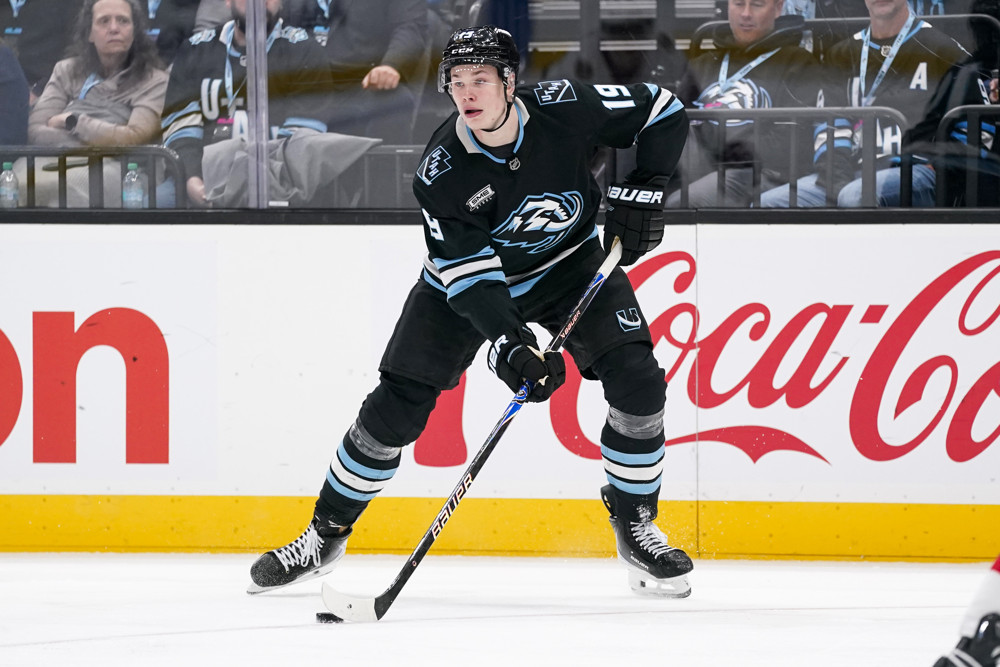
There was much skepticism and many raised eyebrows when then-Arizona’s (now Utah’s) scouting staff decided to select But 12th overall in 2023, ahead of other available prospects with more name recognition, but it was clear what they both saw and foresaw at the time: a huge, athletic, toolsy, determined Russian teenager who had the potential to eventually blossom into a dominating force at the NHL level, if given enough time and hands-on guidance. Fast forward three years and the fruits of that labor have already started to blossom, with the enticing winger playing a regular shift for the Mammoth and progressively figuring out how to bend and mold game states at his whim. He is truly a sight to behold when everything is really clicking for him, using his size, skating ability and puck control to power his way around the ice, going around or outright through opposing defenders who struggle to contain him. Utah’s front office is surely looking at how Juraj Slafkovský has emerged in Montreal and is optimistic that But is currently following a similar kind of path.
3. Dmitri Simashev, D, Tucson Roadrunners (AHL)
It was a bit of a surprise when Simashev made Utah’s roster right out of training camp, and after a couple of months of action it became clear that the then-20-year-old defenceman wasn’t quite yet ready for that challenge. However, his demotion to the AHL might have been a blessing in disguise. He was already trending toward eventually becoming one of the best shutdown defencemen in the entire NHL, with an intoxicating blend of immense size, superb athleticism and elite skating ability, but his contributions on the offensive side of things had always been lacking. Elevating that part of his game appears to have been a primary focus of his assignment to the AHL, because he’s been scoring at nearly a point-per-game pace at that level since then, which makes it kind of scary to imagine just how seismic his impact at the NHL level could be once he’s fully developed. Simashev isn’t a well-known name in the hockey world as of this point in time, but that isn’t going to last for very long.
4. Tij Iginla, LW, Kelowna Rockets (WHL)
The Kelowna Rockets made an aggressive (and, in the end, successful) bid to host the 2026 Memorial Cup, and one of the biggest reasons why they wanted to do that was because they knew that their roster this season would be anchored by Iginla, a prospect with enough talent and leadership abilities that they could build a contending team around, one good enough to take down whichever league champions emerge from the WHL, OHL and QMJHL. He is about as balanced and versatile as a hockey coach could dream of, as someone who can comfortably line up at both center and wing, play both a skill game and a power game, and effectively handle both tough offensive and defensive assignments, all of which is bolstered by exceptional hockey sense, competitiveness, and calmness under pressure. Iginla will likely never become one of the top point-producers in the NHL, but much like Gabriel Landeskog in Colorado, he’ll bring a rare wealth of value as a core roster piece on a team with serious Stanley Cup aspirations.
5. Cole Beaudoin, C, Barrie Colts (OHL)
It has been an excellent bounce back season for Beaudoin after a disappointing draft year plus one. He has emerged as one of the best players in the OHL and was solid for Canada at the World Junior Championships, helping them capture bronze. The large spike in production can primarily be explained by two improvements. Firstly, he has upgraded his overall skating profile, adding more explosiveness, but also improving his balance and edgework. This has allowed Beaudoin to play with greater pace and to utilize his size and strength to play through traffic on his way to the net. Secondly, his puck skill and ability to handle at a greater pace has improved, which has made him a better playmaker and a more consistent play driver. Even with these improvements, Beaudoin’s upside as an NHL player is not likely extremely high. He still profiles best as a potential middle six player or elite third liner. His two-way awareness, positional versatility, and physical approach make him the kind of player that coaches will love. So long as his skating continues to improve, he should have a long NHL career ahead of him.
6. Michael Hrabal, G, UMass (NCAA) (Currently with Tucson Roadrunners, AHL)
It has been yet another incredible season under the radar for Hrabal in net for UMass in the Hockey East. Four shutouts, alongside a .937 save percentage, he has really become a monster of a college goaltender. Hrabal’s 6-foot-7 frame is the biggest selling point but his athleticism along with that size is what makes him so special. He sees play develop so well and is still just as mobile when he’s down on his knees. The glove work is going to be a focus of even further development when he is up with Utah; it’s been solid but there is a weak spot under both of his arms that he’ll need to further work out. The Mammoth is getting a goaltender that battles and fights every night for them in Hrabal. He signed an entry level contract and turned pro at the end of UMass' year, where, pending strong play, he'll move right to the top of the Mammoth's depth chart behind their NHL netminders. This is their goalie of the future.
7. Maveric Lamoureux, D, Tucson Roadrunners (AHL)
Lamoureux has already had a few cups of coffee at the NHL level, and it’s only a matter of time before he sticks around in Utah for good. After all, six-foot-seven defencemen with excellent skating ability are incredibly useful at hockey’s highest level, and players like that don’t grow on trees. His development has been a work in progress since getting drafted 29th overall in 2022, but everyone involved in that decision always knew that this would be the case — despite being extremely raw at the time, it was also obvious even back then that he had tremendous potential. While there are some occasional flashes of offensive pop and physical snarl, his most likely long-term value will come from his using his mobility and immense reach to take space from opposing attackers and making defensive stops. The Mammoth are currently slated to have a couple open spots on their blueline as soon as next year, and it’s safe to assume that Lamoureux will be slotting into one of them.
8. Artyom Duda, D, Tucson Roadrunners (AHL)
After a lot of bouncing around between leagues and levels in recent years (which included an unexpected and unconventional stop with Toronto Metro University, at the Canadian collegiate level), Duda has since found a consistent home with the AHL’s Tucson Roadrunners, and that stability has helped him achieve steady individual growth. He gets a little overlooked amidst the other high-end defence prospects in Utah’s system (Dmitri Simashev, Maveric Lamoureux, Maksymilian Szuber), but he still has a lot to offer as a smart, mobile and versatile blueliner. He is confident and pacey, someone who stays very involved in the play across all three zones while looking for opportunities to step up and make something happen individually. At the same time, however, his game is a bit lacking in terms of identity, as he’s not a true specialist on either side of special teams or in any specific in-game situations. Duda is trending towards seeing time in the NHL, but he might have to wait for another season or two because of the stiff competition on the mammoth’s depth chart.
9. Maksymilian Szuber, D, Tucson Roadrunners (AHL)
Szuber is something of an underdog within Utah’s prospect pipeline. He’s competing internally against other young defenders who were much higher draft picks and have undeniably higher ceilings, but it would be an outright shame if he got left behind because there wasn’t room for him too. He is a rock-solid blueliner who has gotten better year over year without fail, across every aspect of his game. With his smarts, size, skating ability and puck management he can do a little bit of everything that a coach needs. At age 23 he’s already played in three World Championships for Germany, and you can bet he’s going to keep getting that call every spring if he’s not deep into the playoffs with his club team. This is the last year that Szuber is able to pass freely through waivers, and you can bet that some pro scouts on other NHL organizations are watching him closely and getting ready to pounce if the Mammoth bring him back in the fall and try sending him down to the AHL one last time.
10. Yegor Borikov, RW, Dinamo Minsk (KHL)
Borikov's steady progression in the KHL continues, as he is on pace for just over a half a point per game in his third pro season. He flashes some offensive skill at times and has added a bit of physicality to his game, helping him protect pucks and be more effective along the boards. His skating ability is his best asset, using quickness and agility to push the puck up ice and weave through opposition in transition. He can score from distance with a solid wrist shot and isn’t afraid to battle in front of the net. He has a ways to go before he can be considered a solid prospect, as the motor and physicality are not at an NHL level, and he tends to stick to the perimeter. There is a good transition forward here but that isn’t enough to justify an NHL role. If he rounds out his game he could potentially be a pacey bottom six-er.
11. Tomas Lavoie, D, Chicoutimi Sangueneens (QMJHL)
While Lavoie hasn’t been able to replicate last year’s breakout offensive totals, he’s still a very valuable two-way defender at the QMJHL level. He’s big, he’s mobile, and he’s the ideal shutdown defender for today’s NHL.
12. Max Psenicka, D, Portland Winterhawks (WHL)
A mid second round pick last year; Psenicka has returned to the WHL with Portland and continues to improve. He has really upped the physical ante this year, using his 6-foot-5 frame to be a more consistent defensive player. A toolsy defender, Psenicka remains a long-term project.
13. Noel Nordh, RW, Tucson Roadrunners (AHL)
The competitive winger has had a decent first pro season after playing last year in the OHL with the Soo Greyhounds. Nordh is always in attack mode, and he projects as a bottom six forward for the Mammoth.
14. Will Skahan, D, Boston College (NCAA)
Rather than take a step forward offensively this year, Skahan has taken a step back. While that's never going to be his game, it is a bit concerning. The big defender does still project as a potential bottom pairing, PK anchor.
15. Gabe Smith, C, Moncton Wildcats (QMJHL)
Smith has enjoyed a massive breakout season with QMJHL powerhouse Moncton following last year’s strong playoff performance (in helping Moncton capture a title). The big pivot continues to work hard to improve his skating, and he could be a real diamond in the rough for the Mammoth organization.