


Fantasy Skill vs. Pedigree
Some dynasty battles become particularly interesting when the players aren't merely competing for spots on our fantasy rosters, but are also competing for opportunities on the same NHL team. That's precisely the situation developing in San Jose, where Luca Cagnoni and Sam Dickinson represent two very different approaches to building a successful NHL defenseman, with considerably different developmental profiles and potential fantasy outcomes.
LUCA CAGNONI WINS IT FOR THE SHARKS IN OVERTIME WITH HIS FIRST CAREER NHL GOAL 🚨🚨🚨 https://t.co/Jd9ldEHDqX
— Gino Hard (@GinoHard_) October 2, 2026
Dickinson was selected 11th overall in 2024, bringing an impressive combination of size, skating and two-way ability that made him one of the most highly regarded defensemen in his draft class. Cagnoni, meanwhile, wasn't selected until the fourth round in 2023, largely because his undersized frame raised questions about whether his offensive game would translate against professional competition. Those concerns haven't disappeared, but his production since being drafted has consistently challenged the assumptions that caused him to fall.
Collin Graf ties it up!
Great feed from Sam Dickinson
2-2 #SJSharks https://t.co/ygWuBAsY8f— JD Young (@MyFryHole) October 9, 2026
Fantasy hockey doesn't particularly care where a player was drafted, and opportunity often matters more than pedigree, particularly for defensemen whose value depends heavily on power-play usage. Cagnoni has emerged as the more intriguing immediate fantasy option, earning substantial ice time and an opportunity to quarterback San Jose's top power-play unit. With Macklin Celebrini, Will Smith, Michael Misa and an increasingly talented collection of young forwards forming the foundation of the Sharks' rebuild, that assignment could become extraordinarily valuable. However, Ryan Lin, Keaton Verhoeff and potentially Eric Pohlkamp could eventually enter the competition for offensive responsibilities, making the long-term picture considerably more complicated than a two-player battle.
The Case for Cagnoni
Cagnoni's argument begins with his exceptional offensive production, which has consistently exceeded expectations since San Jose selected him 123rd overall in 2023. After establishing himself as one of the WHL's most productive defensemen with Portland, he transitioned remarkably well to professional hockey, recording 16 goals and 52 points in 64 games during his 2024-25 AHL rookie season. He earned AHL All-Rookie Team honors and contributed two assists during a six-game NHL opportunity, demonstrating that his offensive instincts and creativity could remain effective against older, stronger competition.
His development is reflected in several prospect projection models, although their assessments of his long-term upside vary considerably. HockeyStats.com, developed by JFresh and Patrick Bacon, currently assigns Cagnoni a 94% probability of becoming an NHL regular, defined as playing at least 200 NHL games, but only a 15% probability of developing into a star, defined for defensemen as finishing among the top 15% in wins above replacement per 82 games. His NHL equivalency peaked at 29 in his second post-draft season before declining to 24, suggesting that while his probability of establishing an NHL career has improved substantially, the model remains relatively conservative about his chances of becoming an elite contributor.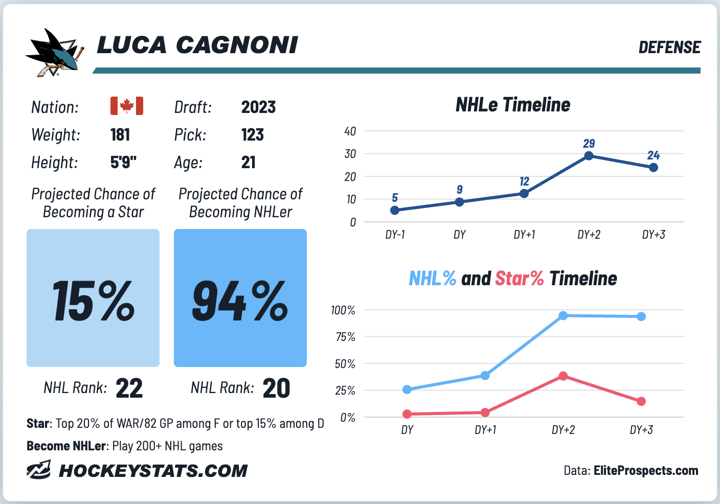
NHL Rank King's fantasy-oriented model offers a more encouraging perspective on his offensive ceiling. Cagnoni's projected NHL equivalency (PNHLe) climbed steadily through his junior career, reaching 92 in 2023-24 before declining during his transition to professional hockey, eventually settling at 54.6 entering 2026-27. Although that represents a considerable reduction from his peak, the current projection remains above the model's second-line potential threshold. The difference between these models is particularly relevant for fantasy managers because HockeyStats.com emphasizes overall NHL impact, while NHL Rank King's projection focuses more directly on offensive production, which is where Cagnoni's greatest value lies.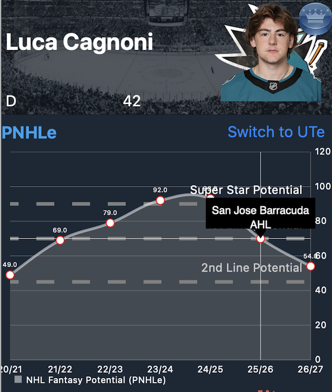
The Fantasy Hockey Life Prospect Skater Card reinforces that offensive specialization. During the 2025-26 AHL season, Cagnoni recorded eight goals and 45 points in 69 games while averaging nearly 22 minutes per game. His points production ranked in the 90th percentile, with his power-play contributions reaching the 98th, while shots, scoring chances and expected goals also ranked near or above the 90th percentile. However, his passing, play-driving and transition metrics were considerably less impressive, ranking in the 43rd, 43rd and 20th percentiles, respectively, while his peripheral contributions sat in the 27th. His overall fantasy average nevertheless reached the 82nd percentile, illustrating a player whose value is driven overwhelmingly by offense and power-play involvement rather than a well-rounded statistical profile.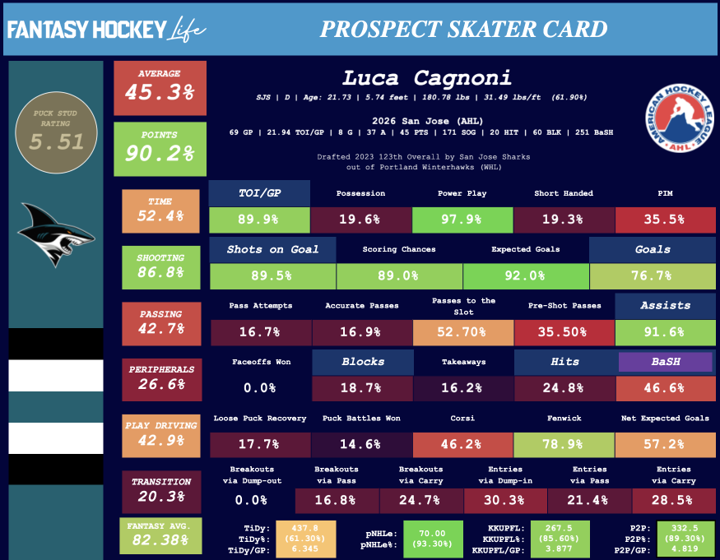
The primary concern surrounding Cagnoni has never been his offensive ability, but whether his size and defensive limitations would prevent him from earning the NHL deployment necessary to capitalize on those skills. That's why his early involvement in San Jose's 2026-27 season has been particularly encouraging. Through five games, he has recorded one goal and two points while averaging 19:37 of ice time, including a memorable season opener against Florida in which he contributed a power-play assist before scoring his first NHL goal in overtime. More importantly, San Jose has continued utilizing him on its top power-play unit, providing precisely the opportunity that could allow his offensive abilities to translate into substantial fantasy production.
There are legitimate reasons for caution, particularly given the limited sample and the challenges associated with defending at the NHL level as an undersized defenseman. Cagnoni will need to demonstrate sufficient defensive consistency to maintain the coaching staff's confidence, and the prospect models reinforce the uncertainty surrounding his long-term ceiling. Nevertheless, if he establishes himself as San Jose's primary power-play quarterback, a future in which he produces 45 to 55 points annually is certainly conceivable, particularly as the Sharks' young forwards continue developing. That would make him a valuable fantasy defenseman regardless of whether he ever becomes a conventional top-pairing NHL player.
The Case for Dickinson
Dickinson's appeal is considerably broader, beginning with the combination of physical tools and offensive ability that made him the 11th overall selection in 2024. At 6-foot-3 with excellent skating, strong puck-moving skills and the ability to contribute in all three zones, he possesses the attributes typically associated with defensemen who eventually handle substantial NHL responsibilities. His development with the London Knights demonstrated that he could contribute offensively while maintaining a significant defensive role, although translating that production against NHL competition has proven more challenging than initially anticipated.
HockeyStats.com provides an interesting perspective on Dickinson's developmental trajectory, assigning him a 99% probability of becoming an NHL regular but just a 5% probability of developing into a star. His NHL equivalency increased from four in his pre-draft season to 16 in his first post-draft season before leveling off, while his star probability declined from a previous peak of approximately 43%. Those figures reinforce his relatively secure projection as a long-term NHL defenseman, but they also suggest that his offensive ceiling deserves some reassessment. For dynasty managers, there's an important distinction between becoming an established NHL player and becoming a consistently productive fantasy contributor.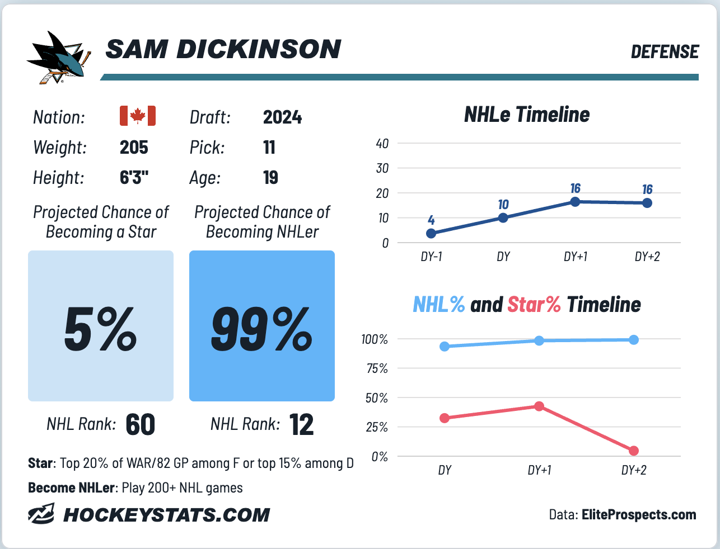
NHL Rank King's fantasy projections reflect a similar concern. Dickinson's PNHLe increased from 48 in 2022-23 to an exceptional 102 during his final OHL season in 2024-25, placing him within the model's superstar potential range. However, his transition to the NHL resulted in a substantial decline to 31 in 2025-26, with the projection recovering to 49 entering 2026-27. That decline isn't entirely surprising for a young defenseman adjusting to professional competition with limited offensive opportunities, but it illustrates how much more difficult generating offense has become. His earlier production demonstrates that meaningful offensive upside exists, although the challenge now is translating those abilities into consistent NHL results.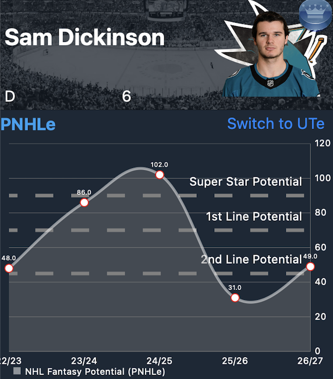
The Fantasy Hockey Life Prospect Skater Card provides a more encouraging perspective on Dickinson's underlying abilities despite his modest production of one goal and 13 points in 73 games during 2025-26. His overall points production ranked in just the 41st percentile, but his passing reached the 72nd percentile, supported by strong results in pass attempts, accuracy and pre-shot passes. His transition game ranked in the 73rd percentile, highlighted by breakouts through passing in the 98th percentile and controlled entries through passing in the 80th. These figures suggest that Dickinson's ability to move the puck and facilitate offensive opportunities has translated more effectively than his scoring totals indicate, providing some encouragement for his longer-term offensive development.
His defensive and peripheral profile is similarly interesting, with loose puck recoveries and puck battles won both ranking above the 90th percentile, while takeaways reached the 93rd. However, his overall peripheral production was more modest at the 57th percentile, including hits in the 58th and blocked shots in the 35th, suggesting that his projected multicategory value hasn't yet fully materialized. Compared with Cagnoni, Dickinson demonstrates considerably stronger passing, transition and puck-recovery metrics, while Cagnoni holds a substantial advantage in offensive production and power-play involvement. That distinction helps explain why Dickinson remains appealing despite his relatively disappointing early fantasy returns.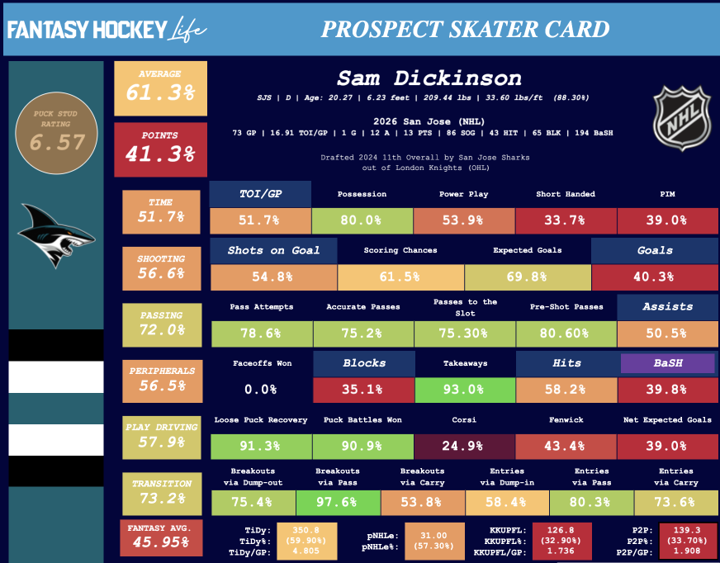
Evolving-Hockey's 2025-26 evaluation adds another layer to the discussion, ranking Dickinson in the 43rd percentile overall, with his offensive contributions reaching the 60th percentile but his defensive impact falling to the 23rd. His even-strength goals above replacement was strongly positive, approaching nine goals, although his expected goals above replacement was slightly negative, suggesting that his actual offensive results exceeded what the underlying metrics would anticipate. His defensive GAR and xGAR were also negative, reinforcing that his defensive game remains a work in progress, while his limited power-play deployment of just 22 minutes helps explain his modest fantasy production. These results suggest a player with promising offensive tools whose overall NHL impact remains inconsistent, which isn't particularly unusual for a young defenseman adjusting to the league.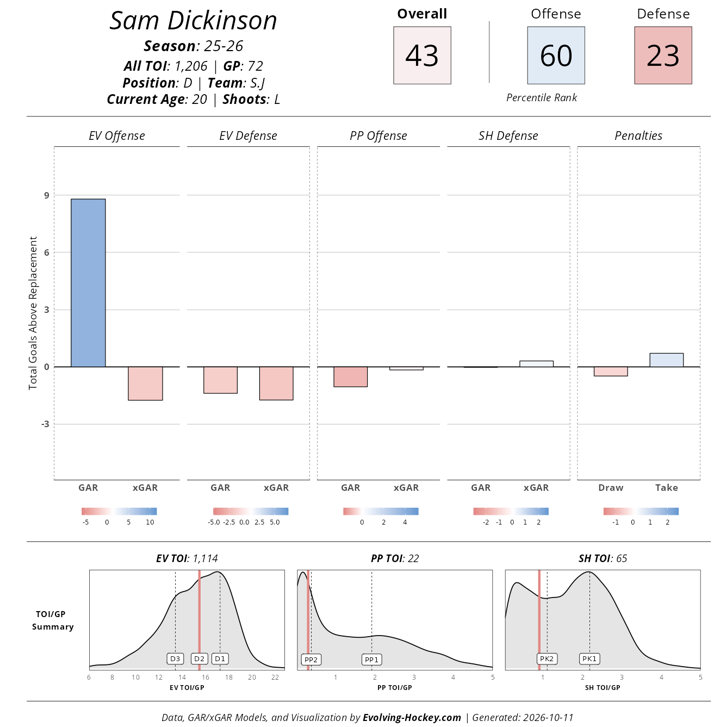
The beginning of the 2026-27 season has provided another reminder that Dickinson's development may require patience. He was scratched for San Jose's first two games before making his season debut against Dallas on October 5, and through his first three appearances he has recorded one assist while averaging approximately 16:17 per game. Those numbers are underwhelming compared with Cagnoni's early deployment, but the underlying passing, transition and puck-recovery metrics provide reasons to believe that Dickinson possesses the tools to become a considerably more effective player as he gains experience.
Ultimately, Dickinson's greatest advantage is the variety of ways he could eventually contribute to both the Sharks and fantasy rosters. His skating, size and puck-moving abilities provide a foundation for handling substantial responsibilities, while his offensive instincts give him the potential to contribute beyond a conventional defensive role. If he develops into a player capable of handling 22 or 23 minutes per game, contributing across multiple categories and eventually earning meaningful power-play opportunities, his fantasy value could become substantial. Those outcomes aren't guaranteed, particularly given the declining offensive projections across several models, but his broader pathway to sustained NHL deployment remains attractive from a dynasty perspective.
The Battle
The early stages of the 2026-27 season have made this comparison considerably more interesting because Cagnoni has begun answering the most important question surrounding his NHL projection: whether he could earn enough ice time to translate his offensive talent into meaningful fantasy production. His early deployment suggests San Jose is willing to give him that opportunity, while Dickinson is still establishing himself as an everyday NHL player. It's an unusual situation in which the less heralded prospect currently possesses the more attractive fantasy role despite his counterpart's considerably stronger draft pedigree.
The accompanying Hockey Prospecting graphic from Byron Bader provides another perspective on their developmental trajectories. Dickinson's pNHLe increased from nine in his pre-draft season to 40 following his final OHL campaign before declining to 15 during his transition to the NHL, while his modeled probability of becoming an NHL regular reached 98%. Cagnoni's pNHLe followed a different trajectory, increasing from 22 in his draft season to 36 during his first AHL campaign before declining to 28 in 2025-26. His star probability peaked at 67% before settling at 40%, while his NHLer probability currently stands at 60%. These projections suggest greater uncertainty surrounding Cagnoni's long-term NHL outcome, although they also recognize his offensive upside. Importantly, the Hockey Prospecting data was last updated in June 2026 and doesn't incorporate either player's early-season deployment.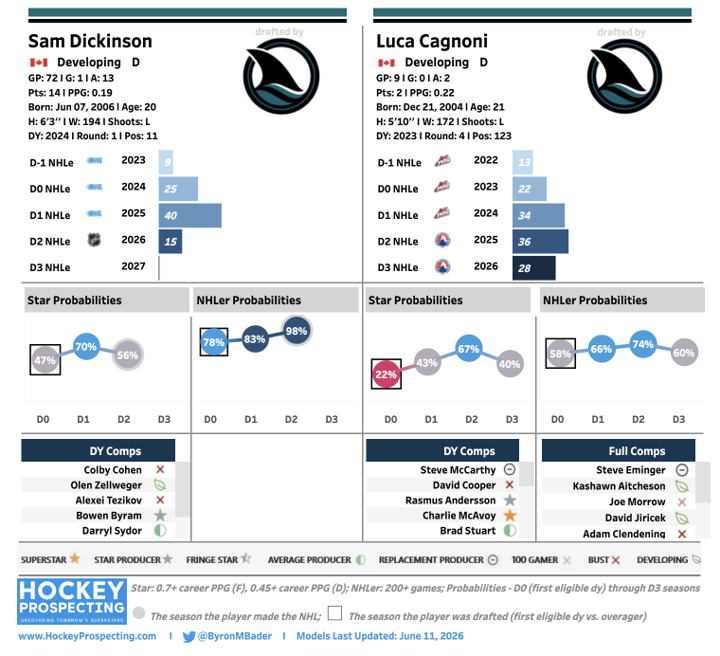
Those historical probabilities are useful, but they don't necessarily predict which player will ultimately provide the greatest fantasy value. Cagnoni's opportunity to quarterback a power play featuring San Jose's emerging offensive core could allow him to outperform his modeled expectations, particularly if Dickinson eventually assumes more demanding defensive responsibilities. It's entirely possible that the Sharks find the greatest value in allowing the two players to occupy complementary roles, with Dickinson handling difficult matchups and substantial even-strength minutes while Cagnoni specializes in offensive situations. Such an arrangement could favor Cagnoni in points-only formats even if Dickinson becomes the more important all-around NHL defenseman.
The central distinction is that Cagnoni's fantasy ceiling appears more dependent upon maintaining a premium offensive role, while Dickinson has several potential pathways to sustained value. If Cagnoni loses PP1, his projection changes considerably, particularly given his limited peripheral contributions. Dickinson could still develop into a productive top-four defenseman who contributes at even strength, accumulates hits and blocked shots, and provides secondary power-play production, while retaining the possibility of eventually challenging for greater offensive responsibilities. However, the early statistical models also suggest that Dickinson's offensive upside shouldn't be taken for granted simply because of his draft pedigree.
Ultimately, the decision depends partly upon league format and competitive timeline. Managers prioritizing immediate production or playing in points-only formats have a legitimate argument for preferring Cagnoni, while those building for the longer term, particularly in leagues rewarding peripheral categories, may find Dickinson's broader projection more appealing. I can envision a scenario in which Cagnoni becomes the better fantasy producer over the next season or two while Dickinson eventually develops into the more valuable dynasty asset, although neither outcome is inevitable.
The Verdict
I'm rostering Sam Dickinson, although Cagnoni has made this a much closer decision than I would have anticipated a year ago.
Cagnoni deserves considerable credit for challenging the expectations associated with his draft position and physical limitations. His exceptional AHL production established him as a legitimate offensive prospect, and his early NHL deployment suggests that San Jose is prepared to utilize those abilities in meaningful situations. The possibility of quarterbacking a power play featuring Celebrini and the Sharks' emerging offensive core is particularly enticing, and I wouldn't be surprised if Cagnoni substantially outproduces Dickinson during the 2026-27 season. In points-only formats, especially for managers competing immediately, there's a reasonable argument that Cagnoni is already the more desirable asset.
Nevertheless, dynasty decisions require looking beyond immediate deployment, and Dickinson's combination of physical attributes, offensive potential and long-term NHL projection continues to give him the advantage for me. His early NHL adjustment has been less impressive than Cagnoni's, and the declining offensive projections suggest that his fantasy ceiling deserves some reassessment, but his underlying passing, transition and puck-recovery abilities provide reasons for optimism. Cagnoni may ultimately become the better offensive specialist, particularly if he secures San Jose's PP1 assignment, but Dickinson has a realistic pathway to becoming a top-pairing defenseman who contributes across multiple categories. When choosing the player I'd prefer to build around over the next decade, I'm still betting on Dickinson's combination of floor, ceiling and long-term opportunity.