


Team Outlook
The Minnesota Wild have spent much of the last decade stuck in a frustrating middle ground. Over the past 11 seasons, the organization either failed to qualify for the playoffs or exited in the first round nine times, consistently remaining competitive enough to avoid a full rebuild but rarely threatening to become a true Stanley Cup contender. Minnesota finally broke through that barrier during the 2025-26 season by advancing past the opening round, but the organization still appears to be searching for the pieces necessary to take the next step deeper into the postseason.
There is still legitimate talent on the NHL roster, particularly with the combination of elite star power, structure, and defensive stability already in place. However, several major organizational questions remain unresolved, including improving the long-term center depth and navigating the looming challenge of eventually re-signing star defender Quinn Hughes. Because of that, the development of the prospect system will play a major role in determining whether Minnesota can evolve from a solid playoff team into a legitimate contender.
Several young players appear positioned to gain significant value as openings emerge within the organization over the next few seasons, particularly among the forward group. At the same time, some prospects may currently carry more dynasty appeal based on draft pedigree or lingering hype than realistic long-term fantasy projection. Below are three players worth targeting as buy candidates, along with three players who may represent strong sell opportunities before expectations recalibrate.
Buy Candidates
Adam Benák, C
Benák continues to look like one of the more underrated skill prospects in hockey despite ongoing concerns about his size. What stands out immediately is the pace at which he processes the game offensively. He consistently creates offense through anticipation, deception, and elite puck distribution rather than relying purely on physical tools. His transition this season from the Youngstown Phantoms of the USHL to the Brantford Bulldogs of the OHL could hardly have gone better, as he quickly adapted to a stronger offensive environment and became an important contributor on one of the most dominant teams in junior hockey. Even though Brantford ultimately fell short in the OHL semifinals, the overall season reinforced just how dynamic Benák’s offensive toolkit can be when surrounded by skill and pace.
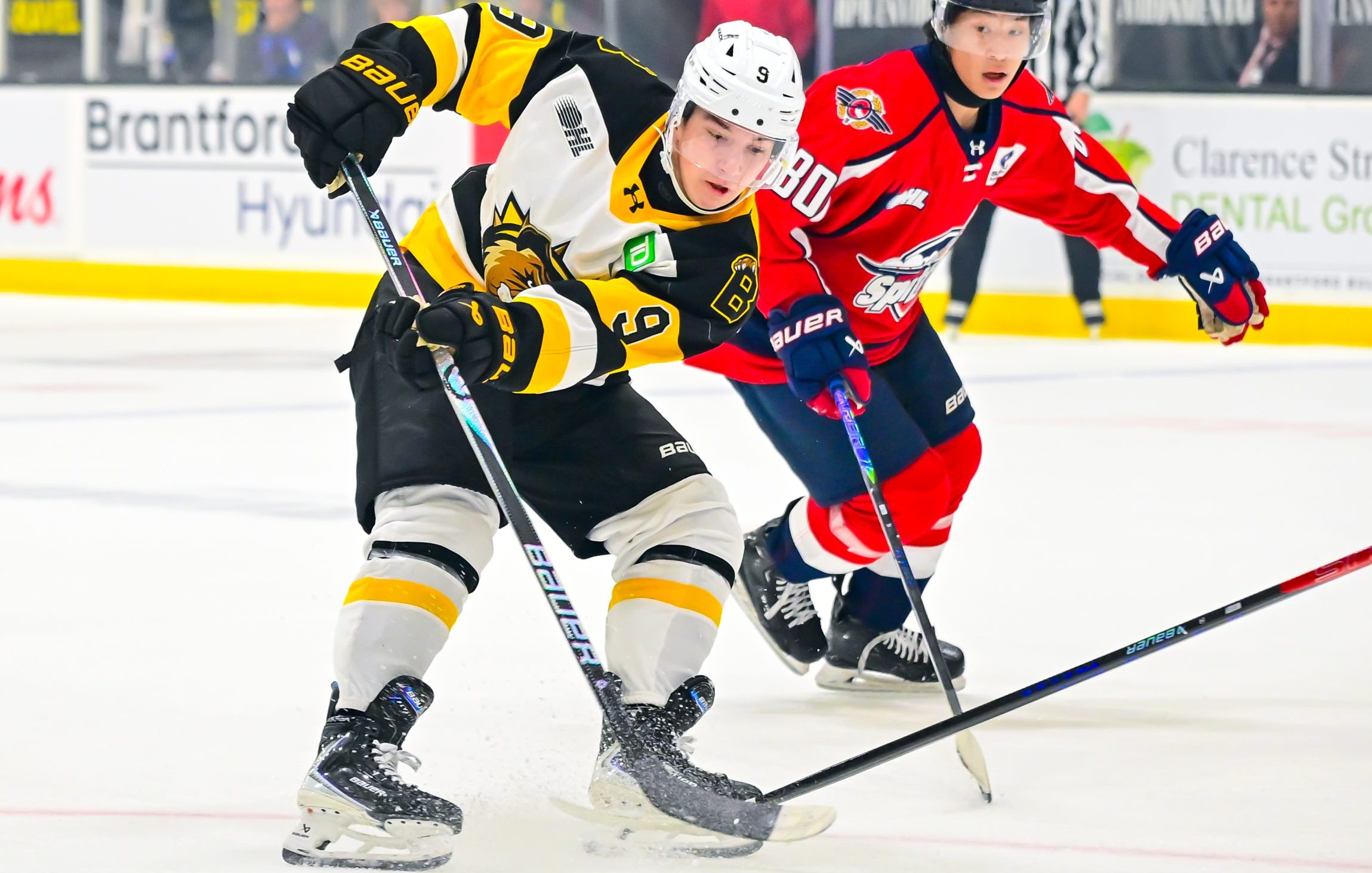
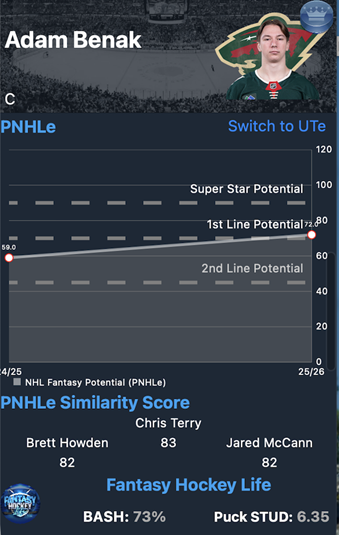
Benák is especially intriguing in that his pNHLe currently sits as the highest among all Minnesota Wild prospects, reinforcing the idea that the offensive upside here may be even greater than many dynasty managers realize. He thrives in transition, creates controlled entries consistently, and has the type of playmaking vision that can drive long-term power-play production. His strong season also extended internationally, where he played an important role for Czechia during its silver medal run at the Under 20 World Junior Championships (U20WJC). Smaller forwards will always carry some projection risk, particularly within organizations that traditionally value structure and responsibility, but the offensive skill level and production trajectory here are becoming increasingly difficult to ignore.
Charlie Stramel, C
Stramel once looked like a prospect whose fantasy value was driven more by projection than production, but this past season at Michigan State may have significantly changed that narrative. After a rough couple of seasons at Wisconsin where the offensive consistency simply never fully materialized, Stramel transferred to Michigan State and immediately looked far more comfortable offensively. After a strong 2024-25, his 2025-26 season was easily the best offensive season of his post-draft career, finishing with 44 points in 37 games, well over a point per game and a level of production he had not reached since his bantam hockey days. For a player whose combination of size, physical tools, and defensive reliability already made him intriguing, the offensive breakout has reignited optimism surrounding his long-term upside.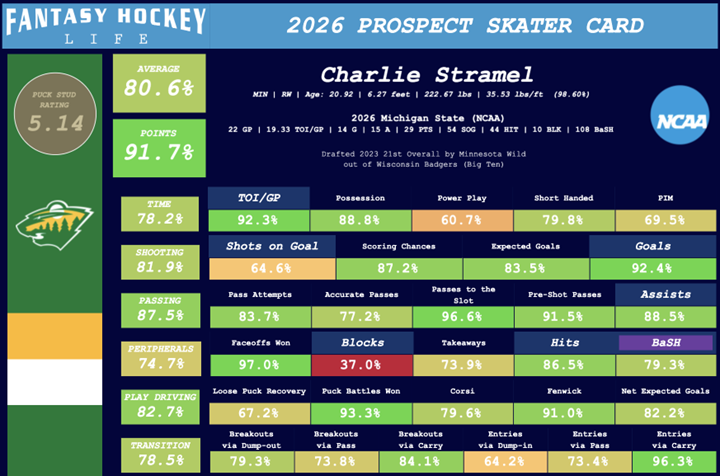
What makes Stramel particularly interesting now is that there may finally be meaningful scoring upside to pair with his already strong peripheral profile. His Fantasy Hockey Life skater card demonstrates just how thoroughly he dominated the NCAA this season, with impressive impacts across possession, transition play, puck recoveries, and physical engagement. His pNHLe projection is now approaching 70 points, a dramatic improvement from where it sat during his struggles at Wisconsin. While there are still reasonable questions about whether he becomes a true top-line offensive driver at the NHL level, the combination of improving offense, center versatility, physicality, and strong peripheral coverage makes him a much more attractive dynasty asset than he was a year ago. In many formats, this may actually be the ideal time to buy before the broader fantasy community fully adjusts to the breakout.
Ryder Ritchie, RW
Ritchie was productive in junior hockey and still flashes many of the traits that made him such an appealing prospect originally, particularly his pace, offensive instincts, and dangerous shot. However, his transition to Boston University did not produce the level of offensive success many hoped for right away. That said, context matters. Boston University as a whole struggled to consistently generate offense this season, and the environment was not particularly favorable for maximizing individual production. Because of that, it is probably premature to overreact to the uneven statistical transition.
Ryder Ritchie didn't have the best season at Boston University, but this OT GWG was pretty sweet. pic.twitter.com/eYifpR7dgH
— Fantasy Hockey Doctor - Victor Nuño (@VictorNuno12) May 21, 2026
The good news for dynasty managers is that Boston University is expected to look significantly stronger next season, including the addition of elite offensive defense prospect Xavier Villeneuve along with several other highly regarded incoming players and transfers. A more dynamic offensive roster could create a much better developmental situation for Ritchie and allow his strengths to re-emerge more consistently. From a fantasy perspective, his value may currently be somewhat suppressed because of injuries and the rocky NCAA transition, but there is still legitimate upside here, especially in formats that reward goals, shots, and power-play production. If the offensive confidence returns in a stronger environment next season, his stock could rise quickly once again.
Sell Candidates
Riley Heidt, C
Heidt was dominant offensively in junior hockey and still possesses many of the offensive traits that originally made him such an exciting prospect, particularly his vision, puck distribution, and ability to create offense through possession. However, his transition to the AHL was much more uneven than many expected. He struggled to consistently produce offensively at the professional level, and some of the long-standing concerns surrounding how his game would translate against stronger, faster, more physical competition appear increasingly valid. While his creativity and processing speed still flash at times, generating offense consistently against pro defenders proved far more difficult than it was in junior.
Excellent playmaking displayed here by Riley Heidt, instead of shooting into the goalie, he makes a slick pass to Elliot Desnoyers for the goal. pic.twitter.com/BMnaMIOaiI
— Fantasy Hockey Doctor - Victor Nuño (@VictorNuno12) May 21, 2026
That does not necessarily eliminate his NHL upside, but it likely lowers expectations from a fantasy perspective. Players whose games rely heavily on puck possession and offensive creativity often require time to adapt to the pace and structure of professional hockey, but the lack of immediate offensive impact certainly raises questions. The encouraging aspect is that Heidt still competes hard, plays with pace, and has the offensive instincts to potentially develop into a productive secondary scorer if things click. Still, at this point, the projection looks less like a future offensive driver and more like a player who may need careful development and favorable deployment to reach meaningful fantasy relevance.
Aron Kiviharju, D
Kiviharju remains an extremely intelligent defenseman with strong puck-moving instincts, but developmental stagnation have significantly complicated what once looked like a very high-end projection. Earlier in his development cycle, he was viewed by many as a potential elite offensive defense prospect, but that trajectory has become far less certain over the last couple of seasons. While he still processes the game very well and can facilitate possession effectively, the dynamic offensive creation that once separated him from his peers has not progressed the way many expected. His pNHLe has remained stuck in the 40-point range for several years now, even while playing professionally in Liiga, and at some point the lack of offensive growth becomes difficult to ignore.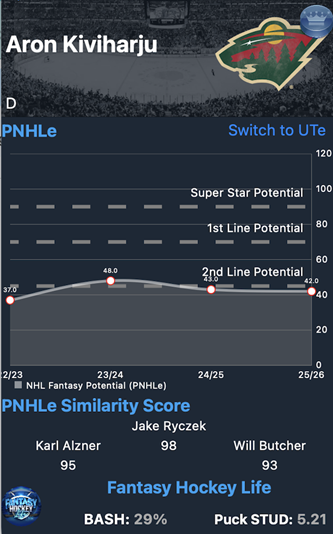
Kiviharju did perform reasonably well at this year’s U20WJC, but he did not dominate the tournament in the way many hoped or expected given his pedigree and reputation. That disconnect between perception and actual production is becoming increasingly important from a dynasty perspective. There is still likely an NHL path here because intelligent transitional defensemen often carve out professional roles, but it now seems far less likely that he develops into the kind of impact fantasy defenseman many managers once envisioned. In fact, at this point, there is a legitimate argument that he may struggle to become a long-term NHL regular altogether. Because his name recognition and early hype still carry weight in many dynasty leagues, this may be one of the better opportunities to move him before the broader fantasy market fully adjusts to the more modest projection.
David Špaček, D
Špaček continues to show flashes of puck-moving ability and offensive intelligence, but the overall projection increasingly looks more like a complementary NHL defenseman than a meaningful fantasy asset. His game relies heavily on puck movement and transitional support rather than elite offensive dynamism, and without strong peripheral coverage, that profile becomes difficult to translate into fantasy relevance. The organizational depth on the Minnesota Wild blue line also complicates his pathway toward any significant offensive opportunity at the NHL level. While there is still a reasonable chance he eventually contributes professionally, the fantasy ceiling appears considerably lower than his reputation may still suggest in some dynasty formats.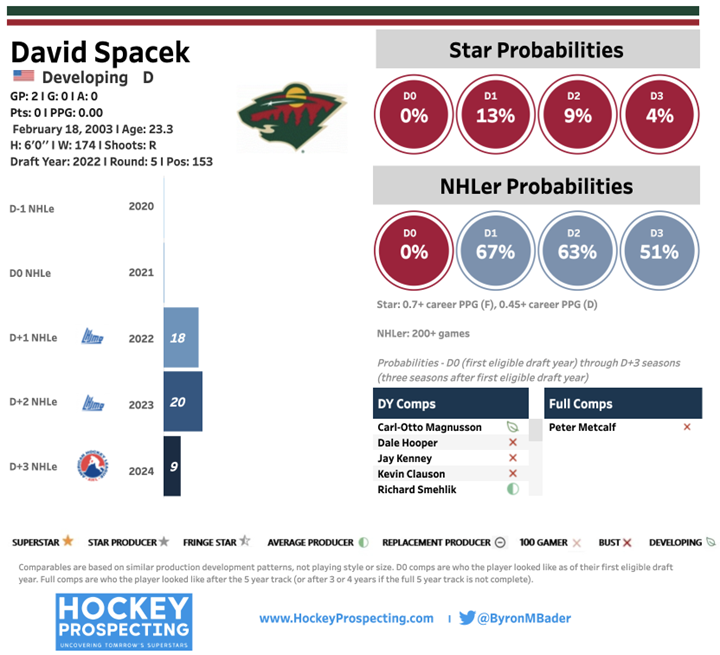
At this point, the developmental timeline is becoming increasingly difficult to ignore. Špaček is now 23 years old and has already spent three seasons in the AHL while appearing in only two NHL games. He did represent Czechia at the Olympic Games in Milan, which certainly speaks to the respect he still carries internationally, but it remains exceedingly unlikely that he develops into a long-term NHL regular, let alone a valuable fantasy contributor. His Hockey Prospecting profile already graduated after his first AHL season with only a four percent chance of becoming a star, and realistically that probability is essentially zero now. If another manager still values him based on his international résumé, draft pedigree, or puck-moving style, there may still be an opportunity to flip him for a late draft pick or minor asset. Otherwise, if he remains on your dynasty roster, he is probably no longer occupying a spot that meaningfully helps your long-term outlook.
Summary
| Player | Role | Key Insight |
| Adam Benák | Buy | High-end offensive IQ with underrated upside |
| Charlie Stramel | Buy | Strong scoring rebound and peripheral coverage |
| Ryder Ritchie | Buy | Strong offensive tools and rebound potential |
| Riley Heidt | Sell | Elite junior producer who has struggled to translate to professional hockey |
| Aron Kiviharju | Sell | Injuries and projection concerns lowering upside |
| David Špaček | Sell | Likely complementary defense profile long term |