


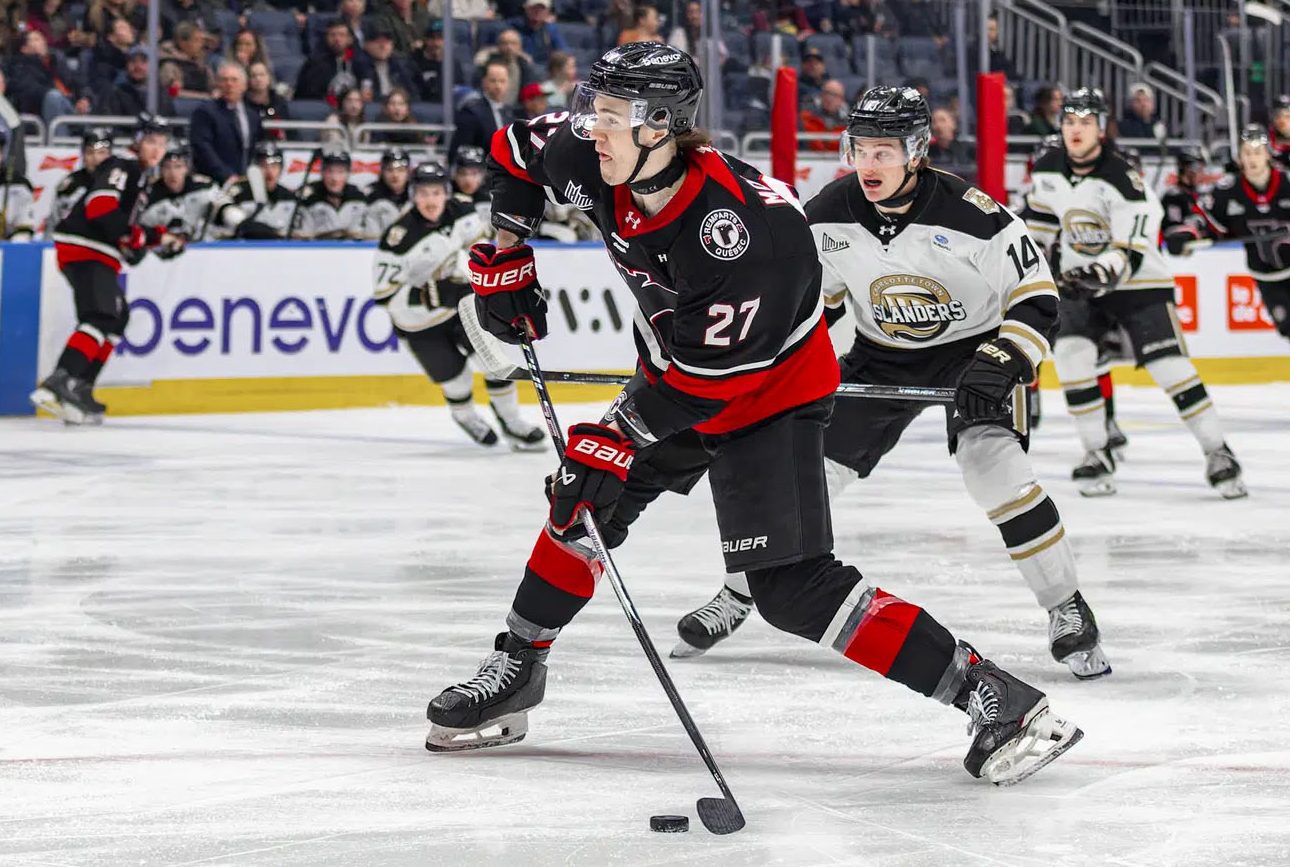
 Position: D, Shoots: L
H/W: 6’3” / 198 lbs
Date of Birth: 2007-10-12
Stats to Date: 4G-9A-13P (41 GP)
The 2024 QMJHL draft was pretty successful for the Quebec Remparts, not only drafting Maddox Dagenais at first overall, but also Charlie Morrison early in the second round, who is slowly becoming the mainstay of their defence. Morrison is only in his second season in the QMJHL, and after his first one, where he scored 15 points in 63 games and was solid on defence, the expectations were high for this season, especially since he was already seen as a top prospect for the 2026 NHL draft. Unfortunately, Morrison suffered an injury that limited his development early on this season, but he still managed to end the season with 13 points in 41 games, which is slightly better than last year. He is committed to play at the University of Connecticut in the NCAA at some point in the near future. The expectation is that he plays one more year in the QMJHL with the Quebec Remparts, which should be perfect for him to refine his game where needed before going in a stronger NCAA.
With hockey becoming faster and more physical, a defender like Charlie Morrison is going to be sought by many teams at the draft. He is a smart shutdown defender with size who isn’t afraid to use it to deliver some big hits. He moves very well for a 6’3” player; very mobile in his own end, and he likes to be involved as much as possible in transition, where he can use his skating and his intelligence. There is a lot to like in his game, but also a lot of work to do. He isn’t the most intense player on the ice, and he doesn’t have the biggest upside offensively. However, you're not likely drafting Morrison for his future offensive involvement. It will be because of his high level of play in his own zone. He has the potential to be an elite shutdown defender.
Skating
It is always essential for a tall defender to be able to rely on his feet as much as his physical side as the game is simply getting faster. Morrison knows that, and with his 6′3″ frame, it is impressive to watch him moving so smoothly on the ice. Without saying that Morrison is an excellent skater, his mobility is often a difference maker in transition or in puck retrieval situations. Once he starts moving his feet, he is hard to stop with all the momentum he can gather with only a few strides. It is on the transition that Morrison demonstrates this best. Often first behind his own net to get the puck, Morrison loves to start the breakout, either by carrying the puck as far as he can with good speed or by passing the puck precisely and joining the attack. He is a smart puck carrier, and his skating ability gives him the opportunity to position himself where he wants.
As shown in these two clips, Morrison is active in his own zone to get the puck and start the breakout. The first clip is something that happens at least one time each game. He starts the breakout and finds an open lane where he can use his speed to carry the puck toward the offensive zone. It is important to see, in the second clip, how Morrison manages his speed and tries to stay an option on the breakout. This simple move creates a lot of space in front to exploit his speed. However, Morrison's skating explosiveness is still a problem. If a player is too close to him, he can struggle to evade him. Of course, he will gain some strength in the near future, but this detail affects a big part of his game right now.
The issue is in his first few strides. They are choppy and inefficient as he struggles to generate speed from it. We can see in the first clip, however, how quickly it changed once he started to make long strides. In the second clip, he was not able to evade the physical pressure after pivoting, starting to skate with nearly no speed.
Once Morrison gets complete use of his own size, he will be able to do spectacular things, like we already saw at times this season. There is still work to do with his agility and stability on his feet. His pivots are often too slow for the level of play, and his feet are not quick enough to walk the blue line easily. This is not where Morrison’s game is, anyway; his strength is in the space he controls once he moves. He needs to keep moving his feet, and great things will happen on the ice, like in this clip.
He takes a lot of space when moving and can recognize a scoring opportunity quickly when one presents itself.
Grade: 55
Shot
Even if Morrison is not the most offensive defenceman, he often finds himself in a position to help the attack and generates scoring chances. Even if his skating ability affords him opportunities to jump up in the play to earn shooting opportunities, he's not currently the most aggressive in exploiting that. Most of his shots come from the blue line when he is moving his feet, using the traffic in front as a screen when he has space and time to take such a shot. The problem is that as soon as another player is putting heavy pressure on him, Morrison quickly gets rid of the puck toward the net, making his shot weak and easily blocked. However, when he has the space to move toward the net and the time to set his release, his shot has a lot of power and precision. With all the strength he has, his shot could become really dangerous with a quicker release.
Morrison sees the open space in front of him. He can take a good shot on net like in the first clip, but the release needs to be quicker. In the second clip, there was a lot of space for him to move forward and make a better shot. Luckily for him, his shot resulted in a goal, but most of the plays like this do not end in a goal or a dangerous scoring chance.
Of course, Morrison has some work to do on his shot, but it is already improving pretty fast. He scans more often before getting the puck, giving him more time to think about his next move. As a result, he is in a better shooting position. He will need to shoot more often if he wants to improve, because his current 1.6 shots on net per game is not much. Even if Morrison doesn’t have a ton of powerplay time right now, but I would like to see him use his one-timer whenever he can. That shot is powerful and could become a dangerous weapon.
The first two clips show the difference between his shot when he needs time and when he is ready to shoot. The moment there is some pressure on him, he puts the puck at the net without any power in it. The last clip here is to show his powerful one-timer.
Grade: 50
Skills
Morrison’s skill level isn’t bad at all, but it simply isn’t a big part of his game. He plays a simple game, putting pucks to the right place at the right time without having to be exceptionally creative. However, there are a lot of subtle skills in his game that he uses each game. Like I said in the skating section, Morrison is an excellent puck carrier on the breakout. He moves well with the puck, and his puck handling is a big reason why. He knows how and when to protect the puck away from other players when he carries the puck out of his zone, using some deception to change his direction with the puck, faking a direction before going the other way. He often uses this skill when retrieving the puck behind his net when an opponent is putting some pressure on him.
Yes, Morrison does have a limited level of skill that will translate to a higher level, but there are some creative plays here and there that show flashes of what he could do later in development. He is slowly getting more comfortable at the blue line lately, moving more smoothly with the puck, trying to get a shot to the net. It will be interesting to see how his puck skill evolves as he gains more experience at the QMJHL level, perhaps even with significant powerplay time.
Morrison does have a few tricks in his pocket. It doesn’t happen often, and it’s maybe why it is so surprising to see him executing a move like the one shown in the first clip, but it’s good to know that he can be that creative. When there is open space in front of him, like in the second clip, he can calmly move with the puck towards the net.
Grade: 52.5
Smarts
Hockey is a game of mistakes, and when you have a player who rarely commits them, everything looks simpler for everyone on the ice. Morrison's decision-making might be his best attribute. He takes the right amount of time to make the right decision, more than not, with or without the puck. It is easy to see his intelligence level when he is in his own zone, with how often he scans his surroundings to make sure to take as much information as he can. This habit is of great help when he wants to start a breakout with a pass or carry the puck, as we saw in the skating section.
He quickly recognizes passing opportunities on the breakout because of these small scans, noting mentally where each player is. It facilitates the zone exit for everyone on the ice when the first pass is always accurate, and that’s what Morrison brings to his team in his own end. Defensive stability, quick thinking, accurate passing and a solid understanding of the game. However, there are a few moments here and there where Morrison tries to do too much by himself with the puck. He doesn’t need to pass around each forechecker to exit his own zone or try a dangerous move and loose the puck. It doesn't happen often, but Morrison will quickly learn what works and what doesn’t.
This is an example of what Morrison needs to stop doing. There is no reason to try this.
Morrison isn’t an offensive player and doesn’t create much by himself. He often relies on his shot from the blue line or on some rare scoring chances when he has some space. He can accurately pass the puck, but he will always choose a safe play. Morrison won’t get drafted because of his offensive ability, but because of what he can do defensively. Other than being a big defender who moves well, Morrison understands how to defend in transition. His gap control is excellent, managing well the distance between him and his opponent. With his big range, he can easily deflect a shot or close the gap to stop the play. It is hard for the attacker to pass around him because of how he reads to play and positions himself. He simply excels in a 1-on-1, putting enough pressure on the puck carrier to slow him down.
These two clips show how Morrison manages to limit the offensive chance of his opponent in a 1-on-1. Even against a player like Veilleux, Morrison stays calm and blocks the shot.
His big range and positioning help him a lot in intercepting the puck and starting the breakout.
Grade: 55
Physicality/Compete
Morrison is a good competitor. He will do what he can to win a game, like blocking a lot of pucks or backchecking hard. However, he is not the most intense and hard-working player. He tends to slow down his movement, sliding on the ice instead of activating his feet and supporting the play. When the puck goes into the corner of his own zone, Morrison is often the first on it, but he will use his body in a limited way, preferring to try to sneak the puck from his opponent’s skate. It helps that he has a very big range with his stick, but being more intense physically in the corner could help him win more battles.
These 3 clips show the compete level of Morrison. He likes to be involved in the corner to retrieve the puck, but mostly as a stick checker. With more intensity, he will be harder to play against along the boards.
In the open ice, physically, Morrison is simply a menace. He is patient, and he reads well where his opponent is going, waiting for the perfect moment to hit him hard. Morrison doesn’t try to hit everything on the ice and rarely gets out of position for a hit. He doesn’t hit that often in a game, finishing the season with 1.63 hits per game, but when he hits, it looks painful for his opponent. His physical ability is great for a player of his age and will improve even more with more muscular mass and experience. There is no doubt that his physical edge is one of the reasons why Morrison will have a high impact at a higher level of play.
These hits are simply bone-crushing. He hits with speed, and with his size, it’s hard for his opponent to evade the hit. This ability to know when to hit will be very useful for Morrison at a higher level. The last two clips demonstrate how solid on his feet Morrison can be. Even if it’s the other player that is trying to hit him, it’s they that end up on the ground.
This is how Morrison needs to play the wall more consistently, even if he took it a bit too far and earned a penalty.
Grade: 55
OFP: 53.5
A note on the 20-80 scale used above. We look at five attributes (skating, shooting, puck skills, hockey IQ and physicality) for skaters and six for goalies (athleticism/quickness, compete/temperament, vision/play reading, technique/style, rebound control and puck handling). Each individual attribute is graded along the 20-80 scales, which includes half-grades. The idea is that a projection of 50 in a given attribute meant that our observer believed that the player could get to roughly NHL average at that attribute at maturity.