


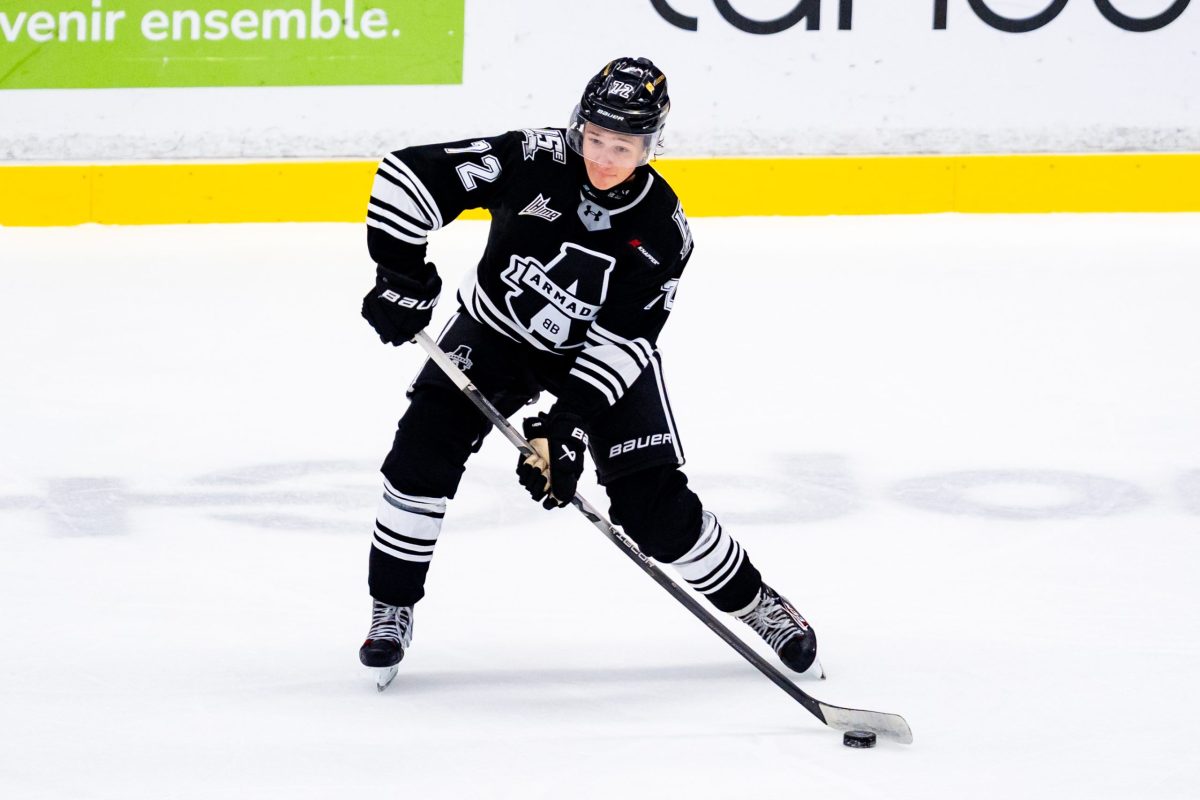
Position: D, Shoots: L
H/W: 5-foot-11, 163 Pounds
Date of Birth: 2007-09-29
Stats to Date: 37GP – 6G – 32A – 38PTS
Xavier Villeneuve is, for many, including myself, the best player in the draft playing in the QMJHL. He is a consensus first round talent, with some people even ranking him inside their top 10. Villeneuve has a tremendously high upside; perhaps one of the highest ceilings out of every player this year. While undersized defencemen can often struggle at the next level, Villeneuve checks many boxes required to be an elite offensive defenceman in the NHL.
The Laval native has been the center of attention in the QMJHL the last few years, dating back to the summer of 2023 when he was selected 7th overall by the Blainville-Boisbriand Armada. Since then, he has been Blainville’s top scorer among defencemen in all three of his QMJHL seasons, including two seasons scoring above a point per game pace. Villeneuve has established himself as one of, if not the best, offensive defencemen in the QMJHL, and one of the best available in this year’s draft.
Villeneuve has committed to Boston University for the 2026-2027 season. This is excellent for his development, as he already is levels above the QMJHL level of play, but a direct jump to the NHL might hurt his development, for reasons that will be explored throughout this report.
Skating
Xavier Villeneuve’s skating is, in my opinion, the defining feature of his game. It is one of the main reasons he has become such a promising defensive prospect. When you watch him shake off opponents and move at the blue line with impressive agility, you can’t help but to draw comparisons with Lane Hutson. Villeneuve can execute any move imaginable that requires agility and evasiveness. His brain and feet are perfectly connected. The sharp turns, the spins, and deceptive moves, almost everything about his skating is perfect. Even today, if his skating completely stopped improving, he would be among the shiftiest NHL defencemen.
His skating also has roots in his early development. Villeneuve began with figure skating at the age of four before turning to hockey, and that background likely helped him build balance, edge control, and sharp turns.
Villeneuve uses his quick turns, agility, and acceleration to create space in order to threaten offensively. His skating is therefore more than a tool. It is the foundation of his identity as an impactful offensive defenseman, and as previously said, the most impressive and high level part of his game.
That said, Villeneuve’s pure straight line skating is not as exceptional as his lateral movement and deceptive moves. While he is very far from a slow skater, his top speed is not necessarily at the absolute top of this year’s class, like his agility would be. This is not necessarily a huge problem, as he has enough acceleration and evasiveness to escape tricky situations, especially in the defensive zone. His playstyle doesn’t require his top speed to be absolutely game breaking.
Here is an example of Villeneuve’s agility, completing a swift spin-o-rama move to shake off an opponent and he scores right after.
This clip is the perfect example of the wonders Villeneuve can create with his feet. He is so evasive and difficult to follow, and will dance around his opponents for as long as he desires.
This clip shows that Villeneuve still has impressive wheels and often carries the puck from one end to another.
This time in the defensive zone, the evasiveness is on display, as he breaks the puck out of his zone by himself.
Grade: 60
Shot
Xavier Villeneuve’s shot is not the flashiest part of his game, but still an underrated one. He has a quick wrist shot and a fast release, which allow him to get pucks on net before defenders can fully close down space. This is a translatable trait; a defenceman who can shoot quickly can catch the opposing defence out of position, create rebounds, and also keep the coverage on their toes. Defencemen who never shoot allow their opponents to have fewer things to worry about when covering them.
His goal scoring comes from smart usage rather than brute force. Villeneuve has consistently produced goals in the QMJHL, including 8 goals as a rookie, 12 the following season, and while only scoring 6 in 37 games this season, he also scored 6 goals in only 17 playoff games. Those numbers show that he is not a one dimensional playmaker; he can finish plays himself, especially when he joins the rush or works from the point on the power play.
What makes his offensive profile especially interesting is that his shot fits his skating and puck skills. He can move laterally, open lanes, and then fire quickly, which makes his attempts harder to read. In that sense, Villeneuve’s scoring value comes less from raw shot power and more from lateral movement, speed of execution, and deception. That said, if you purely isolate his shot and break it down, it can’t be classified as a particularly elite shot. It does lack power and some overall precision as well. This can still be improved with a lot of practice and adding more muscle to his frame.
Here is a clip showing that Villeneuve can be opportunistic and jump on a loose puck to score without his opponents having the time to adjust.
In this clip, Villeneuve jumps on a loose puck, creates space by faking to attack the perimeter, curls back and perfectly picks his corner for a playoff goal.
Here is Villeneuve displaying great shot fakes, showing patience until the perfect shooting lane presents itself, and then scoring a goal.
Grade: 52.5
Skills
While some parts of his game may be the subject of questions and debates, this next one is unanimous. Villeneuve’s pure skill is obvious the moment he touches the puck. He has impressively quick hands, a wide arsenal of creative dekes, and the confidence to attack defenders in motion, which makes him one of the most entertaining and dangerous defencemen in this draft class. He has shown this year that he can chain together deceptive moves, sudden cuts, and precise puck touches that open passing or shooting lanes almost instantly. That is what makes him dangerous: he is not just fast and evasive, he is inventive and can make you look like a fool.
Villeneuve is not simply a highlight-reel player who tries to be flashy all the time and fails very often. His puck manipulation and problem solving are strengths in all three zones. He can carry the puck through traffic, escape pressure on the breakout, and keep control of the puck as long as needed to find a better play.
The Laval native is a truly gifted offensive defenseman with a very high ceiling, but his talent comes with a lot of swing factor. If everything clicks, he can drive offense at a high level, quarterback a powerplay, and log north of 20 minutes a night. Defenceman with that level of skill are rare and are always vital to a team’s success.
While his skill arsenal is at a very advanced level, his puck control is also very good. Through traffic and while performing dazzling moves, he keeps control of the puck and is able to execute everything he has on mind.
Here is a sequence of Villeneuve displaying his arsenal of skills at the blue line, right before scoring a goal.
Here, Villeneuve entered the zone with speed and precise puck handling, went deep in the offensive zone, and dropped the puck to his teammate for a scoring chance.
This play, which I had the chance to witness in person, is one of Villeneuve’s most impressive highlights. He embarrassed the two opponents and the goaltender with his ridiculous skill level.
These are two more examples of Villeneuve’s skill level and confidence at the blue line, completely getting rid of forwards covering him.
In the same game, Villeneuve completely fools his opponent and makes a perfect sneaky pass for a goal.
Grade : 57.5
Smarts
In order to be elite at the NHL level, a shifty, uber talented offensive defenceman needs to simultaneously be a very smart thinker with great vision and quick processing. Thankfully, Villeneuve possesses these skills at a fairly high level. He is not one of these junior players who capitalize off of weak patterns and a slow pace of play to simply be better than their opponents. He truly creates opportunities out of nothing with great creativity and sees complex passing plays in split seconds, while understanding his role as a defenceman. Villeneuve also perfectly reads opportunities to sneak behind a forward on the breakout, force a turnover and look for a scoring chance.
As he has progressed over the last few years, Villeneuve has learned to pick his spots more efficiently. A defenceman of his profile will always make bold choices from time to time and occasionally cause costly turnovers, even in the NHL. This happens to Lane Hutson, an often brought up stylistic comparison to Villeneuve. The goal is to limit these instances as much as possible, which Villeneuve has been able to do. He shows to be aware of when he has the time, space and coverage to attempt risky but rewarding plays, or when to utilize a rather simple play, like a dump or a D to D pass.
Villeneuve also often successfully completes impressively passes across the ice for a fast break. This type of play is an excellent tool to have in your back pocket, as it often catches the opposing defencemen off guard, even at the NHL level.
While his intelligence is advanced for his age, it is still developing. Villeneuve needs to confirm that his success is not a product of his junior environment, and that he will be smart enough to continuously adapt his game going forward, while still remaining a tremendously skilled offensive defenceman. The true test will be whether that same brain can allow him to find solutions offensively and to keep in mind his defensive responsibilities against faster and stronger opponents.
Putting Villeneuve on the ice can feel like having four forwards at times, just because of how offensively oriented his game is. Even in transition, he loves to receive the puck, carry it in the middle, look for a teammate on the wing, and continue skating down the middle for a rebound/tap in opportunity.
Here are two examples of Villeneuve executing impressive passes across the ice, resulting in a goal.
Here is an example of Villeneuve pick-pocketing a forward on the breakout, and delivering a sweet assist to his teammate.
Villeneuve’s vision is on full display here, faking a shot and right after, dishes a great pass to his right for a goal.
Grade: 55
Physicality/Compete
Villeneuve’s compete level is quietly underrated among the different aspects of his profile. He never really plays passively, rarely ever disappears from the action. Without the puck, he actively looks to join the rush or separate himself as a clear passing option, or even crash the net from time to time. Defensively, his quick reflexes allow him to annoyingly follow his opponents and prevent them from receiving the puck or benefiting from any space. He actively looks to recover pucks and skates his absolute hardest to enter the offensive zone. That kind of persistence matters and speaks on the type of impact Villeneuve can bring on a shift-to-shift basis.
His physicality is a lower point of his game. Villeneuve is, unfortunately, not built like a shutdown defenseman, and doesn’t project as a heavy hitter or crease-clearer, which means he can face issues against stronger opponents. Board battles, breakouts, and playing through traffic will always be a bigger challenge for a smaller player like him. On the brighter side, he does not shy away from contact and will play in traffic when the play requires it, but the limitations still exist.
While his compete level is a stronger element of his game than his pure physicality, neither of these elements of his game are on the weaker end compared to other aspects like the skating or the skill level. With smaller framed highly skilled junior players, there is always a concern that their playstyle and habits will hit a wall when entering the NHL, or even the AHL. That is because the junior level is a much less physical and suffocating level of play than the pro level. While I do think Villeneuve likely figures it out with his tools, the leap from junior to pro could be too big for him. As we have never seen Villeneuve play at a pro level, or even a collegiate level, the questions remain. This is why playing in the NCAA will be an ideal middle ground between the junior and the pro level. He will need to accommodate his game and adopt more pro habits, while still hopefully being a dominant player. He will still never be a dominant physical force at the next level, and especially as a defenceman hese limitations will show from time to time. Hopefully, these limitations don’t turn into major exploitable flaws.
As mentioned, it is still a positive that Villeneuve doesn’t shy away from initiating contact. This is a prime example.
Here, though, Villeneuve panicked before being on the receiving end of a hit from Caleb Desnoyers, losing the puck. Players will only be bigger and stronger moving forward, so he will need to adapt.
Villeneuve’s compete level is on full display here. Jumps offensively, gets into a battle for the puck behind the net, loses it but doesn’t give up and gets possession again.
Grade: 50
OFP: 55.5
A note on the 20-80 scale used above. We look at five attributes (skating, shooting, puck skills, hockey IQ and physicality) for skaters and six for goalies (athleticism/quickness, compete/temperament, vision/play reading, technique/style, rebound control and puck handling). Each individual attribute is graded along the 20-80 scales, which includes half-grades. The idea is that a projection of 50 in a given attribute meant that our observer believed that the player could get to roughly NHL average at that attribute at maturity.