


Team Outlook
The Chicago Blackhawks have spent the last several years trying to climb out of the bottom of the standings, but there are finally signs that the rebuild has real direction. Connor Bedard has already established himself as a legitimate NHL star, and Spencer Knight proved a great deal this season about his ability to stabilize the crease long term. Beyond those two foundational pieces, however, there are still major questions throughout the roster, particularly on the blue line and among the forward group surrounding Bedard. How Chicago builds around its core through another high draft pick, prospect development, and free agency will ultimately determine how this rebuild is remembered.
There is still considerable uncertainty surrounding which young players will become meaningful long-term contributors. Some prospects appear well positioned to be part of the next competitive Blackhawks core, while others may currently carry more value based on pedigree, hype, or perceived opportunity than realistic long-term projection. Below are three players worth targeting as buy candidates who could still be important pieces once the rebuild matures, along with three sell candidates whose dynasty value may currently exceed their long-term outlook.
Buy Candidates
Anton Frondell, C
After spending most of the season developing in the SHL, Frondell came over to Chicago once his Swedish season concluded and immediately looked far more comfortable at the NHL level than many expected. In 12 NHL games, Frondell recorded three goals and six assists while also contributing two power-play points. That offensive production combined with his peripheral involvement translated to a 4.75 blocks, shots, and hits (BASH) per game pace, already hinting at the type of multi-category fantasy value he could eventually provide. Burning the first year of his entry-level contract in such a small sample also speaks to the organization’s confidence in his long-term role.
ANTON FRONDELL'S FIRST NHL GOAL!!! 🚨 pic.twitter.com/SkkwPyluAR
— NHL (@NHL) April 1, 2026
What stands out most with Frondell is how complete his game already looks at a young age. The eye test was extremely encouraging, even if some of the underlying analytics lagged behind during his initial NHL stint. Much of that likely stemmed from adapting to a completely new system while also handling more center responsibilities than he saw in Sweden. With a full offseason to study video, learn the structure, and participate in training camp from day one, there is a strong case that Frondell takes a major step forward in 2026-27. Frondell looks poised to inject legitimate offensive upside into Chicago’s lineup very quickly. If his development continues on this trajectory, his long-term fantasy ceiling is beginning to approach point-per-game territory.
Roman Kantserov, RW
Kantserov and Metallurg Magnitogorsk mutually agreed to terminate his KHL contract, with expectations now growing that he will sign with the Chicago Blackhawks in the near future. It would be surprising to see a player of his caliber leave a strong KHL situation without some level of assurance that he will receive a legitimate NHL opportunity rather than simply being assigned directly to the AHL. Considering he established himself as a top-10 scorer in the KHL this season regardless of age, Chicago appears to recognize that he may be far closer to NHL readiness than many originally expected.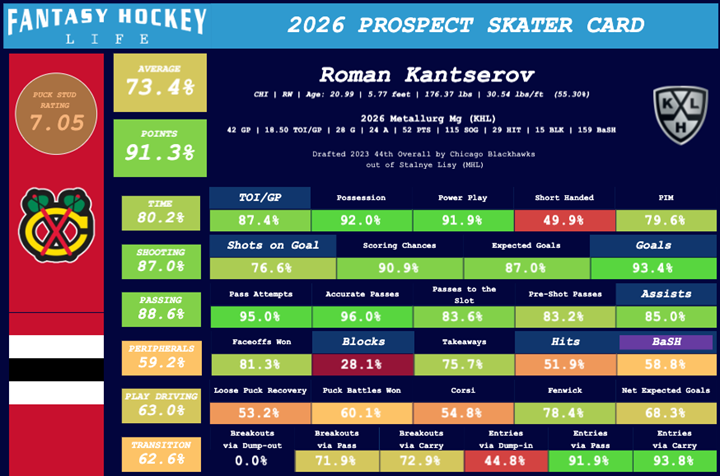
What makes Kantserov especially appealing from a dynasty perspective is how translatable his game appears despite standing just 5-foot-9. He does not play small at all. His Fantasy Hockey Life skater card highlights a player who consistently wins more puck battles than he loses at the KHL level while also posting strong numbers in takeaways, faceoffs, and physical engagement. That combination is rare for smaller forwards and speaks directly to his competitiveness and hockey sense. Offensively, Kantserov processes the game extremely quickly, creates effectively under pressure, and consistently finds offense in tight spaces. Just as importantly, his defensive engagement has steadily improved, making him look far more like a complete NHL forward than a one-dimensional skill player. If the transition to North America goes smoothly, there is legitimate top-six upside here, and his dynasty value could rise very quickly once more managers see him against NHL competition.
Vaclav Nestrasil, RW
The 6-foot-6 right winger was 18-years-old for his entire draft-plus-one season because of his early April birthday and the timing of UMass being eliminated at the end of March. Putting his age into context, he had an exceptional season. After producing well under a point per game in the USHL during his draft year, Nestrasil exploded offensively at the NCAA level with 31 points in 34 games for UMass. That type of jump in production at a more difficult level is extremely encouraging, particularly for a player with his frame and developmental profile. He also played a major role for Czechia during its silver medal run at the under 20 World Junior Championships, further reinforcing the idea that his offensive confidence and overall game are trending sharply upward.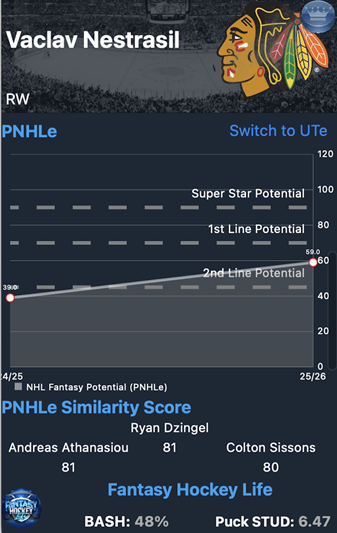
What makes Nestrasil especially intriguing for dynasty managers is how unique his skill set is within Chicago’s prospect pool. He combines puck protection, physical engagement, and offensive instincts in a way very few players in the organization can replicate. Despite his size, he moves well enough to create offense through possession and puck recoveries rather than simply playing a straight-line power game. His pNHLe projection has risen sharply and is already trending comfortably beyond the 60-point range long term, with legitimate potential to approach 70 points if development continues. Even more appealing from a fantasy perspective is the peripheral upside. Nestrasil projects as the type of player who could eventually provide strong BASH coverage while still contributing meaningful offense, an increasingly valuable combination in multi-category leagues.
Sell Candidates
Marek Vanacker, LW
Vanacker remains an appealing prospect on the surface because of the combination of size, offensive production, and physical engagement he brings to the table. Playing for the powerhouse Brantford Bulldogs of the OHL certainly helped elevate his visibility this season, as he increased his scoring from below a point-per-game pace last year to comfortably above it this season. However, context matters. Brantford was by far the highest-scoring team in the OHL, finishing with 31 more goals than the next closest club, which naturally created more offensive opportunities for everyone in the lineup. The Bulldogs were absolutely loaded offensively for most of the season, and Vanacker benefited significantly from playing within that environment. Despite the surprising loss to the Barrie Colts in the OHL Finals, Brantford’s offensive ecosystem helped inflate the counting stats of several players, and dynasty managers should be careful not to overvalue those raw totals in isolation.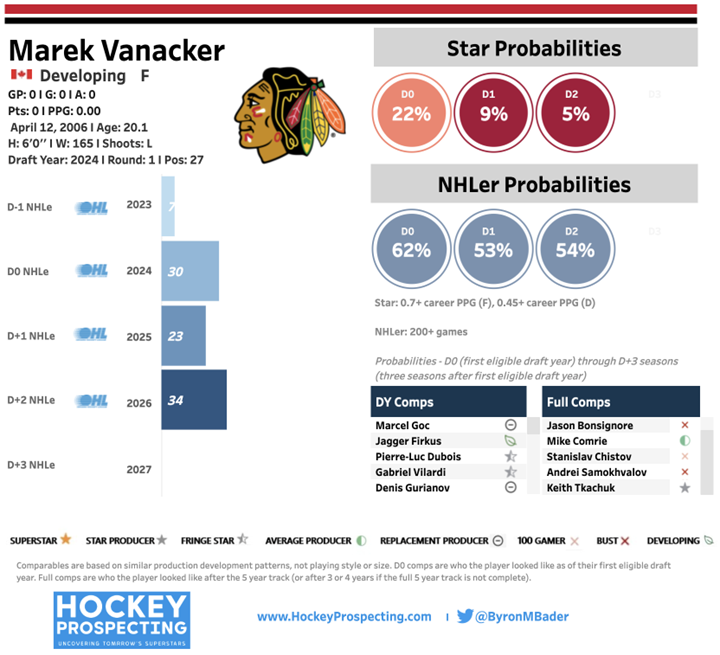
The larger concern long term is projection. Vanacker turned 20 this season and will likely move to the AHL next year, where the pace and physical demands become much more difficult. While he can drive the net, win puck battles, and contribute offensively in multiple ways, there are still concerns about whether his pace and overall offensive creation ability will translate consistently at higher levels. Without a singular elite offensive trait, there is a growing possibility he settles in as more of a complementary middle-six play-driving winger rather than a true offensive centerpiece. That concern is reflected in his Hockey Prospecting profile as well. During his draft season, Vanacker carried a 22% chance of becoming a star-level NHL player, but that projection has now fallen to approximately five percent. Some of the higher-end comparables, such as Mike Comrie or Keith Tkachuk, represent more optimistic outcomes than likely expectations. More realistically, he projects as a useful complementary middle-six piece rather than a major fantasy driver. Because his stock is currently elevated following a strong statistical season on an elite junior team, this may be one of the better windows to move him before those projection concerns become more apparent at the professional level.
Sascha Boisvert, C
Boisvert has always been a somewhat interesting projection case because his game is built around intelligence, structure, and versatility rather than one truly elite standout skill. After being drafted out of the USHL, he spent the 2024-25 season at North Dakota before transferring to Boston University. Unfortunately, the year turned into a difficult and inconsistent season overall. An early shoulder injury clearly impacted his play, and as he attempted to play through it, his offensive production and consistency suffered. Boston University as a whole also failed to meet expectations, and Boisvert even found himself scratched at times during the season, further complicating his developmental trajectory. Despite that, he still signed his entry-level contract with the Chicago Blackhawks and appeared in seven NHL games, recording a goal and an assist. That brief NHL exposure may create some optimism among dynasty managers that can still be leveraged into stronger value elsewhere.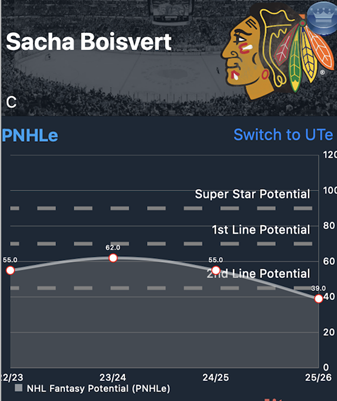
Boisvert has decent size, protects pucks effectively, processes the game adequately, and can contribute within structured systems, all traits that could allow him to become a useful middle-six matchup forward at the NHL level. However, as Chicago continues adding increasingly dynamic skill around Connor Bedard and the rest of the young core, players without a truly defining offensive trait risk sliding further down the long-term hierarchy. His pNHLe projection has also trended downward into sub-40-point territory, which realistically aligns with the eye test and overall developmental arc at this stage. While there is still value in players who can play responsibly and support possession, Boisvert increasingly looks more like a complementary piece than a meaningful fantasy driver. If there are still managers in your league valuing him closer to his draft pedigree or recent NHL cameo, this may be an ideal time to move him before the offensive ceiling becomes more apparent.
Nathan Béhm, C
Behm is coming off a very positive season following his selection by the Chicago Blackhawks in the third round of the 2025 NHL Draft. The 19-year-old significantly increased his production with the Kamloops Blazers, finishing with 86 points in 67 games while continuing to show flashes of offensive creativity and playmaking ability. He is now headed to Arizona State next season, which should provide another important developmental step. This sell recommendation is not necessarily an indictment of the season itself, because it was objectively encouraging, but rather an acknowledgment that his dynasty value may currently be approaching the high end of its realistic range.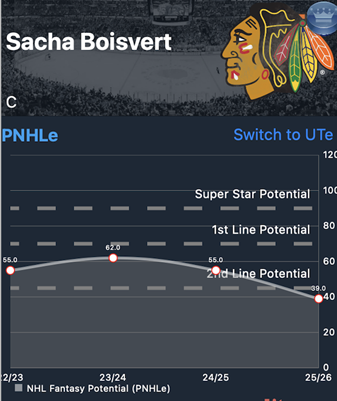
Even after this major offensive jump, Behm still sits at a 21% chance of becoming a star-level NHL player according to Hockey Prospecting. That is solid, but not elite, and his long-term projection still appears more likely to settle into the 55-to-65-point range if development goes well. That level of production certainly has fantasy relevance, but perhaps not enough to justify waiting through several more years of development. His profile also lacks a truly standout fantasy-driving trait that significantly elevates the ceiling beyond complementary offensive production. Some of his optimistic comparables within the model include players like Ryan Getzlaf, Zach Hyman, Robert Thomas, Jason Robertson, and Bo Horvat, but those outcomes remain far more optimistic than probable. More realistically, he projects closer to some of the model’s middle-tier comparables, players who can contribute offensively but may not become major long-term fantasy difference makers, particularly without significant peripheral coverage. Because of the excitement generated by his breakout season, this may be a strong opportunity to capitalize on the increased value before his role and projection become more clearly defined.
Summary
| Player | Role | Key Insight |
| Anton Frondell | Buy | Well-rounded center with rising offensive upside |
| Roman Kantserov | Buy | Elite KHL production with strong translatability |
| Vaclav Nestrasil | Buy | Size and skill combination with middle-six upside |
| Marek Vanacker | Sell | Production may not fully translate upward |
| Sascha Boisvert | Sell | Lacks clear high-end offensive ceiling |
| Nathan Bém | Sell | Likely depth projection without standout traits |