


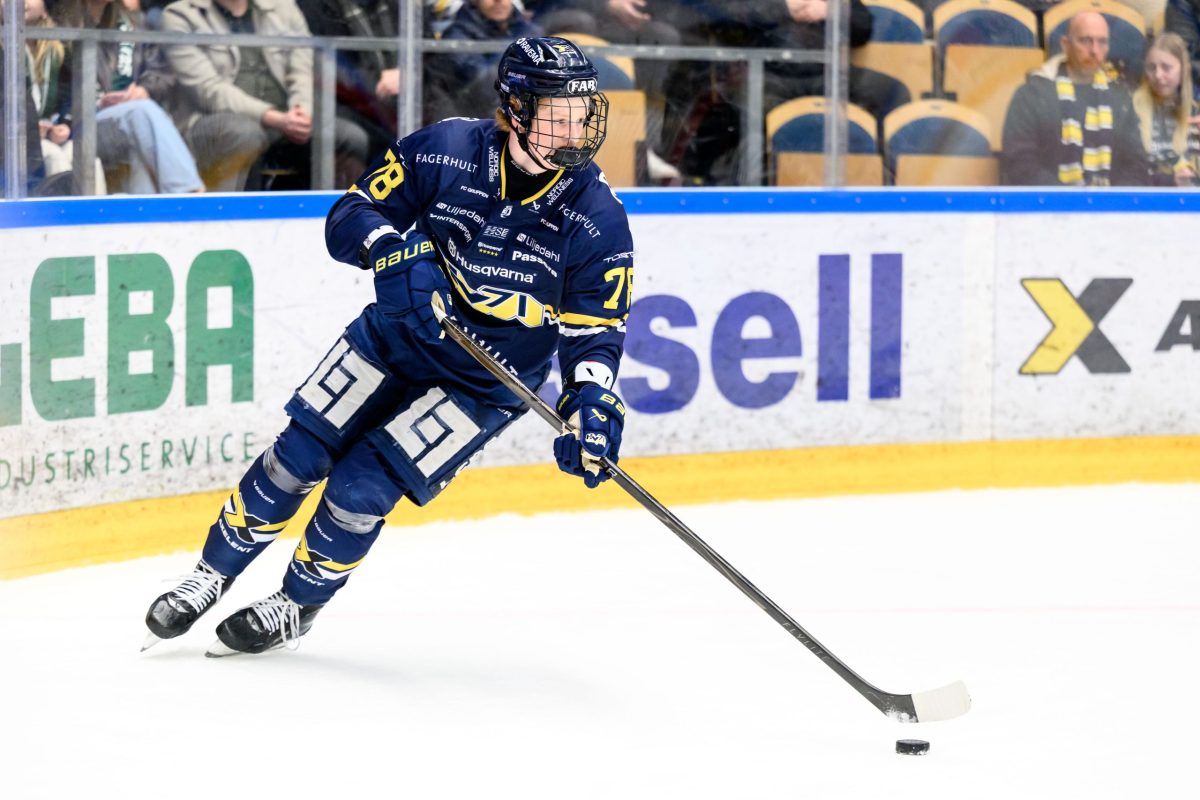
Photo: Carl Sandin / BILDBYRÅN
Position: D, Shoots: L
H/W: 6-foot-4, 203 Pounds
Date of Birth: 2008-06-11
One of the biggest stories of the 2026 NHL Entry Draft has been the quality of defensemen at the top of the class, from the likes of Chase Reid, Alberts Smits and Keaton Verhoeff, to the trio of superb WHLers in Carson Carels, Daxon Rudolph and Ryan Lin. There is one other blueliner who has also firmly played his way into this neighborhood, though he did so without the same levels of public recognition and fanfare, and his name is Malte Gustafsson.
Early on this season, Gustafsson was more of a curiosity for scouts than a must-watch prospect. He had a respectable showing at the 2025 Hlinka Gretzky Cup, collecting six points in five games for the high-scoring Swedes, but at the time he was a lanky string bean with some coordination issues, and it wasn't immediately clear what the next phase of his development would look like. Since then, however, his upward progression has been steep as he has continued growing into his body, which involves filling out his frame and finding his center of balance. And making matters even more enticing, it seems like there's still a lot of physical development left to come for him, which should result in even further improvement that comes at a faster rate than most of his peers.
Gustafsson is the type of defenseman who can contribute in a wide variety of ways once he's out on the ice. His game is built primarily around his high athleticism, smooth footwork and long skating strides, and that combination allows him to stay heavily involved in the play in all three zones even when he's logging a ton of minutes. The most value that he brings come from his off-puck defending, utilizing his mobility, reach and keen understanding of defensive fundamentals to be a major thorn in the sides of opposing forwards. He's also no slouch when it comes to handling the puck, displaying a lot of confidence and showing occasional flashes of high-end skill and vision, though this part of his game is currently much less refined, with puck bobbles, errant passes and lapses in decision-making all happening a little too frequently.
One of the nice things about scouting Gustafsson this season was getting to watch his play across a variety of levels and events, each providing their own unique kind of measuring stick. At Sweden’s top junior level he was outright dominant at times, regularly looking like the best player on the ice. When he was playing up in the Swedish Hockey League he didn’t seem out of place whatsoever, and even had moments where he looked flat-out brilliant. His real crowning achievement, though, came right at the very end of his season at the IIHF U18 tournament. He was the best defenseman on Sweden’s gold-medal winning roster by a mile, registering more than 26 minutes of ice time in all three elimination games, and for his efforts he was named as one of the event’s All-Stars.
There’s a high likelihood that Gustafsson is one of the first 10 players to hear his name get called on the evening of June 26. He won’t be the first, second, or probably even third defenseman ranked on the lists of NHL teams, but the gap between him and the bigger names is smaller than most people realize, and the organization that does get to pick him is going to be very, very excited about doing so.
Skating
The real bread and butter of Gustafsson’s game is how he uses his skating to defend the rush. Not only is he one of the best blueliners in this class in that area, he’s more advanced than most top defense prospects in any given year. He’s almost unbeatable when opposing players try to attack him with speed, and he proved that many times throughout this season, including when he was playing against pros in the SHL. He’s also quite hard to contain when he decides to break pucks out with control, with a great mix of straightline speed and lateral agility, and you’ll even see times where he drives the puck by himself through the neutral zone and into the offensive zone. And for as good as his skating already is, it’s probably going to get another notch or two better once he adds more strength and power into his lower body.
You see this type of play all the time out of Gustafsson. He closes that gap remarkably fast, gets body positioning on the enemy forward, and gains possession of the puck with ease. And he does it all with incredible levels of smoothness and efficiency. NHL coaches will adore having someone who can neutralize transitions like this.
Watch how impressive Gustafsson’s backwards crossovers are in this clip. He’s getting attacked head-on with a lot of speed, but his footwork is just so fast and clean that it allows him to stay with and harass his check until the puck ends up in a less-dangerous position behind the net.
These three clips above help showcase his ability to pivot from forwards to backwards, and how quickly he can do it. He likes to play a high-pace game that’s up and down the ice, and that’s much easier to do when you can react to changes and reset your positioning so effectively.
Great mix of things from him here in this clip, from using his skate to help catch the pass in motion, to his edgework to get past the first layer of coverage, to the straight burst of speed he uses to cut between the two defenders and create enough separation to fire the shot. Opposing players really have to stay on high alert when they’re playing against Gustafsson, because he can make them pay if he catches them napping.
These last three clips highlight how explosive he can be in straight lines, both on exits and entries. He accelerates in a hurry, he can shift his weight easily at top speed, he notices when pressure is breathing down his neck, and you can even see him bait an opponent by pulling the puck inside for a moment before then blowing right by on the outside.
Grade: 55
Shot
Gustafsson projects as a defender who will be able to semi-regularly score goals at the NHL level, though maybe not in the way that you would expect for someone of his size. He currently doesn’t generate much power from his shot, which is hindered in part by how long of a stick he uses, but this could improve over time as he adds more upper-body strength. Rather, his goal-scoring prowess comes from how he combines his awareness, puck handling and mobility to skate himself into high-danger scoring areas, both with and without the puck.
This clip shows Gustafsson at his best as a scorer. That’s some beautiful work at the blueline with his feet and hands to break the ankles of the oncoming opponent, and he keeps his momentum moving forward as he drives past another layer and beats the goalie from close range.
Gustafsson can be quite a dangerous player when he’s fully engaged and really playing on his toes. Just watch how he explodes off the blueline to generate this scoring chance for himself. He’s able to cut right between the two Timrå players because his attack is so fast and aggressive that neither of them can respond to it in time.
Both of these clips showcase something mentioned above, which is how he uses his awareness and skating ability to get himself into scoring position. Not only does he display good tendencies and decision-making in this regard, it’s also easy for his coaches to permit him to have this kind of offensive green light, because if something does go wrong on the play he can quickly cover a lot of ice and get himself back into proper defensive position.
If there’s one area of his shooting that Gustafsson really needs to work on it would be his shot selection. He definitely has a bad habit of firing shots from distance at inopportune times that end up going straight into bodies or equipment. Some defenders are accurate enough that they can get these kinds of shots through traffic at a rate that makes the risk tolerable, but he doesn’t seem to be one of them.
Grade: 55
Skills
As already touched on in the first two sections, Gustafsson is quite adept with his puck skill, to a degree that can catch members of the other team off guard. He comfortably handles the pill with his head up and while moving in any direction, and he can also pull pucks across his body with fast, sweeping dekes that are both effective and entertaining. While he’s not especially dynamic when it comes to his playmaking, he is able to deploy a soft touch on his passes to sneak them through tight spaces. He is prone to some moments where he gets too reckless or careless with his puck management, but overall, there’s way more good than bad for him in this category.
There’s a lot to like about how Gustafsson walks the line in the offensive end. He has a real knack for baiting opponents into moving one way before then dancing around them the other way to open up lanes. There is always an element of risk involved when trying to do stuff like this, but you can’t help but be impressed and encouraged with how successful he already is, especially doing so at the SHL level as a 17-year-old.
Here are a couple of looks at his playmaking ability. In both clips he does a good job of deceiving his intentions with where he’s looking, along with the timing and placement of the passes.
Great sequence from him here on a breakout. He dekes around the first forechecker, before then slipping a pass to a teammate to keep the puck away from a second forechecker and achieve the exit. This play unfolds quickly and under pressure, but he maintains perfect control of the puck to make it happen.
Here’s a good look at his puck management when he’s slowing things down a bit compared to his usual breakneck pace. Great job by him at multiple points to recognize where the threats are coming from and then use his stick to keep the possession alive.
There are a number of defensemen in this draft class who are better with the puck one-on-one than Gustafsson is, but he gets the job done more often than not at keeping plays alive. He certainly knows how to use the advantages provided by his large frame and long wingspan.
As mentioned, there are still some things that he will need to clean up. Sometimes he tries to stickhandle straight into traffic and coughs pucks up. And while his sense of poise is mostly admirable, it can lead to unforced errors that maybe could have been avoided with a little more focus.
Grade: 55
Smarts
When it comes to analyzing a defenseman’s intellect, there are two main categories to consider: how smart they are with the puck, and how smart they are without the puck. Gustafsson grades pretty highly in both categories, albeit with a clear advantage going to the latter. One could even make the argument that he’s a borderline genius as an off-puck defender, because he’s an expert at killing plays. He utilizes different strategies and approaches depending on what the situation calls for, and he knows how to maximize the physical gifts that he possesses. There’s a lot of wisdom and maturity to this part of his game that goes well beyond his actual age.
Watch how many smart little decisions Gustafsson makes in just one shift. He’s quickly scanning his surroundings before going in to retrieve the puck, he keeps his feet moving to keep the first forechecker on his back, he perfectly times his escape from the second forechecker, and he wastes no time passing the puck up to a teammate to maintain the pace of their transition. It’s also notable how he continues staying involved in the play, taking a pass and turning it into a shot at the net, before anticipating that he can keep his team’s pressure going if he gets to the neutral zone fast enough to cut short the clearing attempt. This is all very heady stuff, especially when considering the level of competition and the speed at which it’s all executed.
These kinds of plays aren’t flashy or exciting, but being able to out-battle and tie up opponents along the boards without taking a penalty is much harder than it looks.
Here’s another prime example of Gustafsson making a brilliant defensive play without taking a penalty, this time while defending a rush. That pokecheck had shades of Jaccob Slavin, one of the NHL’s best defensive defensemen, to it.
Gustafsson gets tasked by his coaches to kill a lot of penalties, and it’s easy to see why. Even going beyond his physical tools he’s also excellent at reading situations and keeping tabs of where everyone else is on the ice, which you can see in different ways in this clip.
Shoulder checking is one of the most important habits that defenders need to develop, and Gustafsson already has that part of his game on lock. Watch the frequent movement of his head in these three clips above.
Two similar kinds of highlight here, where he uses his perception and decision-making to activate from the blueline, both of which result in high-danger scoring chances at the mouth of the net.
This is where you start to see some of the limitations of his on-puck hockey sense. He has ample amounts of time and space, and there are options available to him that are safe and obvious, but he tries forcing passes that don’t make any sense given the situation.
This play starts out looking great, but Gustafsson then immediately gets caught trying to do too much himself and turns the puck over, which is extra bad because it happened on the powerplay at his own blueline.
Grade: 55
Physicality/Compete
Similar to the shot category, Gustafsson is indeed a very physical and competitive player, just not in the way that people might envision when they notice his size. He is very comfortable, active and polished with using his body in how he plays, but that is shown mostly through tying up, boxing out, leaning on and pinning opposing players, with less emphasis towards throwing big hits, inflicting pain in the trenches, or getting combative in post-whistle scrums. Make no mistake, though, he is still a fierce competitor and doesn’t shy away from battles. Hopefully he also finds a way to add a little more nastiness over time, once he has fully filled out his frame, because that would even further elevate his already-high chances of becoming one of the most successful and feared shutdown defensemen in the sport.
This clip encapsulates everything that makes Gustafsson such a fantastic defender. He reads the oncoming rush perfectly, uses his skating to stay in close proximity, and then rides his man into the end boards and overpowers him to eliminate him from the play. Being able to defend in this kind of way in the NHL, against the size and speed of the league’s best forwards, is a wildly underappreciated skill.
This clip is similar to the one above it. Just watch how Gustafsson velcroes himself to his check and completely denies that check any further advancement.
This type of play often goes unnoticed, but it really shouldn’t. He fully envelops the Canadian player helplessly along the boards for multiple seconds, which directly leads to an errant pass that sends possession of the puck back to Sweden.
Defending doesn’t have to be pretty in order to be effective. A killed play is still a killed play.
Gustafsson got stronger as the season went along, and he started to show it in his board battles. It’s exciting to think about how much developmental runway he still has left in this area, and what his game could look like in a few years down the road.
Grade: 57.5
OFP: 55.5
A note on the 20-80 scale used above. We look at five attributes (skating, shooting, puck skills, hockey IQ and physicality) for skaters and six for goalies (athleticism/quickness, compete/temperament, vision/play reading, technique/style, rebound control and puck handling). Each individual attribute is graded along the 20-80 scales, which includes half-grades. The idea is that a projection of 50 in a given attribute meant that our observer believed that the player could get to roughly NHL average at that attribute at maturity.