


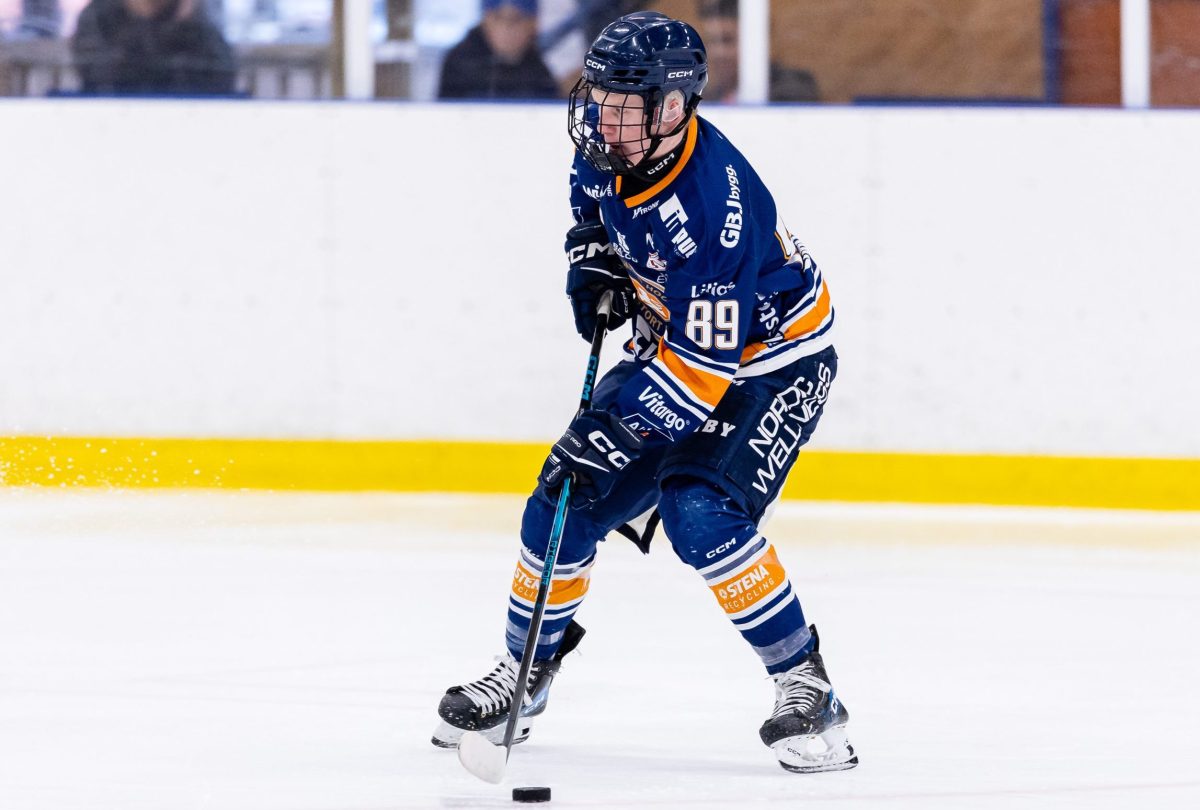
Photo: Jonas Ljungdahl / BILDBYRÅN
Position: C/W, Shoots: L
H/W: 5-foot-10, 180 Pounds
Date of Birth: 2008-04-15
Sorensson may just be the 2026 Draft’s man of mystery. There’s such a wide variance on his rankings for this draft. NHL Central Scouting has him 84th among international skaters (ranking him as a draft long shot). Meanwhile, we have him ranked 42nd overall. Other scouting agencies and organizations have him ranked everywhere and in between. So what’s the story?
The main reason Sorensson is such a wild card is because he plays in a league that is not typically on the scouting radar: Division 2 in the Swedish pro circuit. This is actually the fourth division behind the SHL, Allsvenskan, and HockeyEttan. Simply put, it’s not a high-caliber league, even if he’s competing against players sometimes double his age. It’s when he played outside of Division 2 that he really caught the attention of scouts. He was great at both the Nations tournament and at the year end U18’s. He was terrific in the U18 Nationell playoffs, helping Växjö capture a title, earning playoffs MVP. No matter the league, Sorensson produced and performed extremely well. It begs the question: if he had played in Växjö all year, would he be considered a top-two-round lock?
It also begs the question, why would such a high-caliber prospect play in a lower-level league when the opportunity to play in a better one exists? The answer is complicated. You’ll want to check out colleague Chapin Landvogt’s interview with Sorensson in our draft guide, which divulges a ton of information. In a nutshell, Sorensson is from Boro/Vetlanda. His Dad played there and coaches there. He wanted to help the team earn promotion to HockeyEttan and he did just that. Additionally, much like Max Domi, Sorensson has Type 1 diabetes and staying closer to home currently is better for management and treatment.
The first thing you’ll notice about Sorensson is his speed. He’s an electric skater, one of the quickest players eligible this year. He has such a profound impact as a transitional attacker. The fact that his hands work in sync with his feet gives him a major advantage, too. He’s dynamic. His lack of size will be seen as a limiting factor, however, he is competitive enough to overcome that. With his speed, tenacity, and high IQ, Sorensson is viewed as a versatile future pro.
What has many divided is his offensive ceiling. Does Sorensson have the skill and touch to be a top-six NHL player? Can he create offense consistently when his speed is neutralized? How do you evaluate his performance across various levels this year? We obviously feel that he does, given our aggressive ranking of him. This piece aims to justify that.
Skating
This is Sorensson’s bread and butter and because he’s not the biggest, it’s the key to his success and production across his different levels this past season. His first step quickness is good, but it’s his top speed and ability to alter direction without losing speed that make him elite. His top gear is tremendous, and if on ice testing were done for the entire draft class, he may just win the hypothetical fastest skater event. That speed puts consistent pressure on opposing defenders. He only needs a sliver of daylight and he’s breaking through. However, the ability to work off his edges and quickly change direction without breaking stride or losing speed is the true key to being a game breaker in transition. You have to clog up his space or knock him off stride early, otherwise, he’s getting behind you.
Even as a smaller player, he seems to have a solid base and actually seems difficult to knock off stride in straight lines. He can fight through contact and maintain speed to win retrievals or push through on entries. When he’s trying to pivot or play off his edges, his balance and strength could use some work, but he’s a tenacious and hard-working player who always seems to be pushing pace and applying pressure.
Such an impressive display of Sorensson’s skating ability. The quickness and the agility that he possesses.
I mean, come on…look at that speed. And the balance to maintain speed through contact to help set up the goal.
That’s certainly some terrible defending, but Sorensson’s ability to quickly and effortlessly change direction makes many defenders look foolish.
Similar kind of play.
He consistently beats defenders wide with his speed.
Sorensson is so smooth and powerful on his edges.
A quick burst shows how dangerous Sorensson can be on the counterattack. His skating truly is elite.
Grade: 57.5
Shot
After watching a lot of Sorensson, this is best classified as an underrated component of his game. He played both wing and center this year; center mostly internationally and wing at the Swedish pro level with Boro/Vetlanda. If he ends up playing the wing as a pro, the further development of his shot will be crucial and he already has a pretty solid base. His shot is extremely deceptive. He routinely quarterbacks the powerplay and he’s great at using fakes to open up shooting lanes or freeze netminders. He can also shoot in stride and will use toe drags to give himself better angles and lanes. Sorensson isn’t a huge threat with the one-timer, but his wrister is a solid weapon for him. There are certainly times where his release isn’t quick enough or he settles for low percentage shots that end up in the chest of the netminder, but with continued work, it could be an above average weapon for him.
While the shot goes into the chest, this is still a well executed shot fake that earns Sorensson a clean look from the slot.
This time he scores following the subtle fake to open up a lane.
Toe drag and snipe.
Sorensson shows off the wrister. He sells pass first and then executes with the well placed shot.
Grade: 52.5
Skills
It’s not often that younger players with Sorensson’s speed have the hands to match. Usually, we’re saying things like, “the hands need to catch up to the feet.” Meaning that a player is not able to execute skilled plays or control the puck at full speed. That’s certainly not the case for Sorensson. He routinely dazzles at full speed, using inside/out moves or toe drags to get back to the inside after beating defenders wide. He also corrals passes cleanly at full speed and is quickly able to get the puck to settle for him, allowing him to play at such a high pace. Sorensson is also a skilled finisher in tight, showing soft but quick hands to score on many of his impressive net drives. As a passer, he shows strong execution and can thread seams, excelling as a playmaker.
If there is a criticism, it’s that Sorensson’s small area skill when the game slows down actually seems to give him more problems, which is a rarity. He can struggle to evade sticks or escape pressure when he hasn’t built up speed. I see this as more of a strength deficit issue than a skill one. It’s obvious that Sorensson has skill, he just needs to get stronger to help him play through heavy traffic more consistently. Things like keeping plays alive along the wall or escaping a trap in the neutral zone to advance play.
Such a skilled little play to help Sorensson survey the ice and open up space.
Strong puck protection skill as Sorensson cuts in and finishes in tight.
Look at the quick burst here that allows Sorensson to break in. However, this is in the skills section because that pass is a bit behind Sorensson, but he corrals it cleanly without breaking stride and finishes on the backhand.
Skilled attack from Sorensson that sees him work to the inside.
And again.
Great puck protection and strength on the puck as he fights off the back pressure and scores on a net drive.
Sorensson showing off his small area skill. Catches the deflected pass and then evades three defenders to ensure that the entry is successful.
Sometimes Sorensson can struggle to create when he’s not able to build up speed and offensive and neutral zone turnovers are an issue.
Grade: 55
Smarts
What’s impressive about Sorensson is that he shows an ability to be a critical thinker at the breakneck pace at which he likes to play. He often shows patience when attacking the offensive zone with speed. He’ll look to get inside leverage on defenders by beating them wide and cutting in, but if he senses that defenders have him gapped up, he’ll circle the net or put on the brakes to help him find a passing option. He shows good vision regardless of pace. It’s why he quarterbacks the powerplay for Boro/Vetlanda. Sorensson also shows a strong understanding of how to play without the puck in the offensive zone, using his quickness to beat defenders to open space to make himself available as a shooting option.
Defensively, Sorensson shows well and is a dedicated two-way player. He consistently supports his defenders down low by picking up players in the slot, clogging passing lanes, and being available as a shorter range passing option to help kick start the breakout. His stick placement is especially terrific; he shows great anticipation by jumping or cutting off passing lanes.
The only real issue that I have with Sorensson’s “IQ” is that he can struggle with his decision making in both the defensive zone and neutral zone. He can make poor reads with the puck and turn it over, either by forcing passes or failing to scan to see opposing players. It seems like he can have lapses in concentration and the result is some sloppy plays.
Sorensson draws in the pressure and then makes a great cross ice pass to set up the goal.
Great vision to find the teammate for the tap in.
Sorensson fights through contact to maintain possession, then makes a great read and pass.
Sorensson shows his defensive effort and awareness with a strong backcheck. He goes from being the F1 to hustling to break up a cross ice pass that would have resulted in a dangerous scoring chance.
Another great defensive play here. Sorensson (#22) is in a perfect defensive supporting position and knocks down a slot pass attempt to help kickstart the breakout.
Love this subtle, but effective move. Beats the backchecker, then understands that he can’t beat the defender who has him gapped up, so he plays the puck behind the defender and takes away his hands so that he can regain possession.
Weak backhand passes like this in your own zone never end well.
Grade: 55
Physicality/Compete
This grade may be a tad harsh, given Sorensson’s high energy approach. As a junior player and low level pro, his level of physicality is not below average. However, projecting his frame to the NHL level, he’s not likely to be extremely successful as a lunchpail type. There are components of his game that I think could use improvement. There are others that are critical to his success.
What Sorensson does well is look to attack the net and play through the middle. He has a desire to get to the net after beating defenders wide and he will get his nose dirty near the crease in scrums. He’s also a committed two-way player who will apply himself physically to force turnovers; applying stick pressure or pinning puck carriers to the wall. With his speed, sense, and competitiveness, he projects as a future penalty killer at higher levels.
On the other hand, I think Sorensson leaves a lot on the table as a forechecking threat given his speed. He can arrive too late to truly apply pressure and his physical intensity can waver in this regard; he can be too casual in pursuit of the puck. If he were to look to play through defenders more aggressively on the forecheck instead of passively applying stick pressure, he could be an absolute demon for defenders looking to exit the zone. There are also times when Sorensson seems to rush plays with the puck in order to avoid contact. Again, consistency is the best word here because there are other times when he’s incredibly tenacious. Lastly, while Sorensson does show an ability to play through contact, there are other times when he’s too easily separated from the puck or loses 50/50 battles. As a player who relies so much on speed and pace, bulking up and improving strength will be critical for the further development of his offensive game so that he can be equally effective at a slower pace.
This is such a weak attempt to apply pressure (Sorensson is #22). This allows a clean pass to the slot. He needs to lean on the check and pin. Weak board play like this would have him in an NHL coach’s doghouse.
An opportunity to force a turnover on the forecheck, but Sorensson makes a passive stick check attempt, rather than use physical force to push the American defender to the wall. Given that the U.S. defender bobbled the puck, this should have been a turnover.
But then we have plays like this, where Sorensson looks like a physical beast with the massive reverse hit to maintain possession.
Or this, where Sorensson hounds the defender on the backcheck and forces him to turn the puck over along the wall.
Or this, a very strong physical play in the neutral zone to prevent a clean entry.
Strong defensive play by Sorensson as he wins a loose puck by gaining inside leverage and applying heavy stick pressure, so much so that he breaks the American’s stick.
This is both a good play and a play that shows further growth needed. Sorensson makes a strong defensive play to strip the Czech player of the puck, however, at higher levels, he’s going to need to finish that check harder and pin his man to force that turnover.
This is a little better than the gold medal game of the U18’s. That’s the kind of jam NHL scouts are going to want to see consistently.
Grade: 47.5
OFP: 54
A note on the 20-80 scale used above. We look at five attributes (skating, shooting, puck skills, hockey IQ and physicality) for skaters and six for goalies (athleticism/quickness, compete/temperament, vision/play reading, technique/style, rebound control and puck handling). Each individual attribute is graded along the 20-80 scales, which includes half-grades. The idea is that a projection of 50 in a given attribute meant that our observer believed that the player could get to roughly NHL average at that attribute at maturity.